
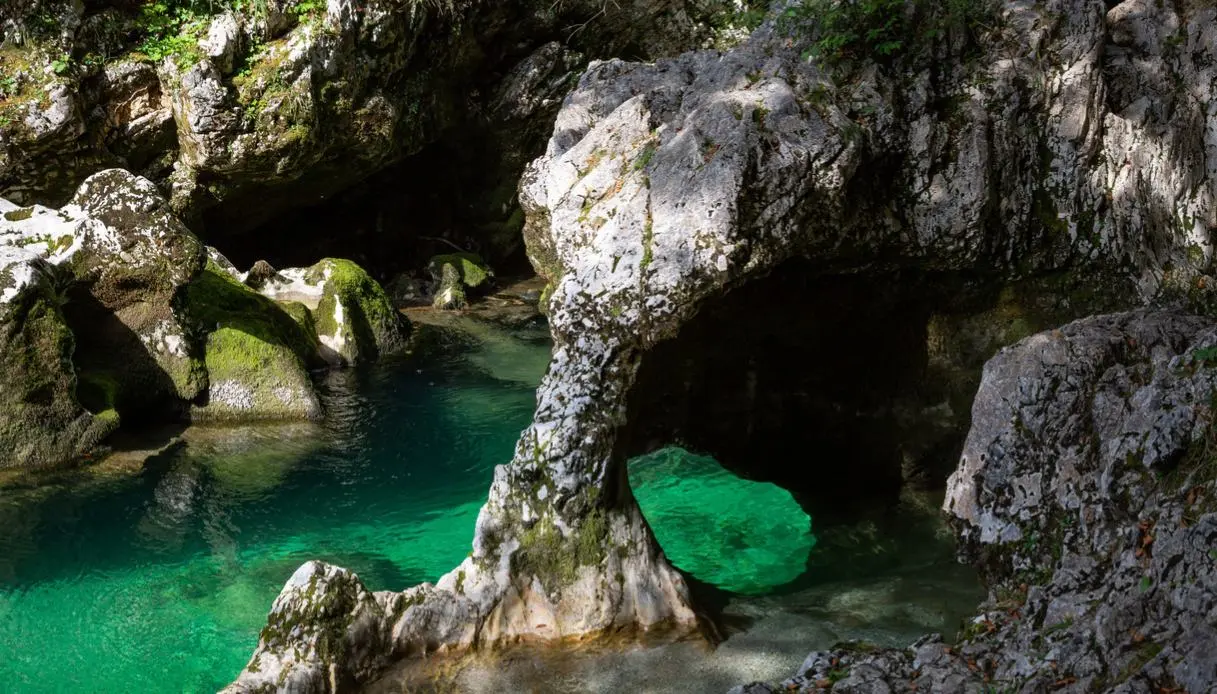
Among the captivating peaks of the Slovenian Julian Alps, precisely just above Lake Bohinj, water has etched a story that spans thousands of years into the rock. The result is the Mostnica Gorge, a narrow calcium carbonate incision about 2 km long, situated within the boundaries of Triglav National Park. Here the Mostnica River flows between light-colored walls, through swift stretches, small waterfalls, and cavities perfectly rounded, some several meters deep. In the narrowest passages the rock leaves barely enough room for the footpath and for the stream itself.
The first surprise arrives already at Stara Fužina, a traditional Alpine village regarded as one of Bohinj Valley’s best-preserved settlements. The stone-and-wood houses, the double-structured barns (called toplarji), and traces of the ancient ironworking culture tell of a community long accustomed to living among forests, pastures, and mountains. From this everyday scene a route starts that quickly changes its look within a few minutes.
First the landscape tightens, then the sound of the water takes center stage while light filters through the trees. And the Mostnica, for its part, reveals itself in emerald green at times, and almost turquoise at others. Then the gorge opens up and gives way to the Voje Valley, a wide glacial amphitheater surrounded by mountains. At the bottom awaits a waterfall about 21 meters high.
Origin, formation and legends of the Mostnica Gorge
The current shape of the valley arose from the meeting of very different geological phenomena. The central part of the area experienced tectonic movements, while later the Bohinj Glacier helped deepen the valley floor. During the glacial melting phases, roughly between 15,000 and 10,000 years ago, the amount of water increased dramatically. The Mostnica thus gained enough erosive power to carve further into the calcareous substrate.
The river’s most important ally was the influx of rock fragments carried by the current. Sand, gravel, and small pebbles are swept along by the water and, at points marked by whirlpools, they roll along the bottom. This repeated motion carved the distinctive korita, large circular basins that evoke natural tubs.
In the deepest stretch, near the Devil’s Bridge, the walls reach about 20 meters. In some spots the gorge narrows to roughly 1 meter, creating one of the most evocative passages of the entire route. Among the more curious shapes is the Slonček, the “Little Elephant,” a natural hollow in the rock that resembles the head and trunk of an elephant.
The Devil’s Bridge, or Hudičev most, is also part of local lore. The stone structure, with a single arch, spans the gorge above the deepest point. Its purpose, however, was anything but decorative: the bridge shortened the transport of iron ore and timber charcoal from the mountainous regions toward the valley’s metallurgical plants.
The name, however, has given rise to a far more imaginative legend. According to local folklore, villagers tried in vain to build a structure over the stream, but during the night the work was destroyed. Someone proposed entrusting the undertaking to the Devil, who agreed in exchange for the soul of the first person, or creature, to cross the bridge.
A farmer came up with a ruse: he brought his own dog and a large bone, then threw the latter beyond the bridge. The animal raced to retrieve it, and the Devil ended up with the dog’s soul instead of the farmer’s. Enraged, still according to legend, he thrashed his tail so violently that part of the fence was toppled.
Visiting the Gorge and the Voje Valley
The classic itinerary starts from Stara Fužina and reaches the Devil’s Bridge. From this point the path enters the forest and follows the Mostnica upstream. The hike through the gorge takes about one hour one way, with times varying depending on stops, while returning to the village takes roughly one and a half hours.
The trail alternates through wooded stretches, rocky passages, small bridges, and sections close to the watercourse. The presence of these little bridges is meaningful also from a historical viewpoint, since these crossings are precisely what gave rise to the name Mostnica, linked to the Slovene word most, meaning “bridge.”
The most spectacular stretch comes near the narrowings. Clear water, limestone walls shaped by vortices, and deep pools compose an exhilarating landscape, yet free of man-made scenery. The Slonček stands out as the most curious feature, while the Devil’s Bridge offers the most vertiginous view of the gorge.
Beyond the carved rock, the Planina Voje opens before visitors with alpine meadows and pastures a little above 700 meters in altitude. The valley exhibits the classic U-shaped profile produced by glacial action. The terrain also preserves important morainic deposits, rock material left behind by the retreating glacier.
Around the Koča na Vojah, an alpine hut with a summer terrace, one can take a break before continuing toward the waterfall. The full route to the far end of the valley requires greater stamina, while still maintaining a generally moderate technical difficulty.
The final destination is the Mostnica Falls, about 21 meters high and also known as the Voje Falls or Šum Falls. In spring and after rainfall the flow increases and the drop appears especially powerful. The complete itinerary can take about 3–4 hours, including stops. For the gorge alone, a half-day is enough and is much shorter.
The path is also suitable for families with children used to hiking. Around five years old, many are able to walk the gorge section independently, while reaching the waterfall demands more energy.
Where it is and how to get there
The Mostnica Gorge lies at Stara Fužina, in the Bohinj Valley, within the Triglav National Park, in the northwest of Slovenia. Bohinj Lake serves as the most immediate geographic reference. From Ribčev Laz, the main hub on the lake’s edge, Stara Fužina is about a 5-minute drive or roughly 45 minutes on foot.
By car it is convenient to reach Stara Fužina and use the indicated parking areas. In peak season spaces can fill up quickly, so an early start makes the visit much easier. Those preferring public transport can reach the area by buses direct to Bohinj and Stara Fužina, checking return times in advance, especially for the full Voje Valley route.
From the village, the signs pointing to Korita Mostnice lead toward the Devil’s Bridge. Another option starts from the Church of St. Paul, while from the village center one can pass near the Zois estate. There is also a road that reaches the Voje Valley without crossing the gorge and without paying an entrance fee, a solution useful only for those who want to reach the upper part without traversing the most characteristic stretch.