
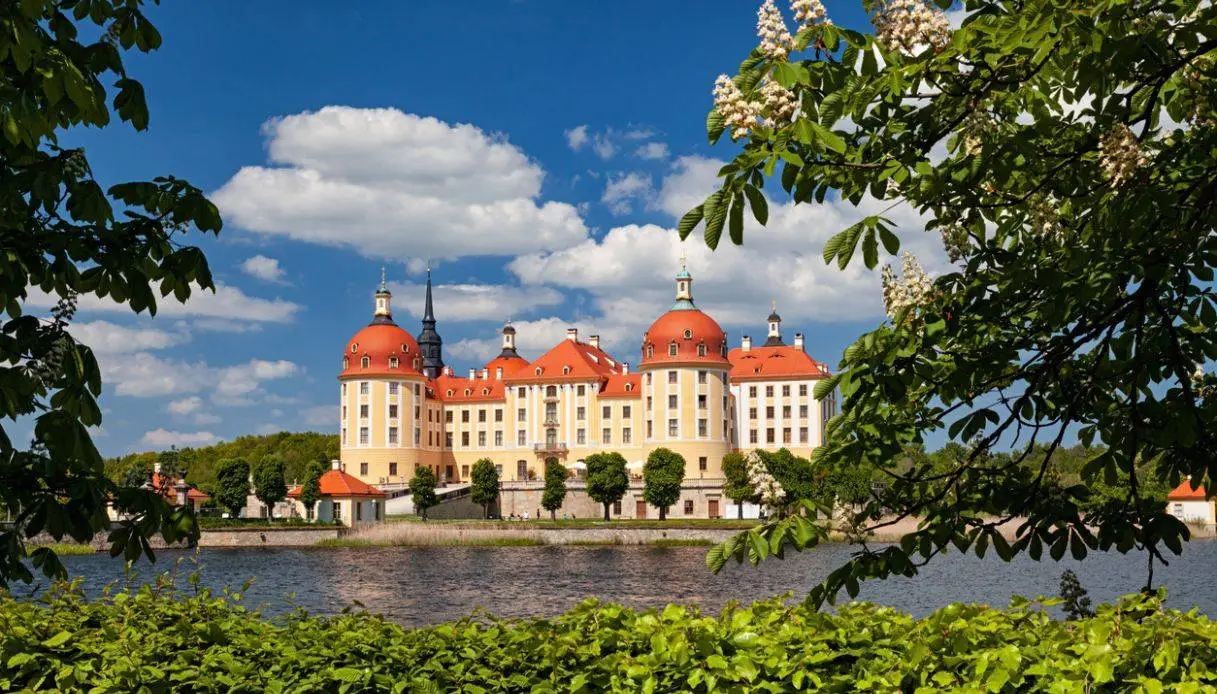
No corner of Germany would be complete without its own castle, and the Saxony region is no exception. One of the most beautiful is certainly Moritzburg Castle, located near Dresden, whose historic center is a precious treasure trove of historic architecture.
Surrounded by the waters of a large artificial pond and set in the greenery of a centuries-old park, this Baroque castle looks straight out of a fairy tale: no wonder, it was one of the locations for the film Three Nuts for Cinderella, and every winter its halls dress up in festive finery recalling precisely that atmosphere, to the delight of visitors to Saxony during the Christmas season. On the outside staircase there is a bronze slipper reminding of the one Cinderella lost in the movie.
The History of Moritzburg Castle
The origins of Moritzburg date back to 1542, when the Duke Maurice of Saxony had a Renaissance-style hunting pavilion built on a granite hill in the heart of the Friedewald forest. In 1661 a chapel was erected, consecrated in the Catholic rite on the occasion of Augustus II the Strong‘s coronation as King of Poland, and it remains a venue for religious services today.
It was Augustus II the Strong who gave Moritzburg the look we know today: from 1723 he began a radical transformation, entrusting the architect Matthäus Daniel Poeppelmann with the task of turning the old pavilion into a splendid Baroque palace, designed for banquets, hunting outings and even faux naval battles on the castle’s pond. The project, however, remained unfinished at the sovereign’s death and only in 1800 did a descendant continue the work, further integrating the castle into the surrounding landscape.
During the twentieth century, Moritzburg served as the Wettin family’s residence until 1945, when the castle was confiscated as part of postwar reforms in East Germany. Some artistic treasures, buried in the park to protect them, were largely discovered and taken away by Soviet troops: only in 1996 did several chests of jewels and gold ornaments come to light thanks to the discovery by amateur archaeologists.
What to See During a Visit to the Castle
Inside the castle, several treasures are kept: one of the most important European collections of hunting trophies, refined tapestries in gilded leather, and the “Feather Room”, lined with over a million colorful feathers.
Don’t miss the Peacock Castle, a small Rococo jewel perched by the pond, complete with a miniature harbor and the only lighthouse in Saxony: once the backdrop for court celebrations, today among Germany’s most valued artistic monuments after a thorough restoration completed in 2013.
The surrounding park, inspired by the French gardens commissioned by Augustus the Strong, was never completed according to the original plan, but its reconstruction, started in 1990 based on an 1740 map, now restores the romantic atmosphere that the site assumed in the nineteenth century.
Location, Prices and Opening Hours
Moritzburg Castle is located a few kilometers from Dresden, in the heart of Saxony.
By car, it can be reached via the A4 (Dresden-Wilder Mann exit) or the A13 (Radeburg exit), following local signs. By public transport, you can take the train to Dresden-Neustadt and continue with the bus 477 toward Radeburg, or the M line from Meissen. A scenic alternative is the historic narrow-gauge railway “Lößnitzdackel”, which links Radebeul to Moritzburg.
The castle is open daily from 10:00 to 18:00. The admission ticket costs €12 for adults and €4.50 for children.