
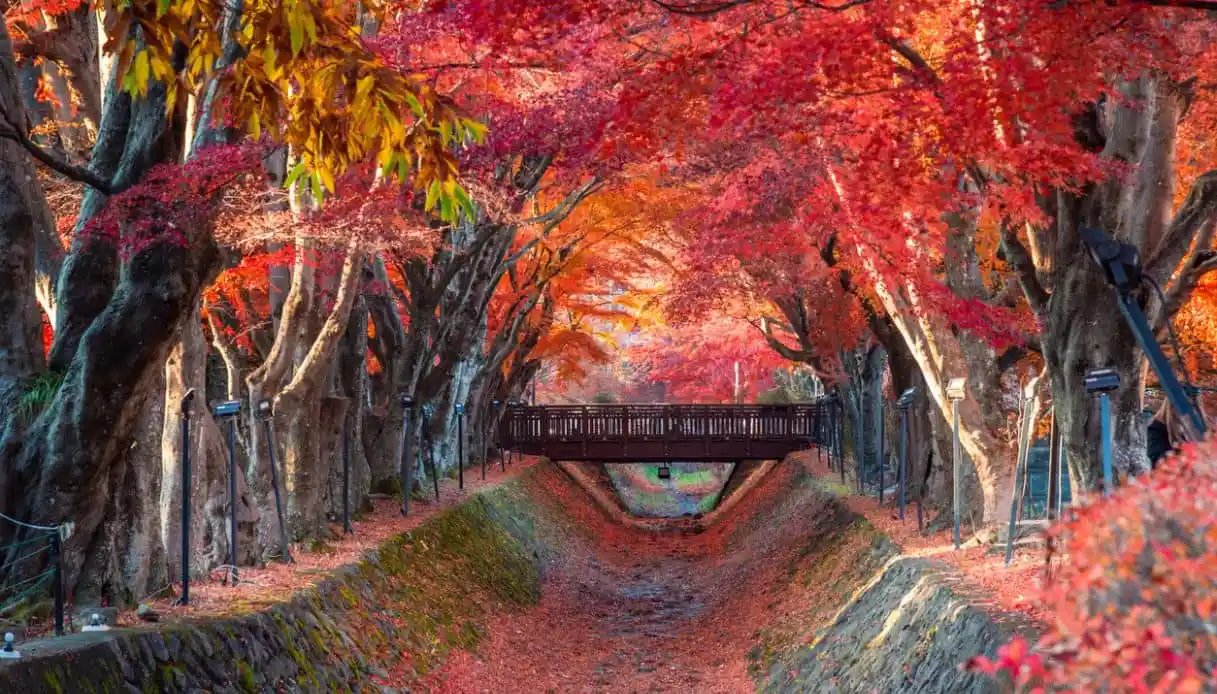
Japan does not offer emotions only in spring, when the cherry blossoms transform parks and gardens into fairy-tale settings. Autumn also brings its grand spectacle of red, orange, gold and suspended atmospheres: it is the Momijigari, the ancient Japanese tradition devoted to the contemplation of foliage.
The period usually associated with foliage runs from October to November, although timings vary with latitude and altitude: precisely by following this progression of colors it is possible to craft a suggestive journey along the Land of the Rising Sun and encounter autumn in different places, even multiple times during the same itinerary.
What Momijigari is and why it is such an important tradition
The word Momijigari translates as “hunt for red leaves” and designates the practice of going in search of autumn landscapes, especially those characterized by maple leaves: the term indeed recalls the momiji, the maple with intense autumn hues, but the experience also includes the foliage of ginkgo trees, which create equally fabulous scenes with their golden shades.
Its origins date back to the Heian period, between 794 and 1195. At that time Momijigari was primarily an aristocratic practice: nobles and poets gathered in gardens and mountain refuges to admire the changing nature. The contemplation of leaves thus became an occasion to devote oneself to poetry and to reflect on the transience of existence, a theme tied to Japanese aesthetics.
As the centuries passed, Momijigari transformed into a popular tradition but kept its deepest meaning. Just as hanami accompanies spring with the contemplation of blooming cherry trees, foliage marks autumn by reminding us how beauty can be intense precisely because it is destined to change.
When to see foliage in Japan
Generally, the best period falls between late October and early December, but by the end of September autumn can already make its appearance in northern and mountainous areas.
In Hokkaido, for example, colors arrive earlier, already from late September in parks and in mountainous zones. In Sapporo the most evocative moment centers on late October to early November.
Heading toward the country’s center, places like Nikko and the Japanese Alps can reach their peak as early as mid-October. In Tokyo, on the other hand, urban foliage tends to peak between late November and early December, and it offers the distinctive contrast between autumn colors, historic parks and the metropolitan landscape.
November is also an ideal month to admire the colors of Hakone and the region of the Five Lakes, with Mount Fuji as a backdrop. In Kansai, between Kyoto, Osaka and Nara, the spectacle usually arrives from mid-November, while further south, toward Hiroshima and Kyushu, leaves may color later, even at the start of December: in Fukuoka, in particular, foliage can extend into late December.
From the north to Kyoto, foliage follows the journey
The magic of foliage makes autumn a season truly interesting for organizing a trip to Japan: by planning movements according to the various timings you can indeed follow the motion of colors and encounter foliage in multiple stops.
Among the most celebrated destinations Kyoto undoubtedly stands out, where the red of the maples is integrated into a landscape enriched by temples and gardens: here the experience can include access to places that require an admission ticket, while in public parks visits are usually free.
Momijigari remains, in fact, an accessible experience, but requires good planning. Knowing the seasonal progression is essential to increase the chances of meeting the leaves at their best and to turn an autumn trip into a journey facing some of Japan’s most evocative landscapes.