
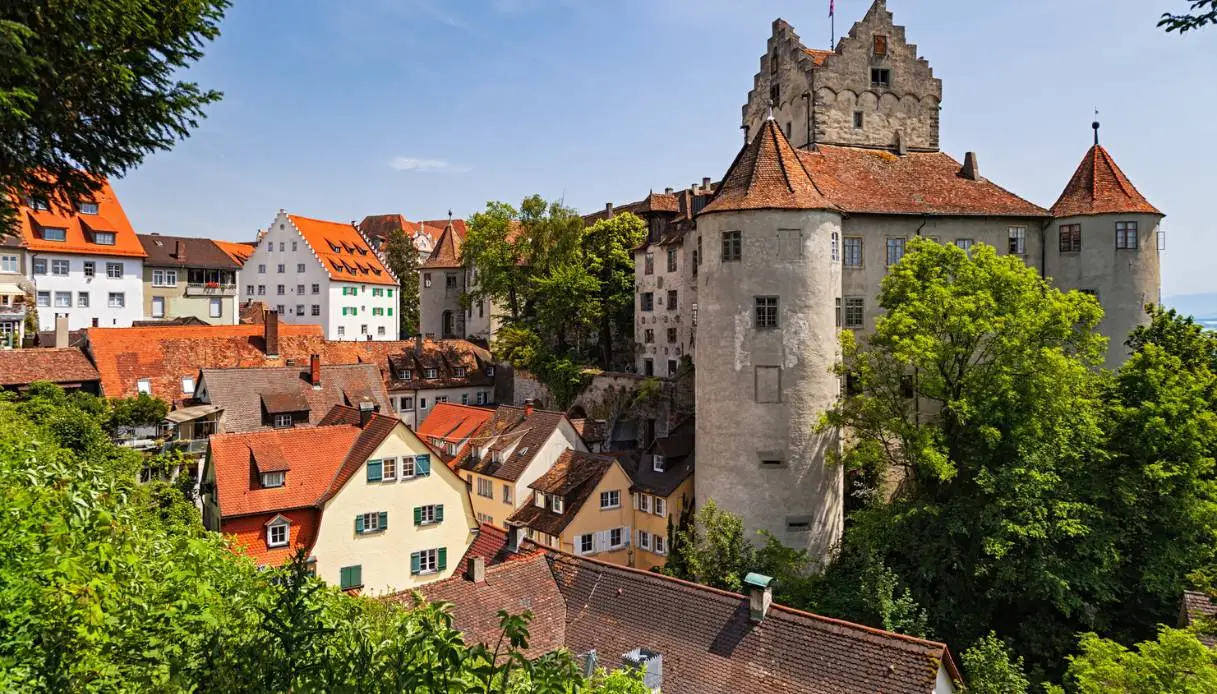
Today we take you to the southern part of Germany, more precisely along the northern shore of Lake Constance, locally known as Bodensee. If you’re wondering why the answer is so interesting: right here rises a rocky promontory where Meersburg comes to life, a town that seems like a sea fortress (indeed, travelers of past centuries really thought so).
From the shore, the gaze climbs pastel façades, meets ancient towers, and reaches the vineyards that cloak the hills. An enchanting geographical landscape that becomes even more exciting on clear days: beyond the lake you can discern the peaks of the Swiss Alps.
Located in Baden-Württemberg, it guards an extraordinarily well-preserved historic center, yet split into two parts connected by steep streets and staircases: Unterstadt, the lower town, and Oberstadt, the upper town. Since 2004 Meersburg has also been part of the Deutsche Fachwerkstraße, the German Road of half-timbered houses, a tourist route dedicated to the finest examples of this traditional building style.
What to See in Meersburg
Stone, wood, and colored plaster compose an urban landscape rich in small details, where distances contribute to the charm as the main monuments cluster in a compact space, albeit distributed across different elevations.
Steigstraße, Market Square and Obertor
To reach the oldest part of the town center of this German town you must tackle Steigstraße, a distinctive uphill street linking Unterstadt to Oberstadt and today one of Meersburg’s most photographed spots.
< /ask-ai-widget>
On either side stand half-timbered houses with visible wooden beams, warm-toned façades and small porches. Some buildings appear to tilt toward the roadway, heightening the sense of traversing a neighborhood faithful to its past.
The street leads to the Marktplatz, the old market square, near which rises the Obertor, one of the historic gates with its characteristic reddish color.
Meersburg Castle, the oldest inhabited castle in Germany
A mighty tower, sturdy walls and a bridge spanning the ancient moat announce Meersburg Castle, also known as Old Castle. Considered the oldest inhabited fortress in Germany, it is the cradle of a museum path featuring 36 furnished spaces, including armory rooms, old kitchens, residential chambers, and areas tied to medieval justice.
Neues Schloss, the Baroque residence of the prince-bishops
A short distance from the fortress lies Schlossplatz, dominated by Neues Schloss, the New Castle, the more elegant face of Meersburg’s aristocracy. With its pinkish façade and large windows facing the lake, the palace testifies to the prince-bishops’ desire to reside in a brighter and more representative residence than the old fortress.
Inside, a monumental staircase designed by the famous Baroque architect Balthasar Neumann enchants, enhanced by statues and decorative paintings. If possible, we recommend a quick visit to the panoramic terrace, where a Baroque garden sits alongside an elegant pavilion (as well as a special view of Lake Constance).
Fürstenhäusle, the refuge dreamed by the poet
Among the vineyards above the historic center lies Fürstenhäusle, a small residence preserving furnishings in the Biedermeier style, portraits, manuscripts and witness accounts of the life of the writer Annette von Droste-Hülshoff, who dreamed of retreating here to write (unfortunately she died before she could truly do so).
Magische Säule, the most irreverent column along the lakeside
Among Meersburg’s surprises is a monument decidedly far from the elegance of the historic palaces: on the harbor promenade stands the Magische Säule, the Magic Column, created by sculptor Peter Lenk.
Rising about 15 meters tall, it gathers figures linked to the town’s history, transformed into grotesque and caricatured characters. At the top, for example, there is Annette von Droste-Hülshoff herself in the guise of a seagull, a reference to her poetic yearning for freedom.
Vineum Bodensee, the wine museum
The link between Meersburg and viticulture continues at Vineum Bodensee, housed in the old Heilig-Geist-Spital hospital. The centerpiece is a large wine press dating from 1607, among the oldest functioning specimens in Europe. Surrounding this historic machine is a route dedicated to wine production and the Lake Constance enology culture.
Unterstadt, the waterfront district
In the lower part of the town, the Unterstadtstraße runs through a succession of historic buildings, shops and small taverns before reaching the lakeside.
The old Unterstadttor recalls the presence of the town’s fortifications, while the tree-lined promenade follows the shoreline between terraces and boat docks.
What to Do in Meersburg
The architectural heritage is incredibly rich, but its relationship with the lake and with the wine tradition is no less fascinating.
- Sample the wines of Lake Constance: in the typical Weinstuben, the local wine taverns, it’s worth trying Spätburgunder, the German Pinot Noir, and other wines produced on the surrounding hills.
- Discover the lake by boat: to admire the town from the water and reach other localities in the region.
- Give yourself a few hours at the spa: Meersburg Therme sits right on the shore and includes pools, saunas and wellness areas.
- Explore the vineyard trails: several itineraries cross the hills toward Hagnau, alternating rows of vines, orchards and lake views.
- Visit the town market: on Friday mornings the Marktplatz hosts the traditional weekly market, a chance to discover local products and observe the village’s daily life.
Where It Is and How to Get There
Meersburg lies in the state of Baden-Württemberg, on the northern shore of Lake Constance, a region happily characterized by international connections and Alpine landscapes. To reach it by car you mainly use the federal road B31, connected to the motorway network via the A81, A98 and A96. The historic center features narrow streets and restricted-traffic zones, so it’s wise to park in one of the outer car parks.
Meersburg lacks a train station. For this reason, the most practical options are direct trains to Überlingen or Friedrichshafen, followed by bus line 7395 which reaches the town in about 30 minutes.
Particularly characteristic is the ferry between Constance and Meersburg, active year-round and accessible to cars and cyclists as well. For those who prefer air travel, the nearest airport is Friedrichshafen, located about 15 km away.
