
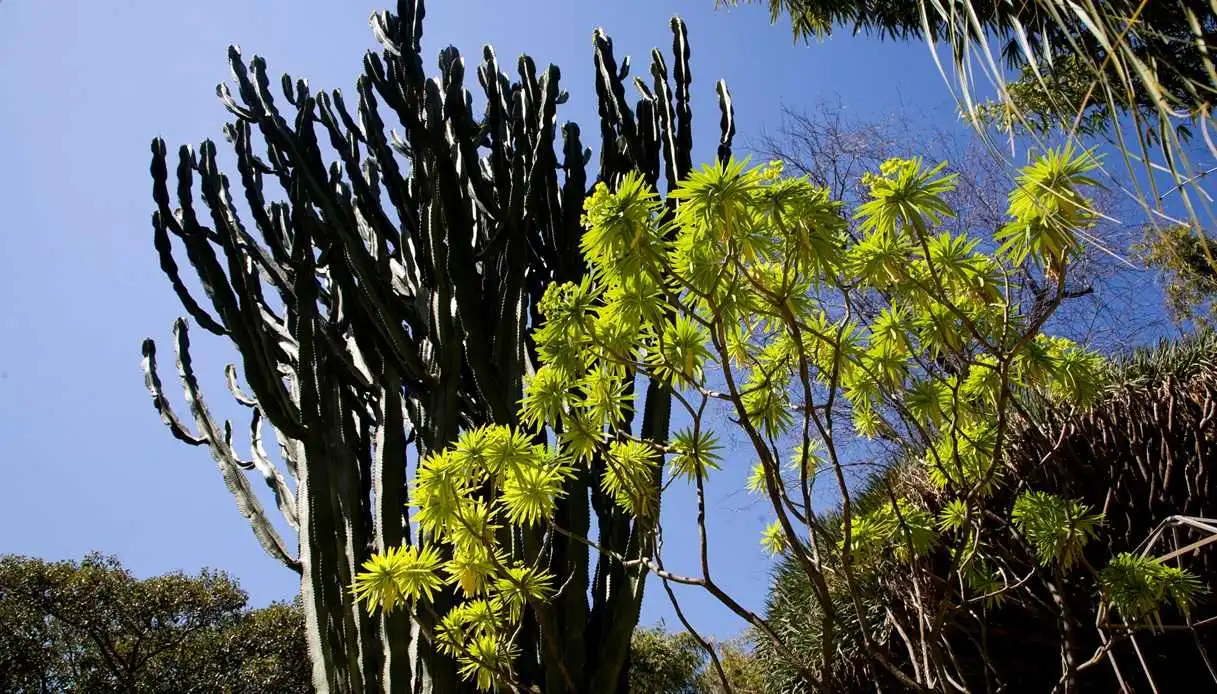
Look at the geographical map: Italy stretches out like a proboscis, or the stereotypical boot, from the European continental mass into the great basin of the Mediterranean Sea. This central position amid a body of water unique in its kind has endowed our country with a peculiar climate and distinctive features, reflected in the vegetation of the regions most exposed to the sea’s influence. Characteristics to discover where nature is regimented and guided by scientific and aesthetic standards together: the gardens. The historic ones, which tell centuries of science and culture. Those born from private passion becoming a public heritage. Those where spring bestows beauty.
Bright colors, distinctive scents, rare and unique plants characterize the most beautiful Mediterranean gardens. In addition to the best-known ones, among those that stand out in the southern regions of Italy, there are many that lie off the beaten paths, yet equally deserve to be discovered.
Garden of Torre Tabaia, Procida
Procida, a small island in the Gulf of Naples: pastel colors of houses and fishing boats that glow kissed by the sun. The lemon is the place’s top product: here, due to climatic and soil characteristics, enormous citrus trees grow, with thick and sweet peels that are used generously in cooking.
Venturing from the alleys of Terra Murata, the ancient fortification on the island’s southern side, toward the eastern spur of Punta della Lingua, one can discover the Torre Tabaia Garden, a small private Eden open to public visits. It is a small space, maintained by the owner, a Procida native who devotes heart and soul to tending his own patch and garden.
Here one can discover up close the lemon grove, which forms a sort of shaded pergola from which hang the large yellow fruits like lamps. A strong citrus scent sways through the air, while you can shelter from the stubborn Mediterranean sun enjoying the company of the garden’s owner, always ready to tell his story and that of his small green paradise.
Botanical Garden of Palermo
Founded in 1779 as an institution of the Royal Academy of Studies of Palermo, the Botanical Garden of the Sicilian capital is today an open-air museum among the richest of its kind in Italy. The current site, in the Kalsa district, was solemnly inaugurated on December 9, 1795 after the first garden, too cramped, was abandoned. The monumental complex was designed by the French architect Léon Dufourny and includes the gymnasium, a neoclassical building of great elegance and classicist style.
Over more than two hundred years of activity, the Palermo Botanical Garden has hosted and disseminated species from every origin: among other things, the institution in Palermo is credited with introducing in Europe the mandarin and the Japanese loquat, as well as the first European experiments with useful plants such as soy.
Today it hosts more than 12,000 different species, and one of its most spectacular attractions is certainly the gigantic specimen of Ficus magnolioides imported from Norfolk Island in 1845. In spring, when everything is in bloom, the garden explodes with colors. Compared to many other gardens, it has a climate-oriented appearance very much shaped by the Mediterranean, with the sharp leaves of palms and the exotic cycads. Despite its scientific and historical importance, it remains a relatively quiet place, away from Palermo’s tourist circuits.
Mediterranean Biodiversity Park, Catanzaro
More recent but no less important is the Mediterranean Biodiversity Park of Catanzaro, inaugurated in 2004. Sixty hectares of green in the heart of the Calabrian city, born from the redevelopment of a degraded area once dedicated to the School of Agriculture. What had been abandoned land, therefore, has become in just over twenty years a fascinating ecosystem capable of uniting nature, history and art in a city park open to everyone.
The botanical garden located within the park extends over about eleven hectares, crisscrossed by avenues, canals and artificial ponds, with over 20,000 ground-covering plants, two thousand large trees and one hundred species of aquatic plants.
Inside the park is also one of the most important European collections of outdoor contemporary sculpture, with works by artists of the caliber of Antony Gormley, Mimmo Paladino, Mauro Staccioli and Jan Fabre. Beside the sculptures you encounter a hedge maze, the swan pond, the wildlife rescue center and the Valley of the Mills, a forty-eight hectare forest of Mediterranean scrub traversed by dirt paths, old water mills and the ruins of a mine.
Gardens of Minerva, Salerno
It is said that the Gardens of Minerva in Salerno are the first botanical garden of the Western world. What is certain is that this place has a long history and that even today they are capable of exceptional charm.
The garden’s origins reach back to the fourteenth century: Master Matteo Silvatico, a celebrated physician of the Salernitan School, took the initiative to transform this family estate on the slopes of the Bonadies hill into a true garden of simples. Here Silvatico cultivated and classified medicinal plants useful for therapy, taught students to recognize them and codified their properties in his Opus Pandectarum Medicinae, one of the era’s most important works in medicine and botany. This place, therefore, is credited as the model that would inspire the botanical gardens of Padua, Pisa, Florence, Pavia and Bologna.
The Gardens of Minerva were restored in 2000 thanks to European funds, and later expanded in 2025. Today they spread across five terraces connected by a long sixteenth-century staircase with pillars and a wooden pergola, built on the city’s ancient medieval walls. It houses over 300 plant species, including some with a distinctly medieval flavor such as mandrake, foxglove, belladonna and yew. The botanical garden is enriched by a tisane bar, where you can stop to sip a tisane with a view of Salerno’s harbor.
La Cutura Botanical Garden, Giuggianello
Giuggianello is the smallest municipality in the province of Lecce. It lies inland in the Salento area, about fifteen kilometers from Otranto. Here, on the border with the nearby Palmariggi, lies a place not to be missed by garden lovers: La Cutura is a private botanical garden of thirty-four hectares that has taken shape over the last fifty years around an ancient eighteenth-century rural estate.
Open to guided visits by reservation, La Cutura’s botanical garden boasts great wealth and variety, and winds through thematic environments very different from one another. The visit starts from the Old Village, the original nucleus of the eighteenth-century farm with architectures of Spanish rural flavor, then crosses the rocky garden with more than eighty varieties of agaves and cacti, the natural pond with papyrus, water lilies and bamboo, the holm forest with oaks over 250 years old, the garden of simples with aromatic and medicinal plants, and the rose garden with more than one hundred varieties in bloom.
The centerpiece of the visit is the grand tropical greenhouse, where there are over 2,000 varieties of succulent and succulent plants from Mexico, Africa and South America. There is also a Secret Garden, reachable through a staircase carved into the rock, where the rarest and most delicate plants take shelter. Spring, with the blooming of the rose garden and the awakening of the Mediterranean scrub, is the perfect time to lose yourself in this hidden corner of Salento.