
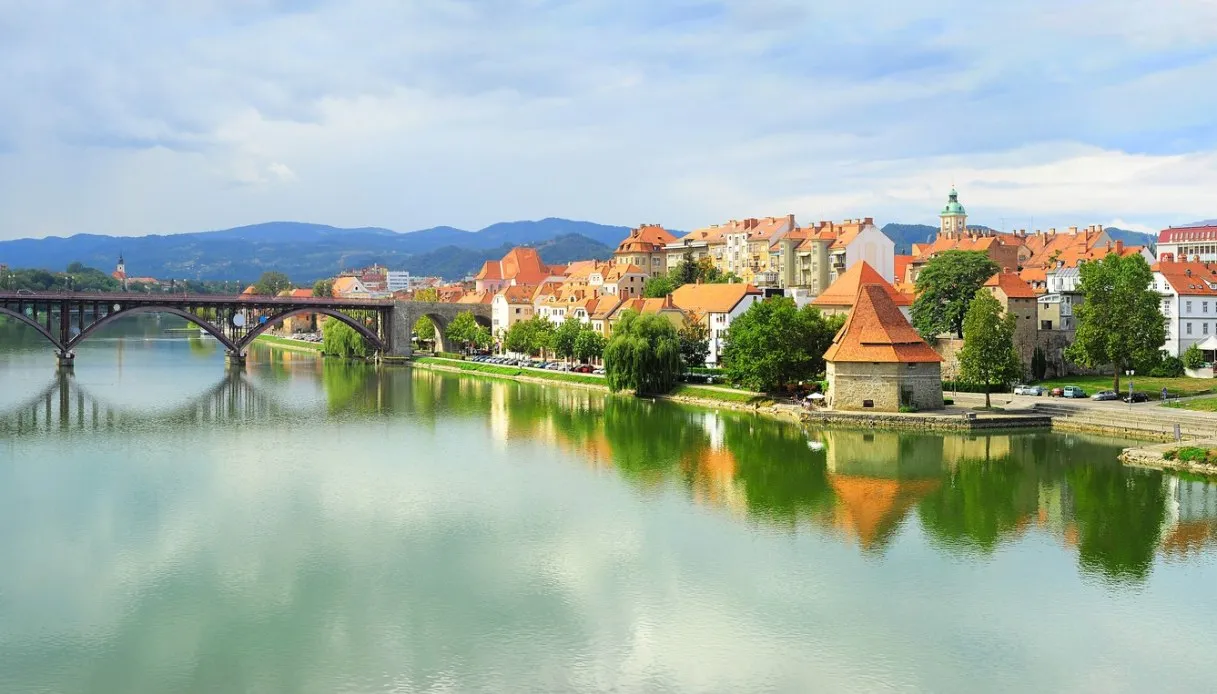
In Maribor, Slovenia, wine belongs to the landscape even before it belongs to the table: just glance toward the hills to notice that the rows of vines reach almost to caress the city, while the Drava crosses the historic center with a broad, calm course. In the background rise the forested slopes of Pohorje, a green presence that makes its charming urban silhouette unusually striking.
As the capital of Slovenian Styria and the country’s second city, it is a place with a long history, so much so that its stratification is most perceptible along the river, in the Lent district, and in the squares of the center. The city preserves towers, remnants of fortifications and historic palaces, but its character also stems from the daily dimension.
Cafés, venues, cultural events and wineries share space with green areas and water-side paths. Maribor was also named European Best Green Capital 2025, while in 2026 it received the title of Best Wine Capital in Europe, recognitions tied to the combination of heritage, nature, and winemaking tradition.
What to See in Maribor
The historic center is easy to explore without long distances, but some highlights deserve a longer pause.
The Oldest Vine in the World
In Lent, on the façade of the House of the Old Vine, grows Maribor’s ultimate symbol: the Old Vine, known in Slovenian as Stara trta, is over 450 years old and is considered the oldest noble grapevine in the world still capable of producing grapes. The record is registered in the Guinness World Records.
The twisted trunk clings to the façade of the fifteenth-century house and narrates a winegrowing tradition that traverses centuries of local history. The vine has also become a cultural and gastronomic symbol, at the heart of celebrations, ritual harvests and initiatives dedicated to wine.
Its history has weathered wars, fires, and diseases that affected many other vines in the region. Today some of its descendants are grown in various parts of Slovenia and even abroad.
Lent and the Medieval Towers
The bank of the Drava leads to the city’s oldest and most characteristic quarter: Lent, which preserves traces of fortified Maribor, alongside buildings and public spaces that look directly onto the river.
Among the most evocative testimonies is the Judgement Tower, born with a square plan in 1310 and deeply rebuilt in the mid-16th century, when Italian architects helped strengthen the city’s defenses. In 1554 the tower and the river port were protected by a bastion named Venice. The port later became an important point for timber trade and the transfer of goods. Today the tower belongs to the Minoriti Cultural Quarter and houses the Maribor Puppet Theatre.
A short distance away, the Water Tower stands as another emblem of the fifteenth-century defensive system. In this stretch the Drava takes on an almost scenic role and makes the succession of towers, walls and historic façades particularly pleasant.
Vinag Winery
Below the urban center, Maribor reveals itself in a completely different light. The Vinag Winery was founded in 1847 and stretches for 2.1 kilometers of underground corridors, across about 15,000 square meters. The overall capacity reaches 3 million liters, stored among wooden barrels, cement cisterns and time-marked bottles.
The contrast with the surface city is striking: above run the streets of the center, below lies a part of Styria’s winemaking memory. The wine archive is particularly precious, with bottles dating from some of the most significant vintages.
Maribor Art Gallery
To shift perspective, the Maribor Art Gallery brings the 20th century and Slovenian contemporaneity inside. The collection comprises more than 10,000 works by Slovenian artists from the late 19th century to today.
It is an interesting stop to understand how Maribor extends beyond its wine-focused image.
What to Do in Maribor
The concentrated size of the center allows for alternating between monuments and lighter moments. The relationship with the Drava and the hills makes it possible to shift atmosphere in just a few minutes.
- Boating on the Drava: to see Maribor from a different perspective, including experiences tied to traditional river rafts.
- Gold hunting: adds a curious element to the river’s history, linked to traditional activities practiced along the Drava.
- Head up toward the Pohorje: means quickly leaving the urban environment to enter a landscape of forests, streams, waterfalls, bogs and lakes. The massif also hosts the Šumik primeval forest and a rich fauna.
- Walk the trails: you may encounter one of the great symbols of local hiking, the Slovenian Alpine Trail, the oldest and most renowned hiking route in the country, which starts in Maribor and ends in Ancarano.
- Taste the wines of Styria: the surrounding hillside vineyards host family wineries and businesses that continue a tradition of viticulture dating back to Celtic and Roman times.
- Observe a klopotecc: one of the most curious symbols of Styrian countryside. This wind-driven wooden structure makes a distinctive sound and belongs to the tradition of protecting the vines and celebrating the harvest.
- Experience a festival: the calendar includes musical, cultural and gastronomic events, and the famous Lent Festival, tied to the Drava-facing district.
Where It Is and How to Reach It
Maribor lies in the northeastern part of Slovenia, not far from the Austrian border. The city is about 70 km from Graz, 120 km from Zagreb, 130 km from Ljubljana, and 230 km from Trieste. Its location along major European routes makes it easy to reach by car, train, or bus.
The train is one of the most practical options: the main railway station is located in Partizanska cesta, practically beside the bus station and already within the urban fabric. From Ljubljana the journey lasts under 2 hours, and international connections include trains from Austria, Germany, and Croatia.
By car you reach it via Slovenia’s motorway network. From Ljubljana you follow the A1/E57, while Maribor is also connected with Zagreb, Budapest, Trieste, Klagenfurt, and Graz. By air, Graz Airport is one of the nearest hubs, about 64 km from the city. There are also connections via the airports in Ljubljana and Zagreb. From Graz Airport there are also rail connections to Slovenia and Maribor.
