
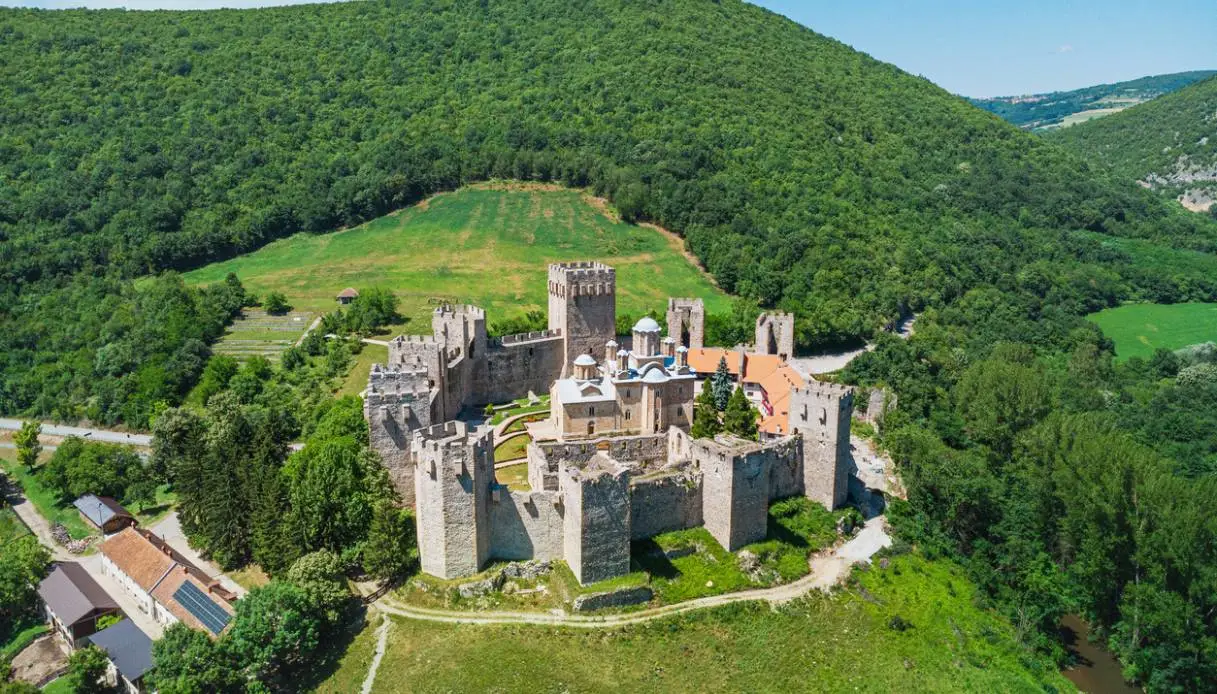
With not too much attention, one might think they have come upon a medieval castle, the kind built to withstand sieges, with towering towers, thick walls, and only a few openings facing outward. But the truth is that behind that formidable defensive ring lies one of the most important religious places in Serbia, guardian of precious frescoes, ancient manuscripts, and the memory of a ruler who helped transform his kingdom into a cultural center of great distinction.
It is the Manasija Monastery, also known by its ancient name Resava, perched on a plateau overlooking the Resava River valley. All around, forests and slopes frame imposing stone towers. Today it embodies two apparently distant identities: on one hand an extraordinary example of medieval military architecture, on the other a cradle of artistic and spiritual heritage tied to the Byzantine tradition.
Its significance is recognized even by the UNESCO, which in 2010 placed it on the proposed list of sites for World Heritage.
A Brief History of the Manasija Monastery
The history of this jewel is closely linked to Stefan Lazarević, one of the most captivating figures of medieval Serbia. Son of Prince Lazar, he ruled during a period marked by Ottoman expansion in the Balkans and ongoing shifts in the region’s political balance.
He was a skilled commander, belonging to the Order of the Dragon, and he cultivated interests quite unusual for a sovereign busy defending his lands: literature, writing, translation, and he actively supported the arts. Between 1406-1407 and 1418 he aimed to realize a monastery that would become his own mausoleum, but also a leading religious and intellectual center.
His ambition, however, went far beyond building a mere place of prayer, so that he inaugurated the famous Resava School, a community of monks “enlightened” who specialized in transcribing, correcting, and translating manuscripts. Before the invention of printing, copying a book required months of work, linguistic skill, and extraordinary precision. The scribes of Manasija contributed to the preservation and spread of religious and literary texts, exerting a substantial influence on Slavic culture.
Upon Stefan’s death (unexpectedly, in 1427) the monastery became the resting place of his remains, while in the following centuries it endured fires, Ottoman occupations, devastations and reconstructions. Then came the 19th century, a period during which new restoration efforts were undertaken, promoted also by Prince Miloš Obrenović. Since 1954 Manasija has housed a female monastic community.
Visiting the Manasija Monastery and What to See
From the outside, the austere aspect of a military fortress is evident, but inside you feel the intimate dimension of an active Orthodox monastery. And the contrast is immediate. The most recognizable feature of Manasija is undoubtedly its defensive enclosure, designed to provide exceptional protection.
The complex includes 11 main towers and a twelfth tower located in an eastern sector that is separately fortified. The structures are linked by walls that originally reached about 12 meters in height. In earlier times, they boasted multiple levels connected by defensive passages. At the top there were crenellations and battlements, openings through which defenders could strike at attackers.
Altogether, the fortified system counted 104 embrasures, a notably rare feature in Serbian military architecture of the era. A second line of walls, now partly vanished, and a defensive moat up to 17 meters wide contributed to the overall imposing appearance.
Known as the Despot’s Tower, the main keep is considered one of the most important achievements of medieval Serbian military engineering. It has a square base of about 14.5 meters per side and stands out compared with the other towers for its greater bulk and the internal organization of its spaces.
In the center of the courtyard rises the main church, which is also one of the most significant examples of the Morava School. The building features a cross-in-square floor plan with apsidal terminations and five domes. The exterior surfaces, built with blocks of sandstone, display a restrained yet dignified decoration.
Originally, about 2,000 square meters of the interior surfaces were adorned with frescoes. Today (and yes, unfortunately) roughly 700 survive, but they are still enough to testify to the very high level reached by the painters who worked on the decoration. The deep blues, the gilded applications, the expressive faces, and the details of the garments render these paintings among the most refined examples of Byzantine art of the early 1400s.
On the western wall of the nave is preserved the famous portrait of Stefan Lazarević, shown wearing sumptuous garments decorated with double-headed eagles. The sepulcher attributed to the despot is indicated by a marble plaque.
Among other structures worth noting are the remains of the medieval refectory, the space used by the monks for communal meals, as well as traces of spaces intended for daily activities, storage and artisanal work. Manasija remains an Orthodox monastery inhabited by nuns, so visiting requires respectful conduct, appropriate dress, and particular discretion in prayer spaces.
Location and How to Reach It
The magnificent Manasija Monastery is located in eastern Serbia, about 3 kilometers from Despotovac, in the historic region of Resava. This means Belgrade is roughly 135 kilometers away in a straight line, while the road distance is longer. To reach the complex from the capital, it is convenient to travel by car, following signs for Despotovac and then for the monastery.
The journey traverses a part of the country that is far from the major international tourist circuits, passing through small towns, rural landscapes, and rolling countryside. Once Despotovac is reached, the remaining distance is short.