
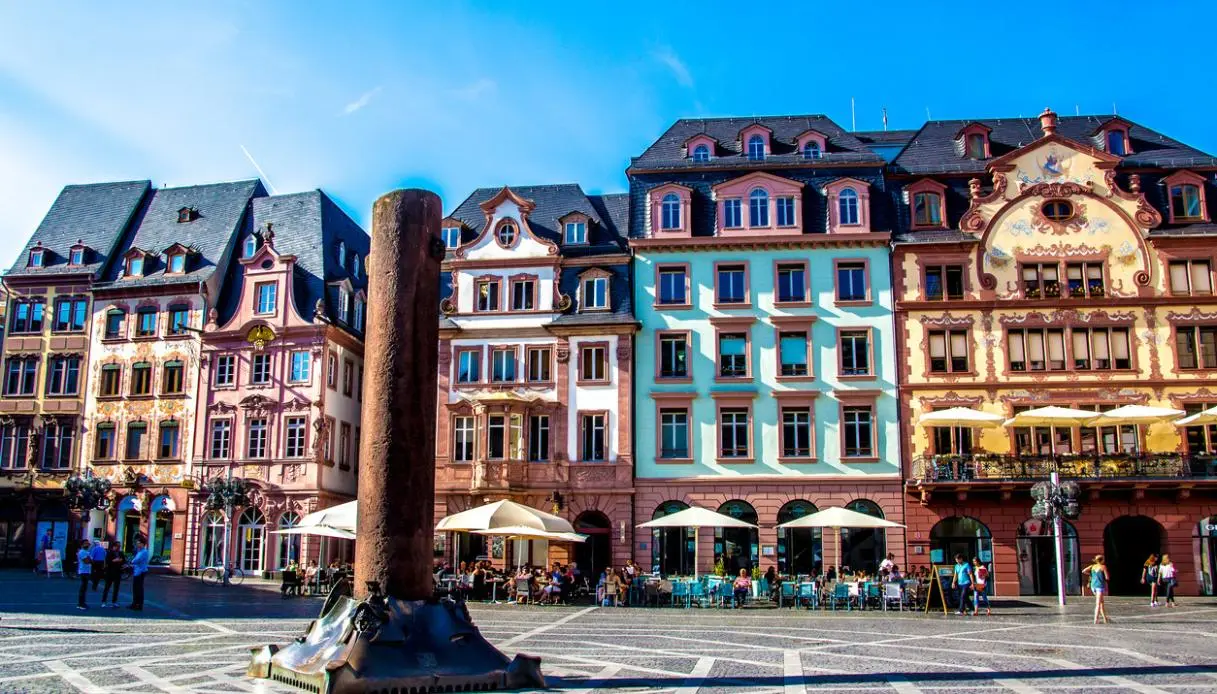
There is certainly no shortage of humidity, namely that of the Rhine that clings to the stones, while honey-colored façades gleam under an uncertain sky. It presents itself at first as Magonza (Mainz to the Germans), because it is a fascinating city perched on the left bank of the river, near the confluence with the Main and across from Wiesbaden.
Capital of Rhineland-Palatinate, among its streets rebuilt after the war there is a buzz of spires, student voices, and crowded taverns. We are in Germany, then, in a corner of the country that proves surprising for those who decide to stray from the most trodden tourist routes. Its geography, among other things, is characterized by gentle vineyard-sloped hills that brush the urban perimeter, creating a microclimate exceptionally mild for these latitudes.
What to See in Mainz
Even the road signs in this German city tell of its ancient relationship with the river: blue signs indicate streets running parallel to the Rhine, red ones those perpendicular. And dating back as far as 1853 they help to orient travelers even when far from the riverbank.
Augustinerstraße and Kirschgarten, the alleys of the Old Town
To the south of the cathedral, Augustinerstraße winds its way among shops, taverns, and Baroque façades. A little further on, Kirschgarten resembles a miniature square, surrounded by half-timbered houses. The dark beams trace geometric shapes on the plaster, while the upper floors protrude over the street.
A picturesque district that was rebuilt after the bombings of 1942-1945, where today the scent of bread blends with the voices of the Weinstuben, the traditional wine taverns.
St. Martin’s Cathedral and Marktplatz, the monumental heart
Step by step one realizes that a reddish or pinkish mass rises above the rooftops (depending on the hour) and it is that of the Mainzer Dom (St. Martin’s Cathedral) that towers over the market square.
The Romanesque monument today preserves two choir sections at opposite ends, a rare feature, in addition to imposing towers and intricately carved tombs of the archbishops.
Externally what catches the eye is Marktbrunnen, a Renaissance fountain donated by Cardinal Albert of Brandenburg and decorated with references to the peasant uprisings.
Gutenberg Museum, the birth of modern printing
Johannes Gutenberg perfected European printing with movable metal type in Mainz by the mid-15th century, a development that inevitably accelerated book production. The famous Bible with 42 lines, so named for the 42 lines printed in each column, bears witness to that revolution.
The museum houses two precious copies and reconstructions of the presses.
St. Stephen’s Church, Chagall’s blue light
On the Stephansberg hill, the Gothic church of St. Stephen houses nine stained glass panels designed by Marc Chagall between 1978 and 1985, the artist’s only works in a German religious building. Angels and patriarchs of the biblical tale drift among shades of blue, indigo, and violet. The light-colored walls themselves catch their reflections.
In seguito Charles Marq added another 19 stained-glass panels, completing one of the city’s most intense artistic experiences.
Isis and Mater Magna Sanctuary, a temple under the shops
In the basement of the Römerpassage, a shopping arcade, survive the foundations of a Roman sanctuary discovered only in 2000. It was dedicated to Isis, the Egyptian goddess, and to Mater Magna, a deity of Anatolian origin.
Among the artifacts there are well over 300 oil lamps, figurines, remains of food offerings, and tablets with carved curses.
Roman Theatre and the Citadel, memory of the legions
Near the Mainz Römisches Theater station, the structures of one of the greatest theatres of antiquity north of the Alps emerge. The cavea, reserved for the public, was about 116 meters wide and could accommodate 10,000 spectators.
Higher up, in the citadel area, the Drususstein commemorates the Roman general Drusus, who died in 9 BCE. It is a cenotaph, that is, a tomb monument without the body, buried in Rome.
Elector’s Palace and the Rhine bank
Finally the Kurfürstliches Schloss stands out by the water with its long red sandstone façade, punctuated by windows and late Renaissance ornaments. Built starting in the 17th century, it was the residence of the archbishops who participated in electing the sovereign of the Holy Roman Empire.
From the riverbank the view reaches the Theodor Heuss Bridge and Wiesbaden on the opposite shore. All this among quays, gardens, and boats as the horizon opens onto hillside vineyards.
What to Do in Mainz
In Mainz people toast even before lunch at the market, and public celebrations fill entire squares.
- Try the market breakfast: on Tuesday, Friday, and Saturday stalls surround the cathedral. On Saturdays, from March to November, the Marktfrühstück tradition brings together local products and wines from the area.
- Sit in a Weinstub: a typical wine tavern where a Riesling accompanies Spundekäs, a spiced cheese cream, or the classic “Weck, Worscht un Woi,” bread, sausage, and wine.
- Explore the city on the Gutenberg-Express: a tourist train that departs from Gutenbergplatz and passes by the main attractions (with explanations along the way).
- Take a boat excursion: river cruises on the Rhine, especially in the pleasant season, lead toward the Middle Rhine Valley, famous for castles on the hills and terraced vineyards.
- Experience the Fastnacht: that is the Carnival, which begins on November 11 and culminates on Rosenmontag, with satirical floats and costumes.
- Join Johannisnacht: a June festival with performances, stalls, antique books, and the traditional Gautschen, a curious symbolic baptism of apprentice typographers.
Where It Is and How to Get There
The city of Mainz sits about 40 kilometers from Frankfurt am Main, in western Germany, along the Rhine-Main corridor. Surrounding it are the wine regions of Rheingau and Rheinhessen, which change their appearance with the time of year.
To reach it from Italy, the most convenient airport is Frankfurt International, connected to Mainz Hauptbahnhof by direct trains in about 20-25 minutes. The S8 suburban line serves the airport connection, along with other regional rail services.
The main station allows you to reach the historic center on foot or by public transit, while by car the principal access routes include the A60 and A63 motorways.
