
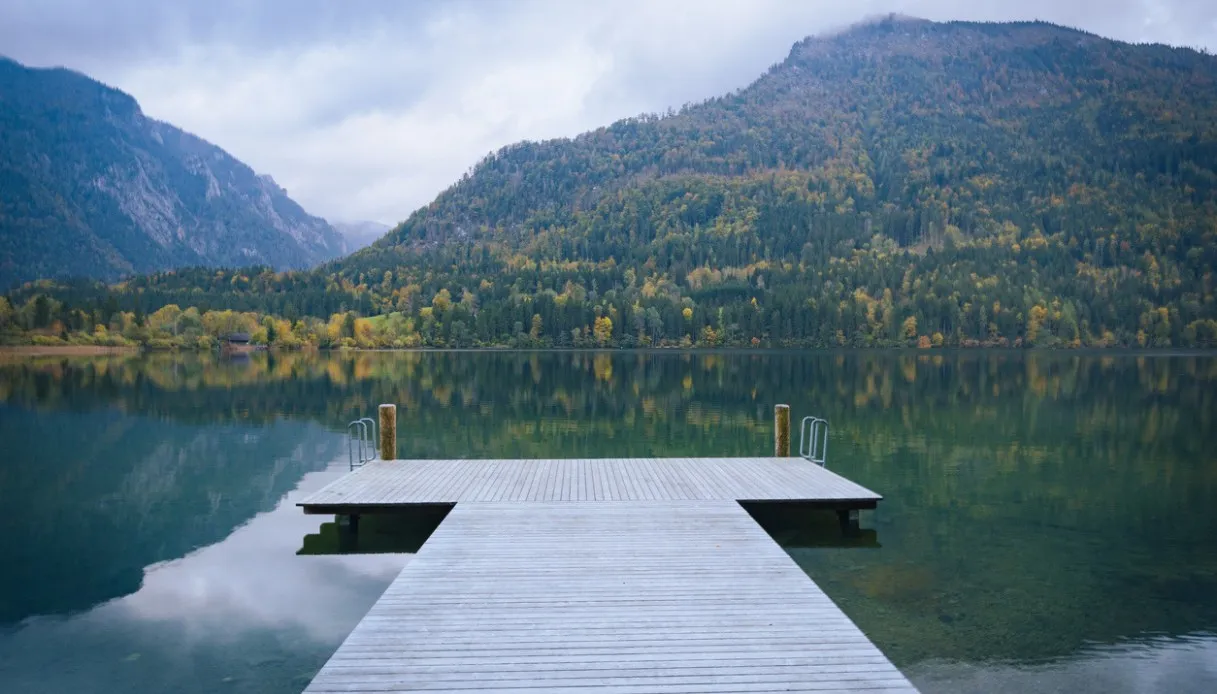
Those who live in the area, precisely in the tiny village of Lunz am See, affectionately call it the Meer der Lunzer, or their sea. The reality, however, is quite different: crossing it from one bank to the other would take barely 500 meters. We are in Lower Austria, at the foot of the Dürrenstein massif, in a corner of the Alps of the Ybbstal. And it is right here that the Lago di Lunz (Lunzer See in the local language) enchants with its presence, as imposing as it is silent.
After all, this is the region’s only natural swimming lake, a body of water spanning 68 hectares nestled among ridges clothed in forests. With autumn’s arrival, it is especially the beech trees that change the face of its shores. The canopies take on coppery hues, the undergrowth fills with leaves, and the dark green of the conifers stands out among the slopes now gilded. On the coldest mornings, a light mist can linger on the surface, while from the southern shore the path crosses stretches of forest that reveal the water only through openings in the vegetation.
Origin and Formation of Lake Lunz
Yes, Lake Lunz is a true jewel of Austria, and this is partly due to the fact that its history began thousands of years ago, precisely when glaciations affected wide portions of the Alps. There were enormous masses of ice that advanced slowly through the valleys, exerting considerable pressure on the rocks.
The Lunzer See basin is therefore the result of glacial erosion. The lake also belongs to a hydrological system formed by three basins connected to one another: the highest is the Obersee, located at 1,113 meters, followed by the Mittersee, at about 766 meters, and finally the Lunzer See, also called Untersee, i.e., the lower lake.
The water descends from the mountain basins through the Seebach, a watercourse that feeds the main lake and continues toward the Ybbs river. We are therefore faced with a continuous water exchange that contributes to the characteristics of its ecosystem, which is also the subject of scientific studies for over 100 years.
As early as 1905, in fact, Lunz became an important center of limnological research, the discipline dedicated to the study of inland waters. Today this tradition continues through the WasserCluster Lunz, a scientific institute that delves into lakes, rivers, and aquatic environments.
Visiting Lake Lunz
Lake Lunz is also suitable for a half-day excursion, as it lends itself perfectly to a few-hour outing. That said, spending more time there allows one to appreciate its less obvious peculiarities as well. The most practical starting point is the western shore, near the lakeside promenade, among parking areas, small establishments, and tourist services.
During autumn the bustle of the summer months gives way to a more intimate atmosphere. On its shores there are benches that, in this season, prove to be privileged vantage points for observing the landscape, while the cooler temperatures invite you to explore the forest trails that wind through the woods.
Available to visitors is a circular path about 4.8 kilometers long. It is absolutely doable since it features a total elevation gain of just 33 meters. Starting from the western shore in a counterclockwise direction, the route climbs slightly along a paved road, then becomes a gravel path. Shortly after, the vegetation becomes denser and the forest seems to envelop the route.
It should be noted that this is probably the most fascinating stretch during autumn, with leaves covering the ground and branches forming something like a natural gallery. There are deviations that lead directly to the shore, while you can take a few minutes to pause and watch the mountains’ spectacle unfold before your eyes (thrilling).
Continuing, the track crosses a bridge and reaches the other shore. From this point the landscape opens up more, offering panoramic views capable of moving you. The return follows part of the road that runs along the lake, with particularly beautiful views on sunny days.
Among Lunzer See’s architectural peculiarities it is worth mentioning the Seebühne. This is a multifunctional structure inaugurated in 2004 and designed by the Austrian artist Hans Kupelwieser, in collaboration with the studio werkraum Wien. But why is it so special? The answer is quite interesting: during the day, part of the structure functions as a sunbathing platform and access to the water; on the occasion of performances, however, it transforms into an open-air theater, with a covered audience and a floating stage.
Indeed it has a mechanical system that allows the cover to rise, while the stage platform can be lowered beneath the surface during winter to protect it from the pressure of ice. The Seebühne also hosts the -wellenklänge music festival, during which performances take place in front of the mountains and lake’s natural scenery.
For those wishing to extend the exploration, from Lunz starts the itinerary of the three lakes, a route of almost 19 kilometers that takes around 6 hours and reaches the Mittersee as well, which lies in a particularly evocative forest setting, and the Obersee, a deep green body of water surrounded by rocky reliefs.
However, it should be noted that in the height of autumn the shorter days and possible snowfalls at altitude require greater caution. In summer, instead, the lake becomes a true seaside destination, with an equipped beach, featuring 4,000 m² of lawn, a diving board, and facilities for families.
From May to June, moreover, thousands of white daffodils bloom in the region’s meadows, while in winter the landscape assumes completely different tones: its surface can freeze during the fiercest cold snaps. A visit to the nearby settlement of Lunz am See, an Alpine village historically tied to ironwork and the mountain culture of the Mostviertel, is also worth it.
Where it is and how to get there
The enchanting Lake Lunz (which in autumn truly seems hand-painted) is located at Lunz am See, in the southwestern part of Lower Austria, in the Scheibbs district. To reach it by car from Vienna, Linz or Salzburg you can take the A1 motorway, exit at Ybbs an der Donau and continue along the B25 toward Lunz am See.
Those who prefer to use public transport can reach by train Scheibbs or Waidhofen an der Ybbs, then continue by bus toward Lunz am See. It is advisable to check the transfer times, especially on weekends and during the off-season.