
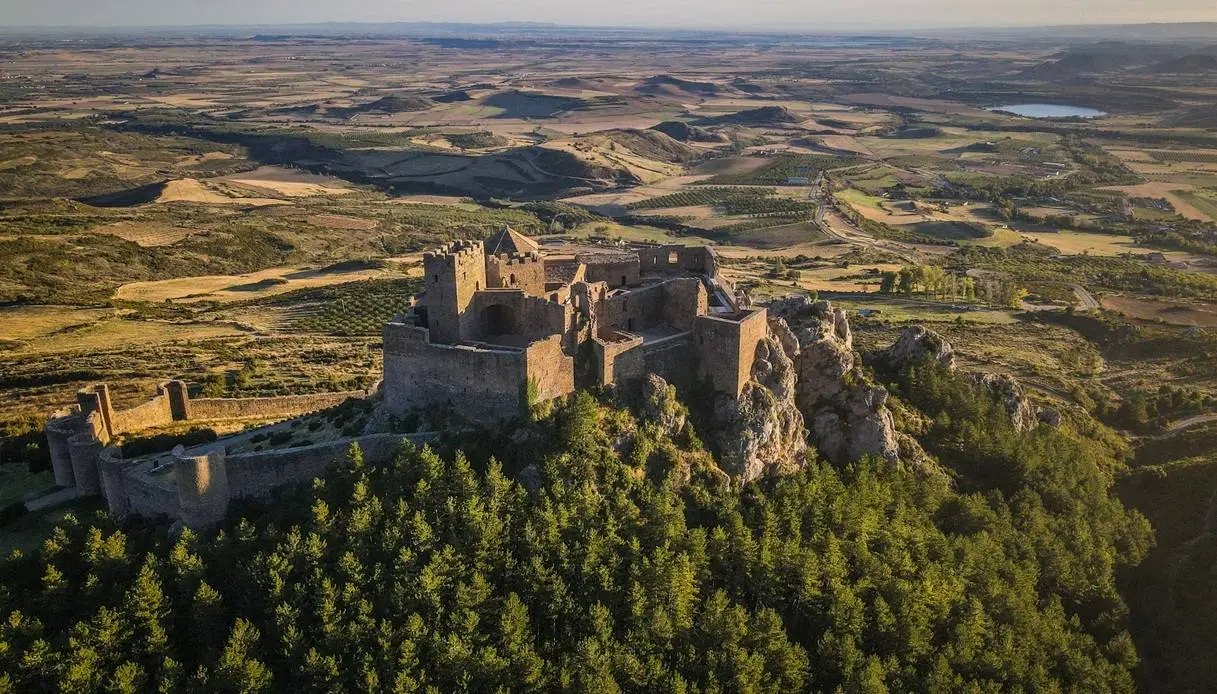
An imposing fortress wall and no fewer than eleven towers built on a rocky spur at an elevation of 1,071 meters form Loarre Castle, in Spain.
A Romanesque jewel whose soul has evolved over the centuries without ever losing its charm: it was first a royal palace and then a monastery; now it stands as a historical testament to civil and military architecture of a distant past, used several times also as a dramatic film set. Even Ridley Scott was captivated by it, choosing it as the location to shoot the famous film Kingdom of Heaven.
The history of the oldest castle in Spain
Commissioned by the great monarch Sancho III el Mayor of Pamplona in the 11th century, the Castle of Loarre was built to defend the border line of the Crown of Aragon and was a key element in the Christian Reconquest of these lands. Expanded in the same century by his nephew, Sancho Ramírez, king of Aragon, its position dominates the entire plain of the Hoya de Huesca and, in particular, Bolea, which was the main Muslim stronghold that controlled the rich agricultural lands of the plain.
In the following centuries, the fortress progressively lost its defensive function. With the Reconquista advancing south, the border moved away and the castle became increasingly less strategic from a military standpoint. From the end of the 11th century it housed a community of regular Augustinian canons and transformed into an important religious center, without renouncing its role as a symbol of the power of the Crown of Aragon.
Today it is considered one of the best-preserved Romanesque castles in Europe and represents one of the most extraordinary examples of medieval military architecture on the Iberian Peninsula. Not surprisingly, it has been declared a Bene di Interés Cultural asset and is a candidate to enter the UNESCO World Heritage List.
What to See at Loarre Castle
Visiting Loarre Castle means diving straight into the Middle Ages: among its perfectly preserved walls, it’s easy to imagine the life of soldiers, monks and rulers of the era. Just as happens in the Ridley Scott film shot at this fortress: The Crusades – Kingdom of Heaven. At the foot of the castle the crew even built a scenic farm, covering the landscape with tonnes of artificial snow to recreate the atmosphere of European winter, after the expected snowfall did not arrive. A choice driven mainly by the spectacle of the place: the costume designer Janty Yates, an Academy Award winner for Gladiator, recalled Loarre as “one of the most beautiful places” she has ever worked, explaining that Scott was struck by the boundless panoramas, the castle perched on the edge of the mountains and the sunsets, deeming it the perfect setting to evoke 12th-century France.
You can witness the eclipse of the century from the castle
On 12 August 2026 Loarre Castle will be one of the most spectacular places in Spain from which to observe the total solar eclipse (which will be visible, albeit partially, also from Italy). Thanks to its position at an altitude of 1,071 meters, with a wide horizon over the Hoya de Huesca, it will offer a privileged view of the year’s most anticipated celestial event.
For the occasion the fortress will exceptionally extend its opening hours until 21:00 and will organize a special experience that will begin at 18:30 with a guided tour dedicated to the relationship between the Middle Ages and celestial phenomena. The climax will be the observation of the eclipse, which will begin at 19:28 and reach its maximum at 20:15, ending at 20:58.
The ticket includes the guided tour, the certified glasses to observe the eclipse, a non-alcoholic beverage and a tasting of Aragonese tapas. The cost is 16.80 euros (15.50 reduced and 14.50 euros for children).
Where it is located and how to reach it
The Castle of Loarre is located in the eponymous village in the province of Huesca, in the autonomous community of Aragon, in northern Spain.
Getting there is straightforward. By car it is about 35 kilometers from Huesca, a little more than half an hour, while from Zaragoza it takes about an hour and a half. Those arriving by plane can fly to the Zaragoza or Pamplona airports, then continue by car.