
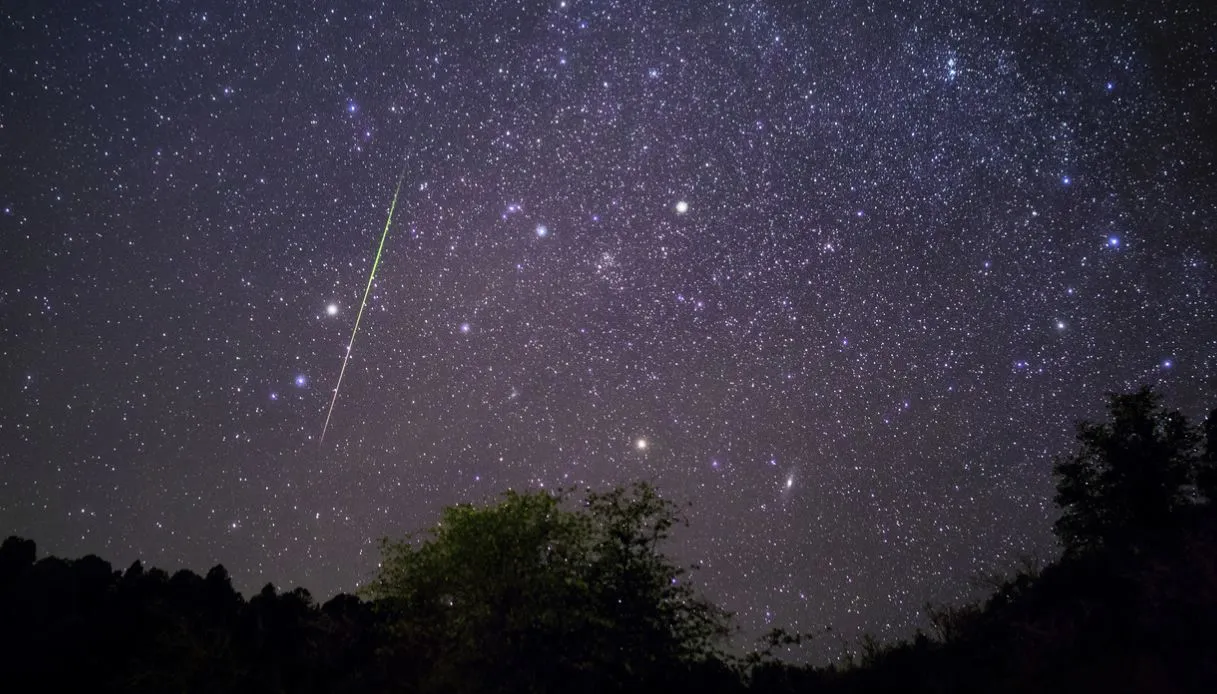
The night between October 17 and 18 is about to gift us a show: the Leonids are returning, and with their peak in the autumn sky, they will allow observers to witness around several dozen shooting stars per hour. All you need is to move away from the brightest urban centers and enjoy the wonder from every corner of Italy.
Leonids 2026, the November shooting stars
The Leonids are lighting up the November sky again, one of autumn’s most anticipated meteor showers. The night to mark is the one between Tuesday, November 17, and Wednesday, November 18, with the peak activity expected around 12:45 a.m. local time. Those lucky enough to stand under a clear sky, far from city lights, could witness some of the fastest meteors of the year. The Leonids enter the Earth’s atmosphere at about 71 kilometers per second. A very rapid passage that leaves behind luminous trails sometimes particularly intense, with blue and greenish reflections.
Originating from debris shed in space by comet 55P/Tempel-Tuttle, the shower’s remnants are what intersect with our planet each year, gifting enthusiasts one of the season’s most well-known astronomical events. The phenomenon will not end tonight. The Leonids will remain visible until November 30, though the coming hours represent the period of greatest activity.
Where to see the Leonids in Italy
The Leonids will be visible from Italy as well, weather permitting. The meteor shower can be observed from both hemispheres, though the best conditions are expected in the northern one. To see the luminous trails, however, you’ll need clear skies and, above all, little artificial light. The meteors will appear to originate from the Leo constellation, but they may traverse various parts of the sky.
So it’s better to leave the cities and seek a dark place, far from street lamps and inhabited areas. Countryside, mountainous areas, and even some sparsely lit coastal stretches are suitable. Italy offers many suitable spots, such as the Asiago Plateau in Veneto, or in Sardinia—the Gennargentu region. The Dolomites area and the Langhe hills are also recommended.
How to observe them
To observe the Leonids, simply raise your eyes to the sky. No telescopes or binoculars, which can actually limit your view. Meteors can appear anywhere in the celestial sphere, even quite far from the Leonid constellation, from which they seem to originate.
It’s best to choose a dark place, away from artificial lights, and get comfortable. A reclining chair, a few warm layers, and a little patience. The eyes take about twenty to thirty minutes to adjust to the darkness. Then all that remains is to watch the sky, not focusing on a single point. The most spectacular trails might appear right where you least expect them.
One factor to consider will be the presence of the crescent Moon, whose brightness could make the fainter meteors harder to see. If inclement weather were to compromise the peak night, there will be other chances through the end of November. The Leonids will continue to cross the sky, reminding us that even a few bright moments can transform an autumn night into an unforgettable experience.