
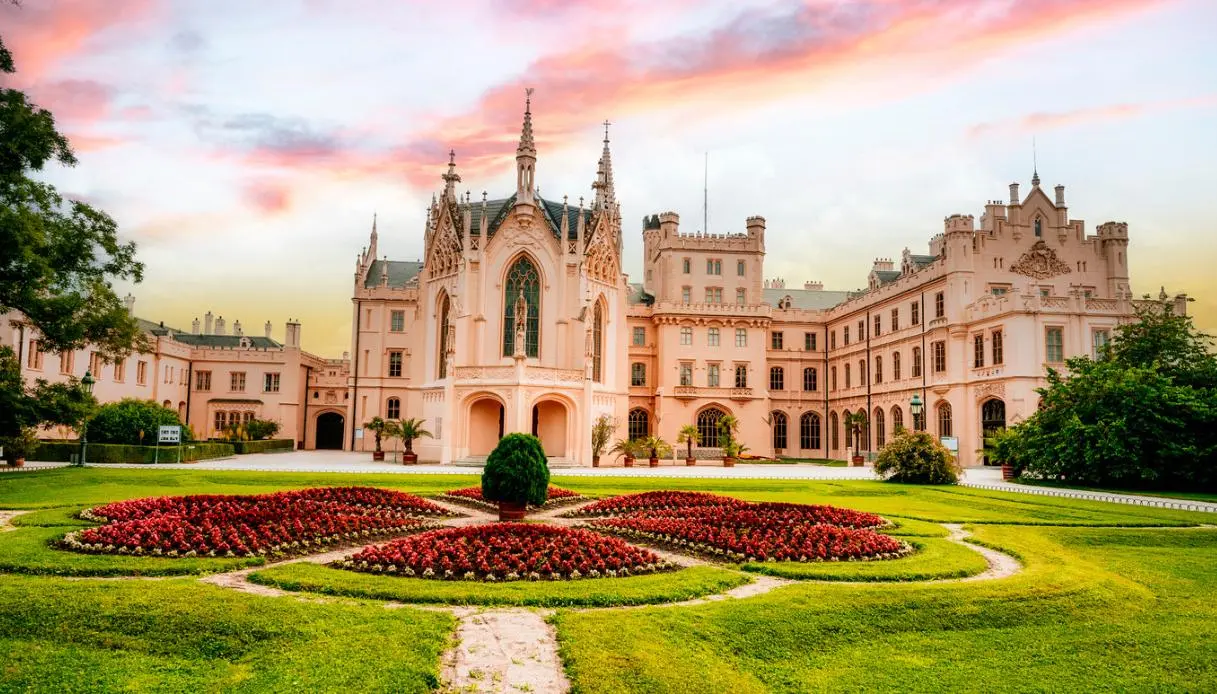
Whoever sees it for the first time might think: is it real? Yes, because the Lednice Castle presents itself to visitors as a teeming mass of crenellated towers, needle-thin spires, windows embroidered in stone, and ivory-colored facades that seem to belong more to a tale than to a place in the Czech Republic. This construction, in fact, has something deeply fairy-tale-like, so that looking at it from the wide green expanse in front of it it’s hard to believe it was actually inhabited.
Yet, for centuries, these halls have welcomed princes, nobles and illustrious European guests, among sumptuous receptions and days spent in the tranquility of the Moravian countryside. Located in the southeastern part of the country, it is undoubtedly one of the most refined examples of English Gothic Revival architecture in Central Europe. Its beauty, however, goes beyond the walls of the residence: around it unfolds a gigantic landscaped park, with monumental trees, reflective pools, small bridges and constructions decidedly unexpected.
Since 1996, the complex has belonged to the UNESCO World Heritage together with the nearby Valtice Castle and the cultural landscape shaped for centuries by the princes of Liechtenstein.
A Brief History of Lednice Castle
The year to reference is 1222, although Lednice at that time looked decidedly different: there were defensive structures and a castle surrounded by water, intended to protect a strategic region between the and Austria. In 1249 the fortress was granted by King Wenceslaus I to the Austrian noble Sigfried Sirotek, while toward the end of the 13th century the possession entered permanently into the orbit of the Liechtenstein, a powerful Tyrolean-born family that would bind its fate to these lands for almost 700 years.
Over the centuries, the family’s patrimony grew enormously. Notable was the rise of Karel of Liechtenstein, a supporter of the Habsburgs during the Bohemian nobility’s revolt. After the White Mountain battle of 1620, the family acquired further properties and attained an extraordinary prestige in Moravia.
Such financial fortune made it possible to gradually transform the ancient fortress into an increasingly luxurious residence, to the point that in the 16th century a Renaissance palace appeared, followed by a Baroque reconstruction at the end of the 17th century. To this phase belong interventions by architect Johann Bernhard Fischer von Erlach, designer of the monumental stables that are still preserved today.
The decisive turning point came between 1846 and 1858, when Prince Alois II of Liechtenstein decided to transform Lednice into a spectacular summer residence. The prestigious project was entrusted to architect Georg Wingelmüller, who chose a style inspired by English Tudor Gothic.
What emerged was a building rich in details, with pinnacles, tracery, ogival windows and decorative towers. Behind that medieval-looking façade lay interiors designed to meet the needs of princely life in the 19th century. Since 1945, however, the castle has belonged to the State, while management is entrusted to the National Heritage Institute of the Czech Republic.
Visiting Lednice Castle: what to see among princely halls and gardens
Entering is almost unnecessary, because even from the outside the abundance of decorations gives a hint of the magnificence of the interiors. The entrance leads into a world of carved woods, elaborately worked ceilings, precious furnishings and details crafted by artisans of the highest level. The visit is organized through several guided routes, dedicated to different areas of the residence.
That of the reception rooms allows visitors to explore spaces devoted to the public life of the princes, while the private apartments circuit unveils a more intimate side of the family. Among the most fascinating areas are the drawing rooms used for receptions, official meetings and banquets. The succession of rooms reveals a particularly elaborate taste, with wooden paneling, carved ceilings and furniture from the Liechtenstein era.
Special attention deserves the library, home to one of the building’s most famous details: a floor-to-ceiling oak staircase, completed in 1851 in the workshop of Carl Leistler. According to a tradition, it would have been carved from the trunk of a single tree. Looking closely, one notices that among the carved vegetal decorations are hidden also three small animals, a frog, a bird and a lizard.
Going up to the upper floor you reach the private apartments, furnished to recreate the atmosphere of daily life in the princely family. Bedrooms, personal spaces and original furniture tell of habits decidedly more intimate than the sumptuous drawing rooms on the ground floor.
An additional itinerary leads to the children’s rooms, located on the second floor, and to the Marionette Museum linked to Milan Knížák’s collection. Not to be missed is the visit to the Grotto, a peculiar artificial Baroque cavity laid out in the cellars, with decorations inspired by stalactite formations.
Leaving the residence, you are welcomed by almost 200 hectares of greenery scattered with open meadows, scenographic avenues, canals and studied perspectives. One of the most fascinating constructions is the Palm House, built between 1843 and 1845 to a Wingelmüller design.
Iron and glass enclose an environment dedicated to exotic vegetation, in a surprising contrast with Central European climate. Not far away, the Minaret introduces a reference to Oriental architecture. Designed by Josef Hardtmuth between the late 18th and early 19th century, it reaches almost 60 meters in height. From the panoramic tower, the view extends to take in the park’s layout and the surrounding plain.
Among other curiosities are an artificial Roman aqueduct, the Venetian Fountain, the Chinese Pavilion and evocative ruins built intentionally to recall distant eras. Particularly spectacular is also Janův hrad, known as Giovanni’s Castle, a faux medieval ruin used by the princes as a hunting lodge and a gathering place for banquets after the hunts.
Where it is and how to get there
The Lednice Castle rises in the municipality of Lednice in southern Moravia, near the town of Břeclav and a few kilometers from Austria. Those who want to undertake a car trip starting from Vienna (about 80 km away) should budget just over 1 hour, depending on the chosen route and traffic conditions. From Prague, instead, it is almost 270 km and a drive of about 3 hours.
Those who prefer public transport can reach Břeclav by train and continue toward Lednice by local bus. During certain periods of the year there is also the historic line between Břeclav and Lednice, inaugurated in 1901. To fully appreciate both the interiors and the park, it is advisable to dedicate at least half a day to the visit, and better if the day becomes a full day.