
Rome seems a city with fewer secrets than ever, not even for those who have only visited it or seen it on screens. The Colosseum, the Pantheon, the Imperial Forums, the Trevi Fountain are all monuments that every year draw millions of visitors to the Capital and have made it one of Italy’s most beloved tourist destinations. Yet, just a few kilometers away from the most trodden routes, one discovers that Lazio’s historic heritage still has many stories to tell.
Two extraordinary openings, organized by the Regional Directorate of National Museums of Lazio of the Ministry of Culture, confirm this, allowing to rediscover just as little-known places to the general public: Cicero’s Tomb in Formia and the Royal Ferdinando Bridge in Minturno. Two monuments very different from each other, a few kilometers apart but belonging to completely different eras, which return to be accessible with a special calendar between September and November 2026.
What are the two new monuments to visit
The first stop is Formia, along the ancient Via Appia, where stands a towering mausoleum from the late republican period traditionally identified with Cicero’s Tomb. Cicero indeed owned a villa in the Formia area and precisely here, in 43 BCE, he was killed by the assassins of Mark Antony. The mausoleum, however, is attributed to Cicero by tradition and by historical studies, and there is no absolute certainty about the monument’s identification with his tomb. Today the structure is set in a green context and the monument is surrounded by a garden with conifers, olive trees, laurels, and citrus trees, laid out in the 1950s within the original sacred enclosure.
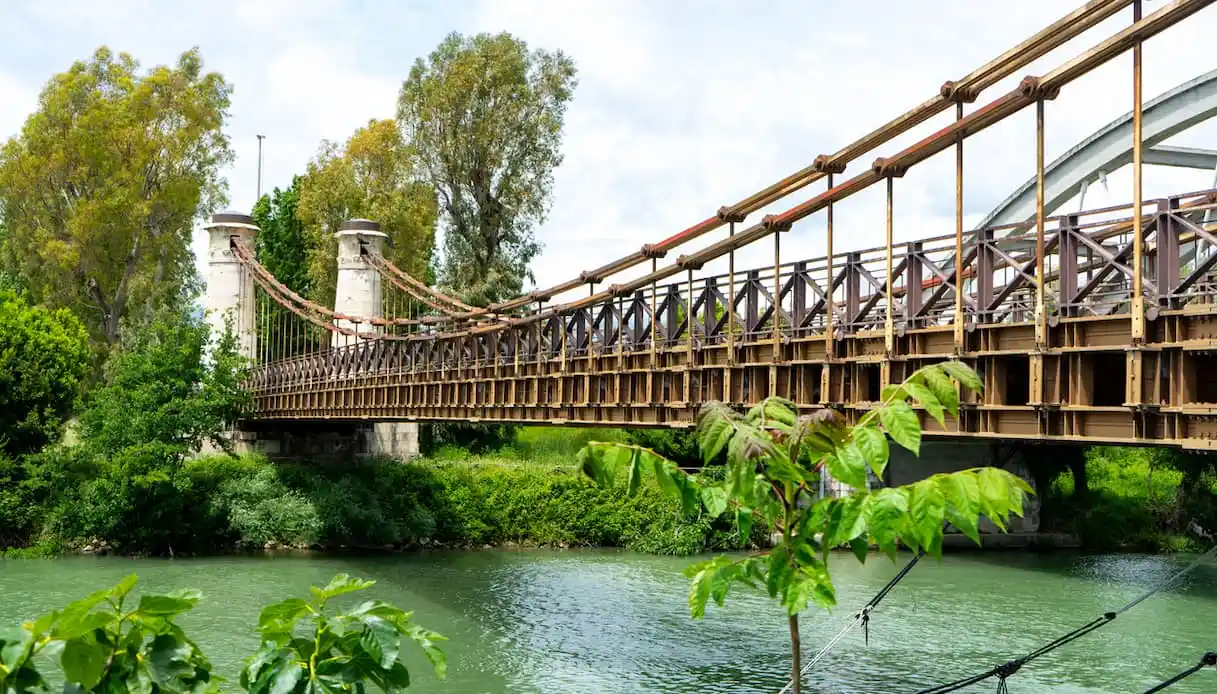
To admire the second monument one must instead move towards Minturno, where the landscape changes and Roman history gives way to that of the Bourbon-era of the nineteenth century. Within the territory of the Minturnae Archaeological Park, on the banks of the Garigliano River, lies the Ponte Real Ferdinando, inaugurated in 1832 by Ferdinand II and designed by engineer Luigi Giura.
The peculiarity of it is far from marginal, despite its notoriety: it is in fact the first iron-chain suspended bridge in continental Europe, an extraordinary testament to the evolution of engineering of the era. The monument is also tied to some important moments in Italian history: it was involved in the clashes of 1860 between the Kingdom of Sardinia and the Kingdom of the Two Sicilies and it was subsequently destroyed in 1943 during World War II.
Visiting information
The Cicero’s Tomb will be accessible on five extraordinary openings between September and November. The first two are planned for Sunday, September 6 and Sunday, September 13, from 14:30 to 18:30. The schedule continues on September 27, from 9:30 to 13:30, October 18, from 14:30 to 18:30, and finally November 1, from 9:30 to 13:30. On all these occasions access to Cicero’s Tomb will be free and the visit will be self-guided. For groups of more than 20 people, booking is recommended.
Also the Ponte Real Ferdinando will be covered by a schedule of extraordinary openings. The monument can be visited on the 6th, 13th and 27th of September, the 4th and 18th of October, and the 1st of November, always from 9:30 to 13:30. In this case attention to access modalities is important. On September 6, October 4 and November 1, the first Sundays of the month, admission will be free thanks to the initiative Domenica al Museo. On the other days, however, a visit to the bridge will be included in the Minturnae Archaeological Park ticket, with a price of 5 euros for the full ticket and 2 euros for the reduced ticket aimed at young people aged 18 to 25.