
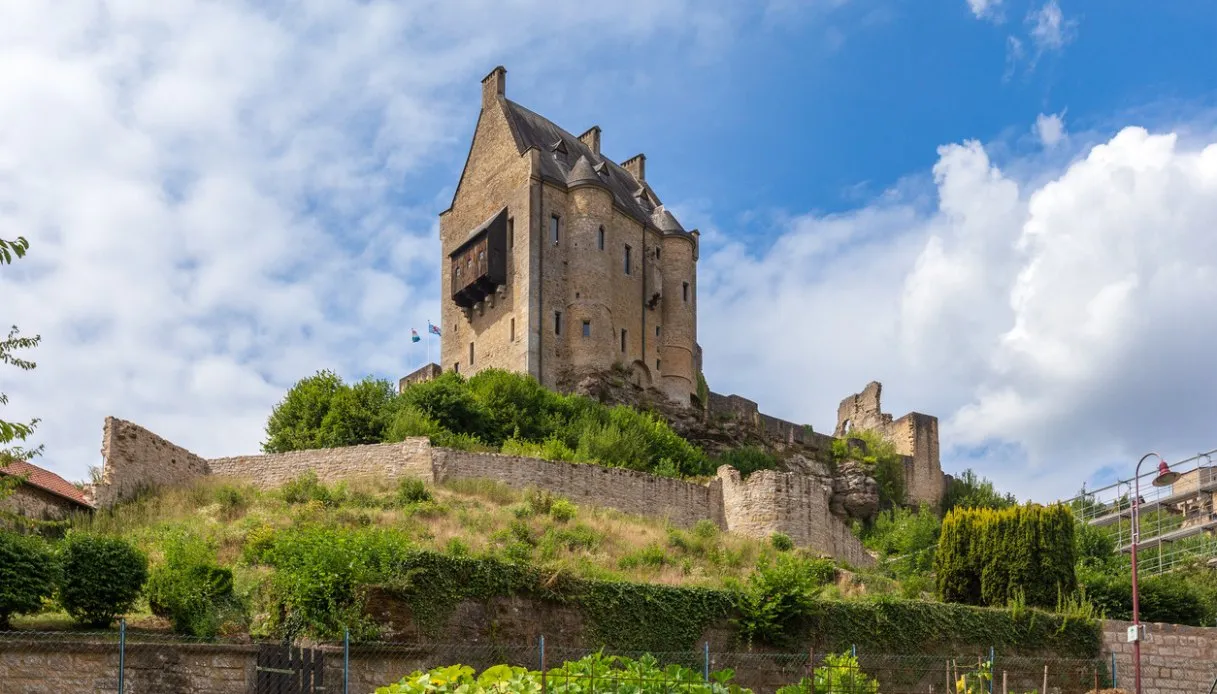
A sandstone wall rises above Larochette, a Luxembourgish village, and at its summit there emerge walls, broken windows, towers, and large blocks of stone. That is the Larochette Castle, also known as Burg Fels in German and Buerg Fiels in Luxembourgish, and at first glance it may appear to be a medieval fortress reduced to a skeleton. As you approach, however, its history takes on a much more complex shape.
The fortress sits on a spur of the Grès de Luxembourg, the sandstone typical of this part of the Grand Duchy, and overlooks the Ernz Blanche valley. If at first it presents itself as a ruin, in the calm details emerge: a deep moat divides the complex into two parts, the defensive wall traces the edge of the cliff, and in the most advanced part of the spur lie the remains of five noble houses.
In addition to being a fortress designed for defense, Larochette also became an aristocratic residence divided among several lords, with separate buildings and ceremonial architecture. The result is a castle intimately linked to the landscape, built into the rock rather than simply resting upon it.
Brief history and legends of Larochette Castle
The origins of the fortress predate the construction of the great aristocratic residences. Municipal sources place the earliest structures at the site in the 11th century, while historical records indicate traces of occupation even earlier and a first stone fortress developed in the 12th century.
By the end of the 12th century, the lords of Larochette appear, belonging to the Fels family and tied to the House of Luxembourg. In 1176 there is a record of Arnoldus de Rupe, the first known lord associated with the site. The name directly recalls the rock, a factor so important that it entered the name of both the family and the castle.
In the following centuries the family gained a prominent position in regional nobility. The fortress’s history, however, took a particular direction through marriages, successions, and divisions of patrimony. By the late 14th century, five different noble families coexisted within the walls. The House of Homburg arose around 1350 thanks to the marriage of brothers Frederick and Conrad of Homburg with the sisters Irmgard and Matilde of Larochette. About thirty years later, around 1385, the House of Créhange was also built.
The new residences gradually modified the fortress’s character, adding spaces intended for aristocratic life alongside the defensive structures.
The castle gradually lost its military function and was progressively abandoned. Then came the decisive moment: in 1565 a great fire devastated everything, leaving it in ruins. The ruins are also linked to some legends. The most evocative concerns the well of the House of Créhange.
According to the locally handed-down tale, during an attack the lady of the castle would have leapt into the well together with her son. After the rescue, the Castellan would have been accused of treason and cast into the same place. Tradition says that his spirit returns every Good Friday in the form of a dragon.
Another story concerns the tower named Verlorenkost, literally “lost food.” According to the legend, a cook stumbled while carrying pots full of food, causing everything to spill. The tower’s name would have remained linked to that episode.
The visit among moats, noble dwellings, and burned walls
You reach the castle by crossing a wide external courtyard defended by an earthen rampart. A rather deep moat, partly dug into the rock itself, separates the complex into two distinct sectors.
It is the moat itself that is one of the most evident elements: its depth and its position along the spur help reveal the relationship between artificial defense and natural formation. Part of the moat indeed exploits the same morphology of the rock, turning the ground into a barrier.
Continuing toward the tip of the spur, the most distinctive part of the entire complex appears: the ruins of the five noble dwellings that tell of a fortress transformed into an aristocratic residence. The buildings bore more ceremonial characteristics than purely military structures and bear witness to the prestige attained by the owners.
The House of Homburg, built around 1350, preserves traces of this transformation. The House of Créhange, dating to about 1385, is rather the best-restored building. The restoration was carried out between 1983 and 1987, while the House of Homburg was consolidated and restored between 1987 and 1988.
The restoration of the House of Créhange allows a clearer reading of the architectural quality achieved by the complex. The openings, the masonry, and the surviving interiors return the image of a residence intended for a nobility concerned as much with protection as with display.
A particular detail makes the castle’s bond with the territory even clearer: the construction uses Luxembourg sandstone, a stone whose tones range from white to beige, very common in the Grand Duchy’s monumental architecture. In the castle, some parts of the original stone, including structures around chimneys and openings, still preserve the material’s natural color.
The visit thus gains value also through its details. A portion of wall tells of defense, a large opening reveals the presence of a residence, the moat recalls the need to protect the complex, and the noble dwellings show the wealth attained by the owners.
The ruins also host temporary exhibitions and occasional concerts, keeping alive a place that for centuries served a completely different function.
Where it is and how to get there
The Larochette Castle is located in the Grand Duchy of Luxembourg, in the center of the country, on the sandstone escarpment that overlooks the Ernz Blanche valley. The site belongs to the natural region of the Mëllerdall, also known as Luxembourg’s Little Switzerland, characterized by forests, rolling hills, and rocky outcrops.
The address is Montée du Château, L-7622 Larochette. A parking lot is located directly at the entrance of the site. For those using public transport, the nearest stop is Larochette, Spuerkeess, about 300 meters from the access point.
As you ascend toward the fortress, the strongest sensation comes precisely from the relationship between rock and architecture: the walls seem to continue naturally along the spur, while the void of the moat separates the parts of the complex. Then the grand dwellings appear, unexpected in a structure that from the outside looks only like a military ruin.