
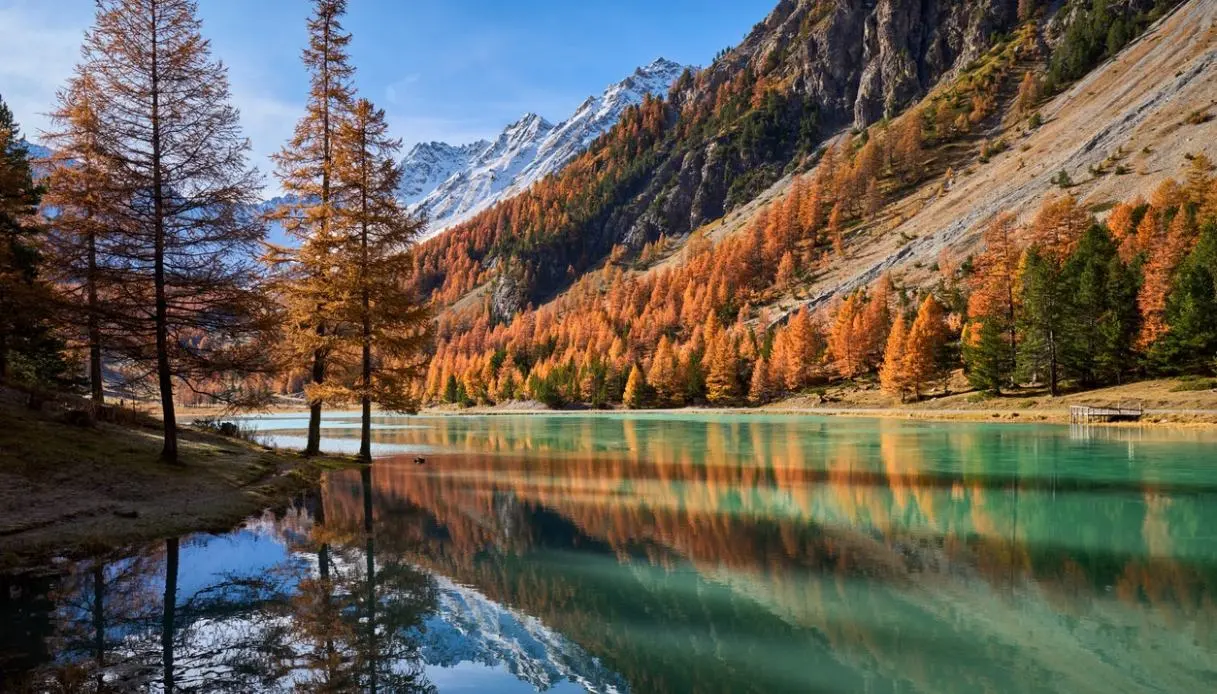
In autumn, on the French Alps, something extraordinary occurs: forests change color, days grow shorter, and the mountains acquire warm hues. And it is precisely around Lake Orceyrette, at an elevation of about 1,927 meters, that this spectacle takes on particularly evocative proportions. In these parts, the larches turn a deep yellow, the silver firs maintain their dark green, and the water mirrors a scene that seems to belong to a Canadian landscape.
Indeed, the comparison with North American great lakes recurs often in descriptions of this little-known corner of France.
We are in the Hautes-Alpes department, in the Provence-Alpes-Côte d’Azur region, a short distance from the fortified town of Briançon and the Italian border. What makes it special is also the contrast between its modest size and the grandeur of the surroundings to which it belongs.
In the autumn period the landscape even changes during the course of the day. In the morning, with still air, the golden canopies are reflected clearly on the surface. In the afternoon, however, the more oblique light heightens the contrasts between gray rocks, yellowed meadows, and conifers. A small mountain universe that has also captured the world of television, so much so that it was chosen as one of the locations for the French police series Alex Hugo, set in the Alps.
Origin and Formation of Lake Orceyrette
Behind the apparently wild aspect of Lake Orceyrette lies a surprising geological story, complemented by a relatively recent human intervention. Originally, this basin was a glacial residual lake, the result of transformations that affected the Alpine valleys during glaciations. The gradual retreat of the glaciers had left a natural depression meant to collect water from the slopes.
Over the centuries, the basin underwent profound transformations, until it disappeared. In 1950, a dam was built to allow water to accumulate again, restoring to the landscape the reflective lake whose image is observed today. Its history, however, begins long before the arrival of glaciers: the rocks on the surrounding mountains, including those of the Rocher Roux, harbor traces of the ancient Ligurian-Piedmontese ocean, which more than 150 million years ago separated portions of continental crust destined to participate in the formation of the Alpine chain.
Even the name tells something about the land: Orceyrette derives from the torrent and the old Orcière chalets, structures tied to agricultural-pastoral activities carried out for generations in the region’s high pastures.
Visiting Lake Orceyrette
To reach Lake Orceyrette on foot is an experience within reach for hikers of varying training levels, though one can opt for the shorter route starting from . The official trail measures 4.2 km in total, with about 100 meters of positive elevation gain and typically takes around 1 hour and 45 minutes (excluding breaks).
From the gravel car park, you cross the Orceyrette torrent near a sign marking entry into the reserve. The route runs along the forest edge, gradually climbing the river for roughly 2 km. In autumn, this stretch already offers a large part of the spectacle, with the needles of larches carpeting the ground, the sound of the stream accompanying the trek, and the mountains peeking through the trees.
The true star of the season, however, is the Bois des Ayes, an extraordinarily valuable forest environment, considered among the finest pine membro forests in the French Alps. Some specimens reach an age of 400 to 600 years, having withstood centuries of harsh winters, heavy snowfall, and climate changes, developing sturdy trunks and shapes carved by high-altitude conditions.
The Pinus cembra, also called the arolla, grows alongside larches in the lower belts of the forest. Beyond 2,100 meters it becomes dominant, forming nearly pure stands. The coexistence of these two conifers makes autumn particularly interesting.
Upon reaching the outflow, the lake appears almost suddenly. On the shore there are picnic tables and a fishing jetty accessible to people with reduced mobility. To fish, you must have the necessary permissions and comply with the current regulations. Continuing on the left, you can complete a circuit around the water, crossing different environments. Toward the upper end, the path skirts a wetland and reaches a forest road, from which you circle back toward the dam, then retrace the initial stretch to Plan Peyron.
Those wishing to extend the hike can also consider the upper alps pastures, with the Orceyrette and Alp chalets, testimonies of traditional Alpine rural architecture, characterized by buildings adapted to the seasonal mountain life.
The visit is free, but requires compliance with environmental rules. Dogs are allowed on leashes on permitted trails, while it is necessary to stay on marked paths and maintain distance from wildlife. Fires, camping and swimming are prohibited.
The official opening period of the itinerary runs from May 15 to November 15, weather permitting. To enjoy the foliage, the most interesting moment generally coincides with October, though the intensity of the color can vary with the season.
Where It Is Located and How to Get There
The Lake Orceyrette lies in the Ayes valley, in the Briançonnais, on the southwestern French Alps. The reference town is Briançon, famed for Vauban’s fortifications, recognized by UNESCO. From Italy you can reach Briançon via the Monginevro Pass, starting from Cesana Torinese, or via the Col della Scala, coming from Bardonecchia, when the pass is open to traffic.
Once in Briançon, continue toward Villar-Saint-Pancrace and follow signs for the Centre Montagne and Les Ayes. The road climbs through forests and small hamlets of chalets up to the Plan Peyron area, the starting point for the short hike. In July and August there are traffic restrictions, including time restrictions between the village of Ayes and the lake. The Municipality invites visitors to favor pedestrian or bicycle access, including via paths that depart from the Centre Montagne.
In autumn, however, it is essential to check the forest road conditions before departure, especially after early snowfalls, frosts or heavy precipitation. It is also advisable to start in the morning, wear shoes with good grip, warm clothing, and an outer layer to stay dry.