
The city of Dresden, in Germany, continues to impress countless visitors with its Baroque heritage, the monumental Frauenkirche, and the elegant palaces facing the Elbe. And no, you cannot fault these people, even though the reality is that there is another marvel that reveals a completely different side of the town: crossing the river you reach the Neustadt district, a corner where everything truly changes.
Grandiose architectures give way to nineteenth-century buildings, alternative venues, independent shops, and a creativity that seems to have conquered even the walls of homes. Right among these streets lies the Kunsthofpassage, one of the most original places in the Capital of Saxony.
Behind seemingly ordinary façades opens up a small universe made up of 5 interconnected courtyards, transformed through artistic and architectural interventions. There are vibrant colors, giant animals climbing the buildings, and fantastic creatures that populate mosaics and decorations. And then there are the gutters, which unexpectedly stage a very particular spectacle on rainy days.
A Brief History of the Kunsthofpassage in Dresden
Neustadt is the neighborhood located on the northern bank of the Elbe that runs through this German city, which during World War II, despite the devastating bombardments, preserved a substantial portion of its architecture. However, in the following decades many buildings underwent progressive deterioration, but only after the German reunification of 1990 did a new phase begin.
Artists, creatives, small entrepreneurs and residents were among the first to roll up their sleeves to transform the district, which became a reference point for Dresden’s alternative culture. Old residential buildings, neglected courtyards and unused spaces gradually gained new functions.
In this context, the Kunsthofpassage project emerged, developed in the second half of the 1990s and inaugurated in 2001. The initiative aimed to rehabilitate a series of inner courtyards through the contribution of artists and designers, while simultaneously enhancing the commercial and artisanal activities present in the buildings.
And the result is incredible: a collection of interconnected spaces, each characterized by a precise visual identity. The works are part of the façades, accompany the entrances to homes and coexist with shops, workshops and cafés.
Visiting the Kunsthofpassage: what to see in the five artistic courtyards
The Kunsthofpassage is a true pedestrian passage that traverses a sequence of courtyards, linking two streets in Neustadt. Yet what takes your breath away is that, in just a few meters, colors, shapes and even the atmosphere change.
The Court of Elements and the Façade That Plays When It Rains
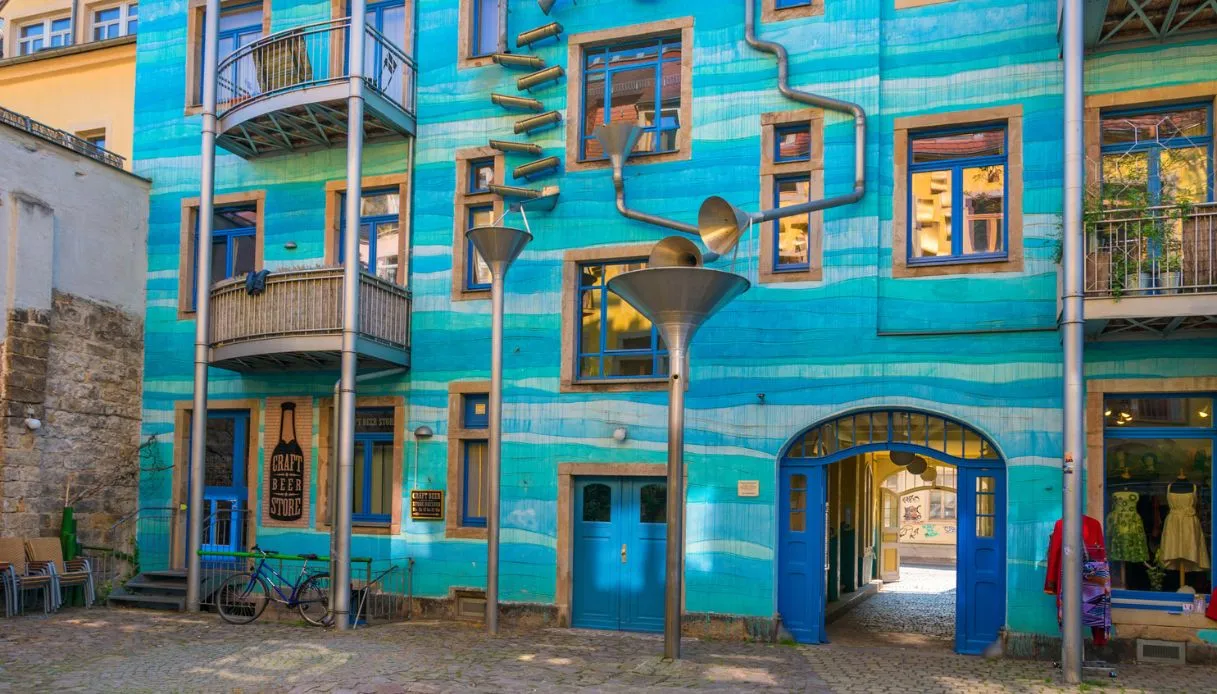
Yes, you read that right: this façade plays when it rains, to the extent that it has become one of the most photographed courtyards in the Kunsthofpassage. Turquoise and crisscrossed by a curious tangle of metal tubes, it is also studded with gutters, funnels and conduits that follow sinuous paths, forming a structure reminiscent of a gigantic musical instrument.
On gloomy days, water travels through the piping until it reaches a collection basin. The flow of the liquid produces noises and resonances that vary, transforming the façade into a kind of sonic theatre. Opposite the blue wall a second façade emerges, dominated by yellow.
Here there are fine strands of golden aluminum arranged in different orientations that reflect the sunlight. The result is the creation of variable effects throughout the day.
The Court of Light, Between Reflections and Installations
In the Court of Light architecture, reflections, metallic surfaces and scenographic possibilities truly seem to interact. By day, the sun’s position changes the reflections and the appearance of the walls. Natural light becomes part of the installation, while the installations help make the space suitable for cultural initiatives and performances.
The Court of Animals, a Giant Giraffe Among the Windows
The curious Court of Animals presents a green façade covered with figures that seem to belong to a fantastical jungle. A gigantic giraffe occupies a large portion of the building’s height, while some monkeys appear to leap between the windows. There are also depictions of cranes and other decorative details.
The contrast between the animals and the residential elements yields a striking effect: the windows become part of the scene, while the giraffe seems to have claimed the entire wall. Notable are also the decorated balconies with wicker-like intertwined elements.
The Court of Mythical Creatures and the Cosmic Mosaics
In the Court of Mythical Creatures, artist Viola Schöpe has transformed the façades into a visual narrative populated by fantastical beings, natural elements and references to the universe. The work was realized using different techniques. One of them is sgraffito, a process that allows figures to be created by incising through layers of colored plaster.
The southern wall depicts the so-called River of Life, a symbolic composition tied to positive energy and the unity of living beings. The northern wall, instead, develops a cosmic imaginary, with celestial bodies and references to higher spiritual dimensions.
The Court of Metamorphoses, Art That Changes Over Time
The final space offers a meditation on the passage of time and the transformation of materials. The project involves artist Arend Zwicker and the metalworking workshop of Karlheinz Löffler and features a façade where two tall steel Corten monoliths rise and touch the wall only at certain points.
Corten is a special steel, recognizable by the brown-rust patina that forms through exposure to the elements. Inside the structures are bundles of optical fibers that create light effects during the evening hours.
Other elements of the courtyard include supports for climbing plants and 24 samples of paper treated with linseed oil. All of these materials gradually change their appearance over time.
Where it is located and how to arrive
The Kunsthofpassage is located in Äußere Neustadt, the outer part of Dresden’s Neustadt district, on the northern bank of the Elbe. The complex links Alaunstraße 70 and Görlitzer Straße 23-25, through a sequence of inner passages accessible directly from the streets.
Starting from the historic center, the district can be reached by crossing the Elbe via one of several city bridges, including the Augustusbrücke, before continuing toward the Neustadt area. Those who prefer public transport can use Dresden’s tram network and reach stops near Görlitzer Straße and Alaunstraße, checking the available connections in advance.
