
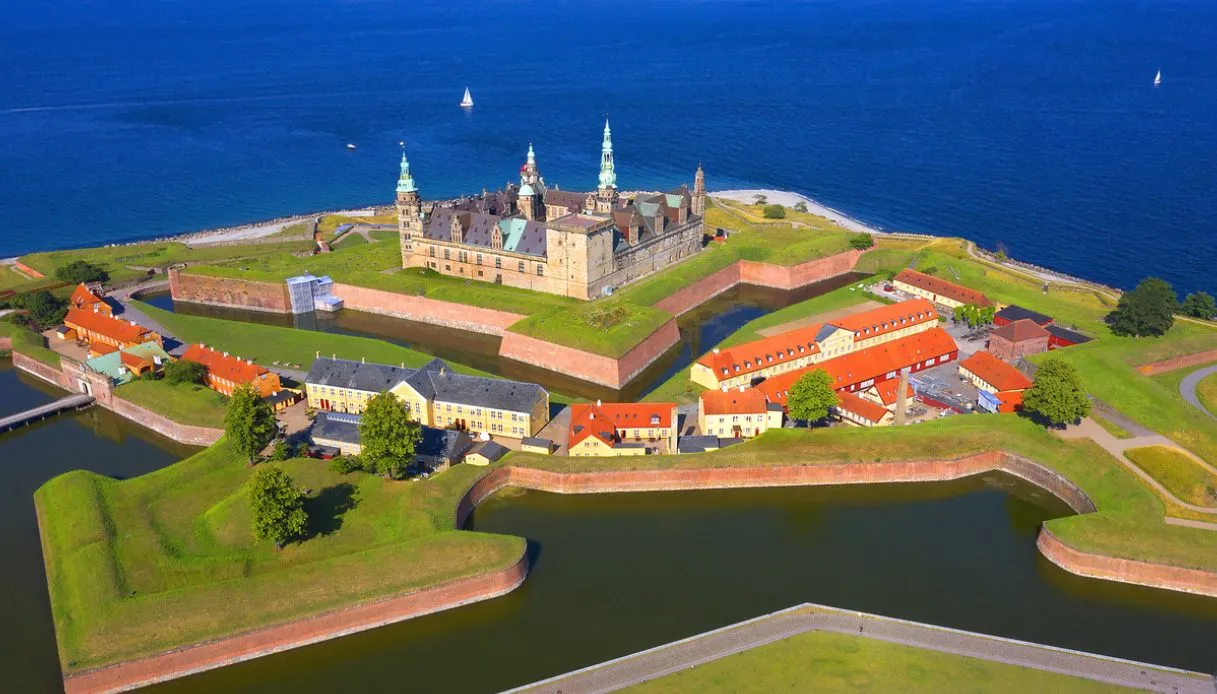
On the northern shores of Denmark, the waters of the Øresund Strait separate two nations that for centuries vied for control of maritime trade. And right at the narrowest point, a fortress rises into the skies, belonging simultaneously to both history and literature. It is the Kronborg Castle, an imposing Renaissance building facing the sea, famed worldwide for having inspired the setting of William Shakespeare’s Hamlet.
With towers crowned by green roofs, light-colored stone facades, and mighty fortifications, its past is marked by ambitious rulers, wars, lavish receptions, and merchant ships. Indeed, its geographic position made it one of the main symbols of the power of the Danish monarchy.
Kronborg dominates the port city of Helsingør, known in English as Elsinore, and since 2000 has been included on the UNESCO World Heritage List.
A Brief History of Kronborg Castle and Its Legends
In the early fifteenth century, King Eric of Pomerania ordered the construction of a fortress named Krogen right on that stretch of coast from which it was possible to monitor the passage of vessels bound for the Baltic Sea (and, at the same time, to collect a toll on the commercial traffic).
The collection of the so-called Sound Toll, the toll for the strait, guaranteed the Crown significant revenues intended to fund royal projects and to bolster the realm’s prestige. A decisive transformation arrived in 1574 when Frederick II began the reconstruction of the old fortress to turn it into a residence worthy of the monarchy. The project gave rise to one of the most important examples of Renaissance architecture in Northern Europe.
In addition to the use of an expensive sandstone extracted from Scania and Gotland, copper roofs, gilded spires, and refined decorations were added with the aim of impressing merchants, ambassadors, and representatives of foreign courts. Kronborg thus also became the stage for the private life of Frederick II and his wife Sophie of Mecklenburg-Güstrow: the halls were frequently the setting for receptions, banquets, and festive gatherings accompanied by music.
In 1629 a terrible fire devastated much of the interior, and for this reason Frederick II’s son, Christian IV, oversaw a reconstruction that largely preserved its Renaissance appearance. Other dramatic events marked its history, including the occupation and looting by Swedish troops under Charles X Gustav in 1658. The fortress returned to Danish control in 1660 and, in the centuries that followed, took on primarily military functions.
The castle’s international fame, however, is closely linked to William Shakespeare, who set the tragedy of Hamlet right in the Elsinore court. The walls, bastions, and sea-facing terraces immediately evoke scenes from the tragedy, especially the moments connected with the appearance of Hamlet’s father’s ghost.
Next to literature, there also lives a legend deeply rooted in local culture, that of Holger Danske, also known as Holger the Dane. It is said that this valiant warrior rests in the fortress’s underground vaults, ready to awaken only when the homeland faces extreme danger.
Visit to Kronborg Castle
Beyond the outer fortifications, this jewel of Denmark reveals a personality quite unlike what its battlements might suggest. The inner courtyard is surrounded by Renaissance façades, slender towers, regular windows, and finely carved stone details. In short, military architecture gradually gives way to the elegance of a royal residence.
The visit allows exploring the state rooms, the historic apartments, the chapel, and the subterranean casemates. Kronborg presents a quadrangular layout, encircled by bastions, moats, and ramparts designed to withstand enemy attacks. From the courtyard one can discern the harmonious proportions of the façades, the angular towers, and the decorative details.
Reaching the panoramic spaces of the fortifications, the eye meets the Øresund, still traversed today by ferries and large merchant ships. On the opposite shore appears Helsingør, in Swedish territory. One of the most impressive spaces is undoubtedly the Great Hall, which, at about 62 meters in length, stands as one of Northern Europe’s largest Renaissance halls.
These dimensions, unsurprisingly, give a sense of the grandeur of the celebrations where music, dancing, and lavish settings helped to display the monarchy’s economic power. Then there are the rooms, rebuilt and restaged after the 1629 fire, which testify to the habits and tastes of the families who inhabited Kronborg during the 16th and 17th centuries.
Historical furnishings, portraits, and decorations evoke the rooms reserved for the sovereigns, distant from the ceremonial of grand receptions. A special note goes to the chapel: saved from the great fire, it preserves a rich wooden apparatus, with elaborate carvings, galleries, and historic benches.
For many, however, the most evocative part of the visit lies several meters beneath the royal chambers, in the casemates. We speak of a network of underground corridors and vaulted rooms, originally used to shelter soldiers during sieges and to store weapons and supplies.
In the darkest passages, among low vaults and bare spaces, the military dimension of the castle emerges, distant from the splendor of the royal residence. In one of the underground rooms, the great figure of Holger Danske appears, seated with his head bowed, absorbed in his legendary sleep. According to popular tales, the giant will remain still until Denmark is safe.
Where It Is and How to Reach Kronborg Castle
Kronborg Castle stands in Helsingør, a port town in northeastern Denmark, on the island of Zealand. It is about 45 kilometers from Copenhagen, and can be easily reached by train. Direct regional connections depart from the Capital’s central station and reach Helsingør in roughly 45–55 minutes. From the railway station, the fortress is about a 15-minute walk, following the harbor area.
It is worth dedicating a few hours to the town as well, characterized by old merchant houses, cobbled streets, and traces of its mercantile past. For the castle visit, it is advisable to check the updated hours on Kronborg’s official site, as they vary throughout the year.