
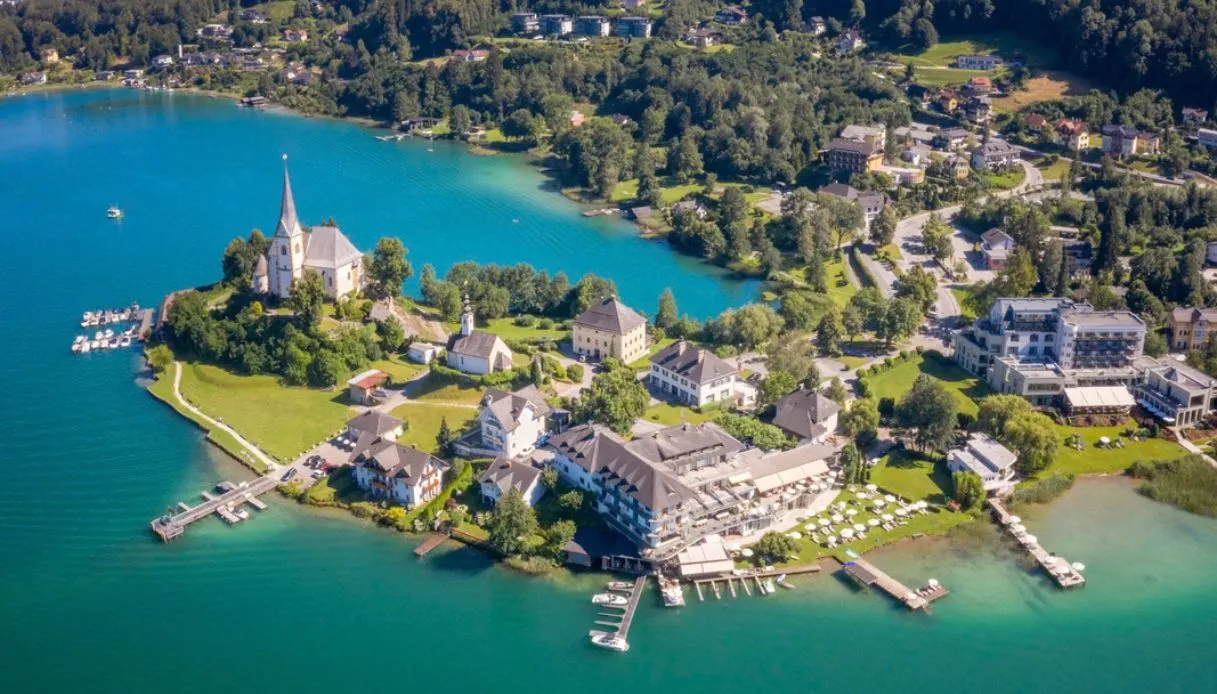
An Austrian city with an Italian soul, perched by one of Carinthia’s most famous lakes and fringed by forests, meadows, and mountains. Klagenfurt am Wörthersee presents itself this way, with a compact, orderly historic center that preserves the hallmarks of Italian master builders who arrived during the great Renaissance era.
Touristically renowned as the “Rose of the Wörthersee,” it exhibits an elegant character, but once you move away from the central streets the landscape shifts: green spaces take over and the lake comes into view a little further off, with its clear waters and vivid hues. Here you’ll also find the country’s oldest pedestrian zone, inaugurated in 1961, between Kramergasse and Wienergasse.
In essence, it is a compact center, pleasant to traverse slowly, with shops, venues, and gastronomic destinations tucked into the historic architecture.
What to See in Klagenfurt
The heart of this Austrian city holds many details capable of surprising you, as they appear almost without warning along the way.
Neuer Platz and the Lindwurm Fountain
The most emblematic spot in Klagenfurt is Neuer Platz, the grand square at the city’s center, precisely where the Lindwurm, a stone-carved dragon from the 16th century, stands as the city’s symbol. The current layout of Neuer Platz dates to 2008, based on a design by architect Boris Podrecca.
Landhaus and the Wappensaal
The Landhaus today serves as the seat of the Carinthian government and stands as one of the most important historic buildings. The true jewel, however, lies inside, in the Wappensaal, the great heraldic hall. The walls are richly adorned with coats of arms belonging to the region’s history, creating a monumental setting heavy with detail.
Cathedral and the Church of Saint Egidio
The Church of Saint Egidio dominates the urban landscape with its bell tower, on which a panoramic platform has been built. Climbing higher, the roofs of the historic center form a tight mosaic beneath the eye, while farther away the Wörthersee’s water and the surrounding mountains appear.
The panorama point thus allows visitors to grasp Klagenfurt’s unique geographic position, set in an urban area tightly linked to the surrounding natural spaces.
Carinthian Museum of Modern Art
The Museum Moderner Kunst Kärnten, also known by its acronym MMKK, brings modern and contemporary artistic production into the historic center.
The exhibition space covers about 1,000 m² and hosts solo shows and thematic exhibitions dedicated to regional, Austrian, and international artists.
Fuchskapelle, the Chapel of the Apocalypse
One of the most unusual experiences leads to the Fuchskapelle, also known as the Chapel of the Apocalypse. The frescoes belong to Austrian artist Ernst Fuchs and transform the interior into a riot of color, figures, and details.
The atmosphere recalls a pop and psychedelic take on the grand tradition of frescoed chapels. The comparison to a small Sistine Chapel in vivid colors captures well the surprise of encountering such a distinctive place within a Renaissance-flavored city.
Maria Loretto
On the shores of the Wörthersee lies the Maria Loretto Castle, built in 1652 on the lake’s eastern bay. Water and vegetation frame the building.
Kreuzbergl and the Botanical Garden
Kreuzbergl rises to 517 meters and is considered Klagenfurt’s local mountain. The hill quickly nudges the city from the urban fabric toward a greener dimension, offering views over the city rooftops and the surrounding landscape.
In the same area you’ll also find the Sternwarte observatory and the Botanischer Garten, the Carinthian botanical garden.
Lendkanal
The Lendkanal connects Klagenfurt to the Wörthersee via an artificial canal about four kilometers long. The waterway threads through a green belt that leads toward Maria Loretto.
Minimundus and Planetarium
A short distance from the lake lies Minimundus, a miniature-world style journey through global landmarks. The park brings together replicas of famous buildings, letting visitors hop from monument to monument within a compact space.
Next to this attraction is the Klagenfurt Planetarium, dedicated to observing and understanding the sky.
What to Do in Klagenfurt
As soon as the historic center gives way to the landscape, the lake becomes the main character, while hiking trails, bike paths, and water routes let you live the city outdoors.
- Take a cruise on Lake Wörthersee: to observe Klagenfurt and the lakeside towns from a completely different perspective. The Rundfahrt lasts about two and a half hours and reaches places like Maria Wörth, Pörtschach, and Velden.
- Head up to Pyramidenkogel: it offers a vantage point over the Wörthersee. The observation tower rises to roughly 100 meters, features a wooden, sinuous structure, and includes a slide more than 120 meters long with a drop of 52 meters.
- Cycle along the Lendkanal: to follow the link between the urban center and the lake through the greenery. The city cycling network spans about 120 kilometers.
- Climb Kreuzbergl: a natural break close to the center, with the possibility to reach the observatory and the botanical garden as well.
- Discover the Wörthersee through its shores: in summer, when the waters reach particularly pleasant temperatures and the lake becomes a popular gathering place for locals.
- Visit Benediktinermarkt: the gastronomic heart of the city. The market takes place on Thursdays and Saturday mornings, bringing together producers from the region, Friuli, and Slovenia.
- Taste Carinthian specialties: a way to recognize the meeting of cultures even through cuisine. Among the highlighted products are dark rye bread, apple strudel, Reindling with raisins and cinnamon, speck, smoked sausages, apple juices, and local spirits.
Where It Is and How to Get There
The city of Klagenfurt lies in southern Carinthia, a short distance from the borders with Italy and Slovenia, and occupies a strategic position for exploring the Wörthersee and the surrounding countryside, with the lake a short distance from the urban center. Klagenfurt Airport serves as the main city airport. For those arriving by car, its location makes it easy to reach the center and then continue toward the lake-facing towns.
The most evocative way to understand the city’s geography, however, comes from the water: from the Wörthersee the view reconstitutes the landscape and makes it possible to perceive the special relationship between the historic center, the green hills, and the Carinthian mountains.