
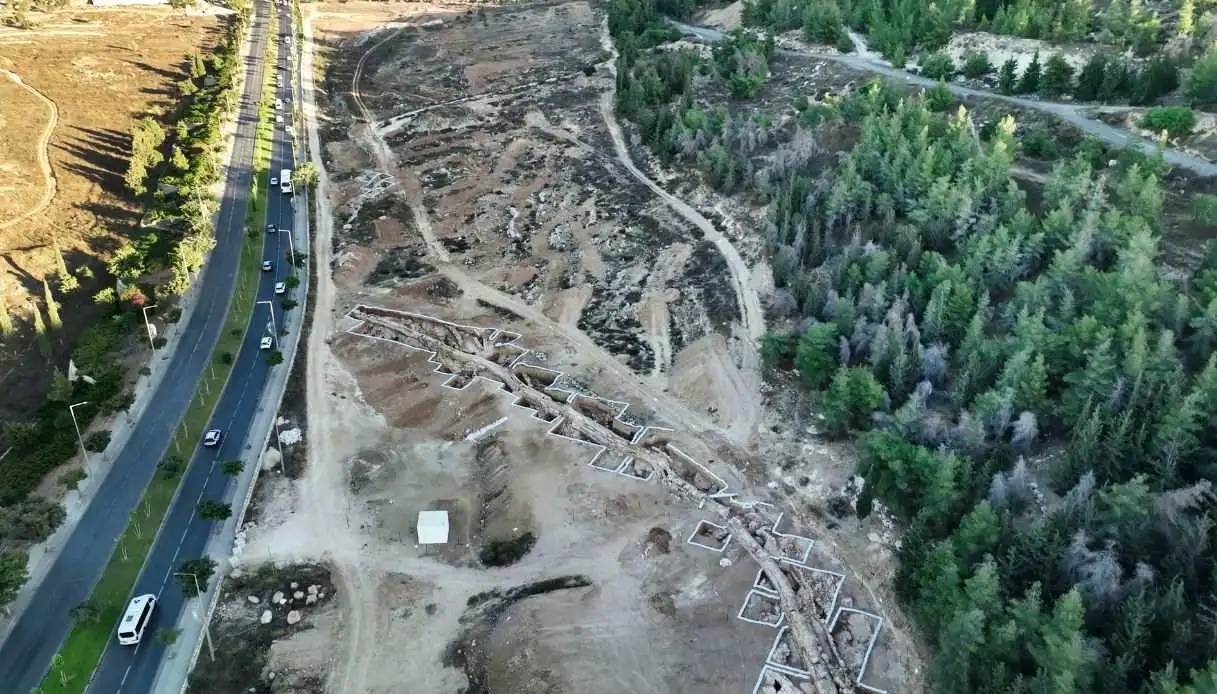
Two thousand years ago, without pumps or any mechanical means, someone managed to bring spring water to the heart of Jerusalem. They did it solely by gravity and with a precise calculation of gradients, an achievement that still leaves people astonished. A stretch of this work has just resurfaced: during excavations conducted by the Israeli Antiquities Authority south of the Ramat Rachel kibbutz, archaeologists have unearthed a 300-meter section of the city’s lower aqueduct, most likely built in the Hasmonean era.
The discovery took place in an area where the Israel Land Authority will construct a new neighborhood. However, the aqueduct will not be sacrificed, because the segment will be preserved, integrated into the new neighborhood, and open to the public. Visitors will thus be able to see up close one of ancient Jerusalem’s most ingenious works, which remained in operation, albeit in phases, until about a century ago.
A sophisticated water system spanning 21 kilometers
The lower aqueduct was part of a sophisticated water system. The water originated from springs in the Gush Etzion area, passed through the Solomon’s Pools (three vast open-air basins located in the West Bank), and from there traveled some 21 kilometers to reach the Temple Mount.
The secret of its operation lay entirely in the gradient. As explained by Benyamin Storchan and Gil Freid, the directors of the excavations, for much of the route the vertical drop was only about one meter per kilometer. To achieve this, the designers had to maintain a gentle and constant slope for many kilometers, adjusting the path to the hillsides and the rock. The system was so well designed that it remained in use until about a hundred years ago.
Along the canal there were also access points for cleaning, which served to remove any obstructions and perform routine maintenance. For Amit Re’em, an archaeologist in the Jerusalem district, the aqueduct is “an engineering marvel”. Even with today’s technology, he notes, a project of this kind would require substantial planning and effort.
An aqueduct, two thousand years of history
The beauty of this section is that it recounts, step by step, the long life of the aqueduct. In its origin, the water ran through a masonry canal lined with plaster. About 500 years ago, during the Ottoman period, ceramic pipes were inserted inside the original canal. In the same period, the exterior wall was plastered, and while the plaster was still damp, small stones were inset. A surface with a characteristic appearance emerged, accompanying the aqueduct along its route.
This sequence of repairs says a lot about the importance of the work and the constant commitment to guaranteeing Jerusalem’s water supply over the centuries.
For Avital Kotzer Adari, director of the Israeli National Tourism Office in Italy, it is a true miracle of ancient engineering, which offers the thrill of touching the city’s unique development and its central role in ancient history.
