
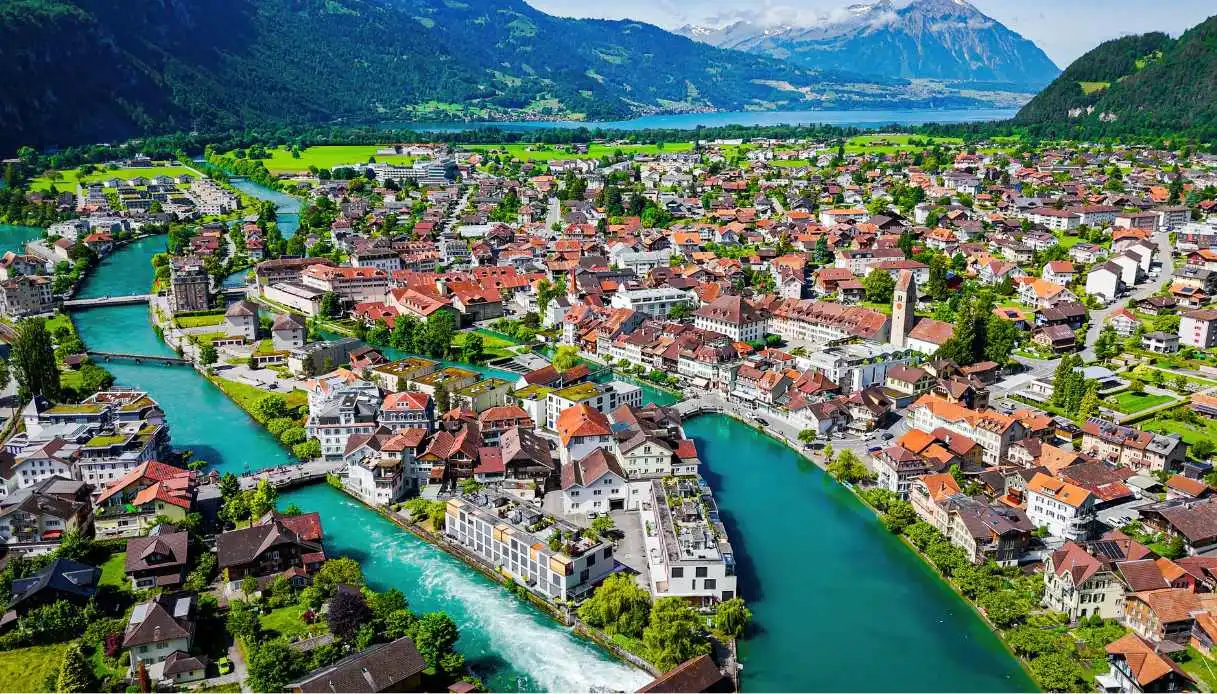
Even the very name, Interlaken, already hints at one of its peculiarities: this elegant Swiss town sits between two lakes, Lake Thun and Lake Brienz, and is also framed by the towering peaks of the Eiger, Mönch, and Jungfrau. An exceptional landscape, then, and that in some way has made its fortune.
However, its history tells us something more: the urban core grew around an Augustinian monastery founded in the twelfth century, mentioned in sources as early as 1133. For centuries local life revolved around the religious complex, which was dissolved at the end of the sixteenth century. With the advent of alpine tourism, Interlaken shed its old skin and became one of the country’s most famous places to stay.
Today its character is quirky and highly recognizable, because on one side there are historic hotels, gardens, buildings tied to holiday-making, and a long shopping promenade; on the other, however, a decidedly more daring vocation dominates, to the extent that Interlaken has built an international reputation in adventure sports.
What to See in Interlaken
The beauty of Interlaken also lies in the fact that its center can be explored without long distances. The most interesting attractions tell of different eras and allow you to move from religious architecture to the culture of alpine tourism, up to a viewpoint high above the town.
Höhematte and Höheweg
Höhematte is the great green space that forms the scenic heart of this Swiss town. On the lawn, magnificent vistas open toward the Jungfrau massif, while the sky is often crossed by paragliders. It’s a scene typically Interlaken, halfway between an urban park and a natural balcony over the Alps.
Along the edge of the lawn runs Höheweg, the town’s most famous avenue, full of shops, hotels, restaurants, and elegant façades.
The Complex of the Former Augustinian Monastery
To understand the birth of the city you must reach the religious complex that has marked local history since the Middle Ages. The Augustinian monastery was founded in the twelfth century and long remained the center of Interlaken’s life.
The historic core still preserves traces of the old religious settlement, supplemented by later buildings and the churches in the area.
Unterseen and the Historic Center
Crossing the Aare (the longest river entirely in Switzerland) you reach Unterseen, a historic town closely tied to Interlaken but administratively separate. The Marktgasse introduces a more intimate setting, with traditional buildings, small shops, and restaurants.
The passage between the two towns clearly shows the landscape’s layout, and the short distance between the centers makes the contrast even more evident.
Japanese Garden
Next to the historic Hotel Interlaken there is a small Japanese garden, a surprising presence in the heart of the Bernese Oberland. The orderly greenery and Eastern aesthetics introduce a compact pause between the center’s architectures and the vast Alpine landscape. It’s one of those details that keeps Interlaken from becoming just a postcard of mountains.
Harder Kulm, the Home Mountain
Harder Kulm is Interlaken’s home mountain and rises to 1,322 meters. The funicular starts near Interlaken Ost and in about eight minutes reaches the upper station, overlooking the city and the two lakes.
The viewpoint allows you to read the geography with remarkable clarity. Below the gaze appear Lake Thun, Lake Brienz, and Interlaken’s inhabited belt; in the background the Eiger, Mönch, and Jungfrau can be distinguished. Even the restaurant deserves a look, as its architecture echoes that of a small castle and adds a nearly fairytale touch to the panoramic terrace.
What to Do in Interlaken
It’s true, it’s a small city, but despite that it offers a surprising amount of activities. The secret lies in its location, with water, woods, rocky faces, and high mountains gathered in a relatively compact space.
- Ride the funicular to Harder Kulm: it means quickly gaining altitude and observing from above the distinctive shape of the land between the two lakes.
- Take a cruise on Lake Thun or Lake Brienz: provides a completely different perspective on the mountains, with villages, wooded shores, and alpine reliefs gliding along the water.
- Reach the Lauterbrunnen Valley: it brings you into one of the Oberland Bernese’s most famous scenes, among vertical cliffs, waterfalls, and Alpine villages.
- Visit Grindelwald: to get closer to the Eiger and then proceed toward the lifts and attractions of the First area.
- Choose paragliding: turns the Jungfrau Region into a panorama seen from above, with takeoff on the mountains and arrival near the town center.
- Try rafting, canyoning, or skydiving: the most adrenaline-fueled face of Interlaken.
- Reach Schynige Platte, Niederhorn, Brienzer Rothorn, or Schilthorn: broadens the scope of the excursion toward some of the region’s most spectacular viewpoints.
- Set off on the GoldenPass Express: it turns the journey into a true experience. The Interlaken–Montreux route lasts about 3 hours and 15 minutes and traverses alpine landscapes, pastures, and famous places such as Gstaad and Château-d’Œx.
Location and How to Get There
Interlaken is located in western Switzerland, in the Canton of Bern, between Lake Thun and Lake Brienz. The Interlaken Ost station stands as the main railway hub for excursions toward the Jungfrau Region, while Interlaken West serves the town’s western center.
Traveling by train is particularly appealing: from Lucerne begins the Luzern–Interlaken Express, a scenic itinerary of about 2 hours that crosses five Alpine lakes and climbs the Brünig Pass with a rack-and-pinion section. From Montreux comes the GoldenPass Express, a direct scenic link about 120 km long. The journey crosses three cantons and passes through Gstaad and Château-d’Oex before reaching Interlaken, with wide windows facing lakes, valleys, and mountains.
Driving also helps reach the town easily via the Swiss road network. For those arriving from Italy or other European countries, the airports of Zurich and Basel are the main entry points, followed by rail onward travel toward the Bernese Oberland.
Interlaken, however, truly reveals its best through its Alpine transport network. Trains, boats, funiculars, and cable-lifts allow you to leave the car behind and build a journey made of lakes and peaks, villages and glaciers, small urban strolls and grand excursions.