
August 2, 2027 is a date worth marking on the calendars of astronomy enthusiasts and travelers seeking extraordinary experiences: indeed, the sky will unveil a total solar eclipse that will darken several regions of the planet, granting some locations exceptionally favorable observing conditions. Among these, Algeria stands out as one of the most interesting destinations to witness one of the most spectacular astronomical events in the coming years.
The North African country will be crossed by the path of totality, with some places able to enjoy more than five minutes of complete darkness of the Sun. A rare opportunity that invites imagining a journey capable of uniting wonder with desert landscapes, Mediterranean-facing cities, and archaeological testimonies of extraordinary value.
Timgad, the eclipse among the ancient Roman ruins
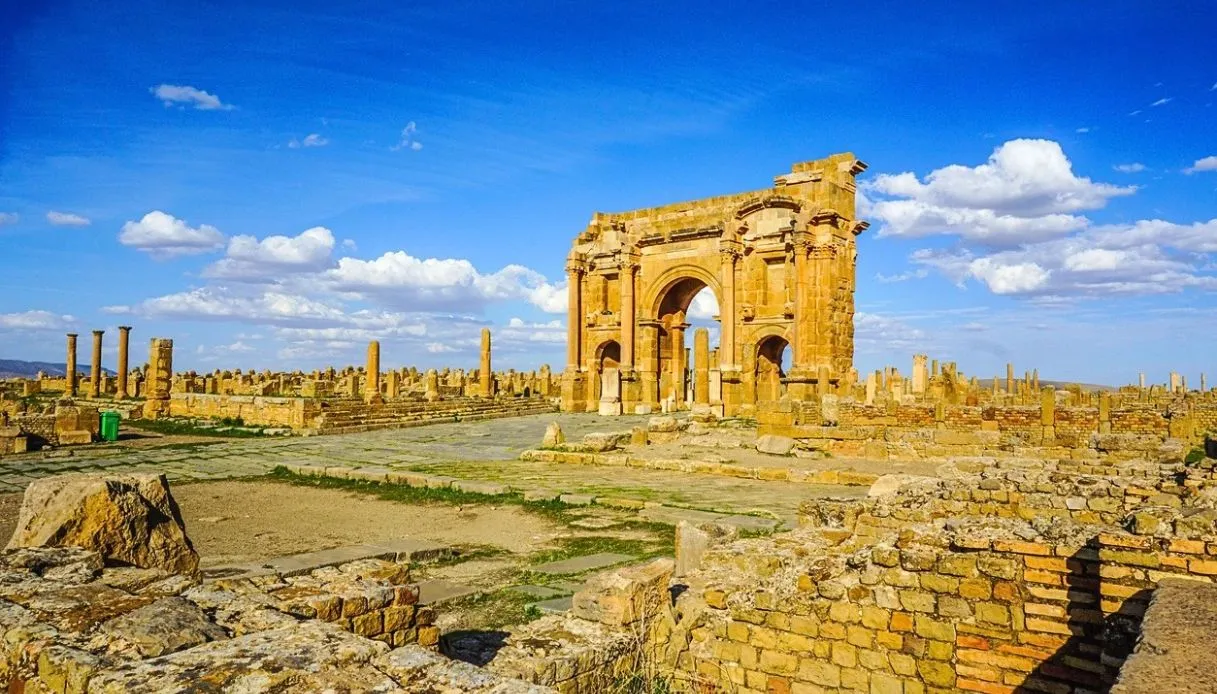
Among the most evocative stops to view the eclipse is Timgad, in the vicinity of Batna, where totality will reach about 5 minutes and 22 seconds. Discover one of the most important Roman complexes in North Africa, designated a UNESCO World Heritage Site and also known as the Pompeii of the North Africa.
The moment of total obscuration is indicated around 10:01, with the event expected to end around 10:07, according to local time. The visit can be integrated into a cultural itinerary that also includes the Casbah of Algiers, the archaeological site of Tipasa, the Royal Mausoleum of Mauretania, Constantine, and Djémila, another important Roman center in eastern Algeria.
M’Sila, between inland landscapes and a dry climate
Another location to consider is M’Sila, where the eclipse will last about 5 minutes and 22 seconds, a good compromise if you are seeking a long totality phase and want to explore inland Algeria, characterized by a dry climate and landscapes different from the Mediterranean belt.
Compared with the major cities, tourist infrastructure is more limited here: an aspect to factor in when planning the trip, especially in view of an event that could attract many enthusiasts. The area can be included in a route exploring the interior of Algeria, combining historical testimonies and natural scenery.
Bou Saâda, the eclipse at the gates of the Sahara
If you dream of a desert-tinged atmosphere, in Bou Saâda the total eclipse will last about 5 minutes and 17 seconds, delivering a long spell of darkness set against a landscape of oases, arid environments, and pre-Saharan atmospheres.
The inland location and dry climate make it ideal for astronomical observation. The journey can also become an opportunity to admire some of the region’s most distinctive places, such as the Balcons of Ghoufi, Biskra, the rock carvings of Ben Srour, and the Kalâa of the Beni Hammad.
Oran, between the Mediterranean and the Santa Cruz Fortress
If you prefer a destination easier to reach and with more services, head to Oran: perched on the Mediterranean, it will offer about 5 minutes and 9 seconds of totality and serves as a convenient base thanks to the airport, connections, and urban infrastructure.
Besides coastal views, Oran houses the Santa Cruz Fortress, one of its most recognizable symbols. To observe the eclipse you can consider viewpoints such as Parc Abdelkader or the hills surrounding the city center. The visit can also be combined with a cultural route along the western coast, with stops in Tipasa, Mostaganem, and Tlemcen.
Mostaganem, an alternative on the Algerian coast
With around 5 minutes and 7 seconds of totality, Mostaganem is another option to observe the 2027 eclipse without giving up proximity to the sea: it offers a different atmosphere from the large urban centers, featuring beaches, cliffs, and historic architecture that shape its landscape.
It can be a choice if you want to plan a vacation that combines the astronomical event with the discovery of the Algerian Mediterranean coast, alternating sky-watching with strolls and cultural visits.
Sétif, exploring Eastern Algeria
Among the places to consider is finally Sétif, a lively city in eastern Algeria, known for its archaeological museum, the famous Aïn El Fouara fountain, and the wide boulevards from the colonial era; it also serves as a convenient starting point to reach Djémila, one of the most important Roman archaeological sites in North Africa and recognized by UNESCO.
Here the totality phase will last about 3 minutes and 23 seconds; the maximum of the eclipse is expected around 10:02, when the Sun will be about 50 degrees high. Sétif can therefore be a convenient solution if you want to visit a city equipped with hotels, restaurants and services, while still having the option to witness the full darkness of the Sun.
