
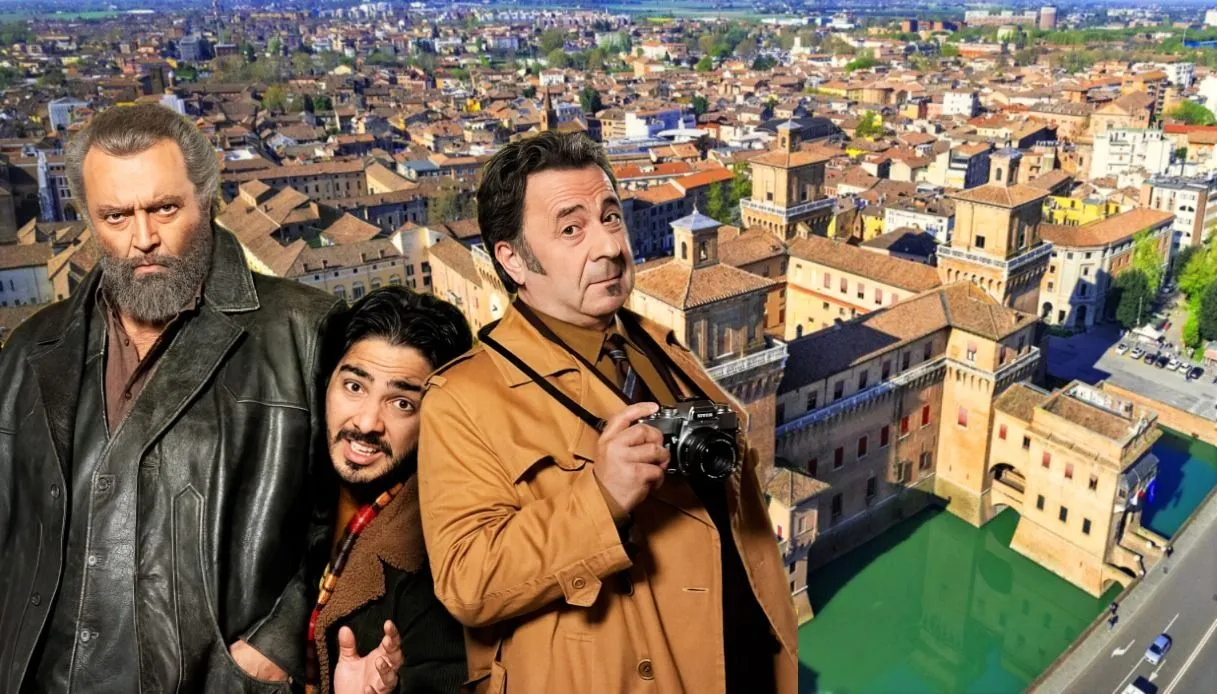
Diego Abatantuono returns to cinema in a wholly Italian comedy directed by Volfango De Biasi and featuring in the cast, among others, Mago Forest and Max Angioni. The locations for Il Malloppo, the film’s title in theaters from September 3, 2026, exude Italianity: the movie, full of gags, misunderstandings, and mix-ups so typical of our homegrown humor, was shot in the historic center of one of Italy’s most beautiful Renaissance cities, amid palaces, parks, sacred buildings, and iconic spots cherished by Italian cinema and literature.
What is the film about
Diego Viani, the character played by Diego Abatantuono, was in the Eighties a famous robber renowned for his hand-to-hand heists. For a long time, however, he has changed his life and opened an osteria in Ferrara. One day Diego’s past resurfaces in the form of Salamandra, his old accomplice, who accuses him of having run off with the loot from the last caper: five billion lire in gold ingots.
When the man is found dead, everyone becomes convinced that Diego is the killer, especially Inspector Castrone (Antonio Catania), who bears a personal grudge against him. Even Diego’s daughter Sara (Irene Girotti), who has since become a policewoman, does not seem fully convinced of her father’s innocence. Only Diego’s best friend, Michele Ragusa (Mago Forest), who works as a private investigator, seems to believe he had nothing to do with the murder and, together with the trainee Alex (Max Angioni), begins to investigate the matter in parallel.
Where the film was shot
The new comedy starring Diego Abatantuono was filmed almost entirely in Emilia Romagna, thanks in part to the support of the Emilia Romagna Film Commission.
Ferrara
In Ferrara, more specifically, most of Il Malloppo’s locations can be found. The historic center of the Estense city was the site of seven weeks of shooting, touching Piazza Trento e Trieste, Corso Martiri della Libertà, Viale Cavour, Corso Ercole I d’Este: key points in a city renowned for its Renaissance past and its present status as an important cultural and economic hub of the area.
Some scenes were shot near the Castle: the city’s true symbol, the fourteenth-century fortress stood at the heart of Ferrara’s political and administrative life for centuries before becoming, as today, an important cultural attraction also thanks to exhibitions and displays. Iconic is the layout of the Castello d’Este, with four square towers from whose summits one enjoys a splendid view of the city.
Other sequences were filmed between the Piazza and the Museum of the Cathedral: the façade with a loggia of the Cathedral of San Giorgio, with its mix of Romanesque and Gothic styles and its enigmatic symbolism, is unmistakable on screen. In the adjacent museum are preserved, besides sacred art treasures, also testimonies of the affection Ludovico Ariosto felt for this corner of the city.
The Osteria del Brigante, opened by Diego when he decided to sever ties with his criminal past, was staged near Parco Massari: the largest city park, frequented daily by Ferrara residents and visitors alike for strolls, reading, and jogging. Dating back to the late eighteenth century, in the mid-twentieth century it inspired Giorgio Bassani in writing “The Garden of the Finzi-Continis,” and it is here that some scenes from Vittorio De Sica’s cinematic adaptation were filmed.
Tresignana
Among the locations for Il Malloppo, just outside Ferrara, Tresignana is also listed: a municipality formed by the recent merger of Tresigallo and Formignana. The former, in the 1930s, underwent a complete redesign under the banner of Rationalism; today it stands out for the distinctive geometries and color schemes of its urban layout, earning it the nickname “metaphysical city.”