
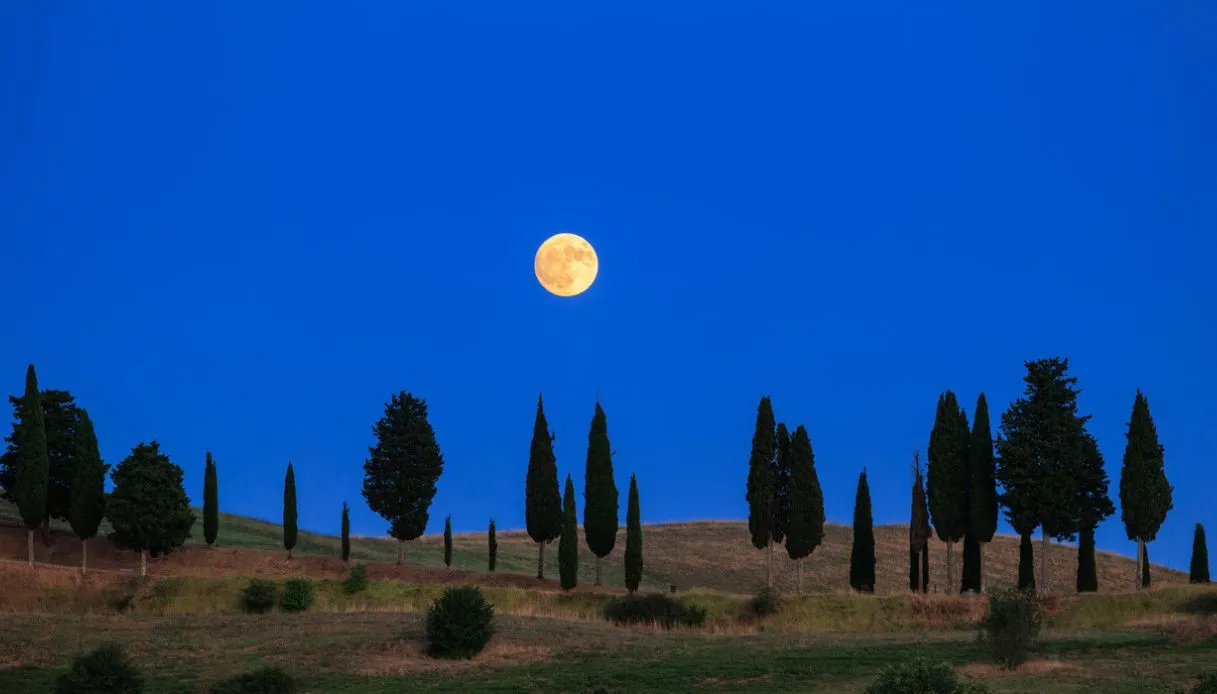
Each autumn, as the days shorten and nature heads toward winter, the sky offers one of the season’s most evocative sights: the Hunter’s Moon, known in English by that name. This year the full Moon is expected on October 26, at a moment when moonlight returns to be the protagonist of autumn nights.
Behind the evocative name of this Full Moon lies an ancient tradition linked to the rhythms of rural life and the need to prepare for the colder months: once, the hours of natural light were essential for agricultural communities busy gathering the last resources available and organizing provisions for winter. The Moon, with its brightness, provided a precious help to prolong activities after sunset.
Why It’s Called the Hunter’s Moon
The name Hunter’s Moon comes from the folklore of the northern hemisphere and is associated with the full Moon that follows the Harvest Moon, linked to the month of September.
The origin goes back to a precise moment in the agricultural calendar: the fields had already been harvested and the game could be easier to spot in the spaces left clear by the vegetation. The light of the Full Moon thus allowed the hunting rounds to be extended and the food to be obtained for storage in view of winter.
As with many other traditional names of Full Moons, the Hunter’s Moon tells a way of interpreting the sky through the needs of life on Earth: the lunar calendar, together with the changing seasons, provided a reference for understanding the changes of nature and facing the less favorable periods with greater preparation.
The Link Between the Harvest Moon and Autumn Nights
To better understand the peculiarity of the Hunter’s Moon, it is useful to consider its relationship with the Harvest Moon, the full Moon associated with the final stages of agricultural work.
Both lunar markers are tied to a characteristic observable at northern latitudes: near their respective full Moons, the delay in Moonrise from one evening to the next is limited. Under favorable conditions, it can rise shortly after sunset, providing light in the early evening for several consecutive days.
In the past, even tens of minutes of extra natural light were precious for finishing fieldwork, moving about, or engaging in other outdoor activities: the Moon’s light helped to extend, at least partly, the time available after the end of the day.
When and How to View the Full Moon of October 26
The Hunter’s Moon is scheduled for Monday, October 26, at around 5:11 a.m., Italian time, when the satellite will reach full phase.
Because the exact moment of the full Moon will fall in the early morning hours, one of the best opportunities to observe it will be the preceding evening, Sunday, October 25. The evening of Monday the 26th will also offer a good chance to glimpse the Moon, which will still appear nearly fully illuminated.
To enjoy the spectacle, simply choose a location with a wide and unobstructed view toward the east, the direction from which the Moon rises.
If you prefer to gaze at the phenomenon during the quieter hours of the night, you can also look skyward before dawn on October 26, provided the weather is favorable.
For a good observation, it is advisable to move away from the brightest lights whenever possible and to choose a panoramic spot along the horizon without obstacles: a park, a hill, or a stretch of coast with an open view can offer an interesting perspective.
