
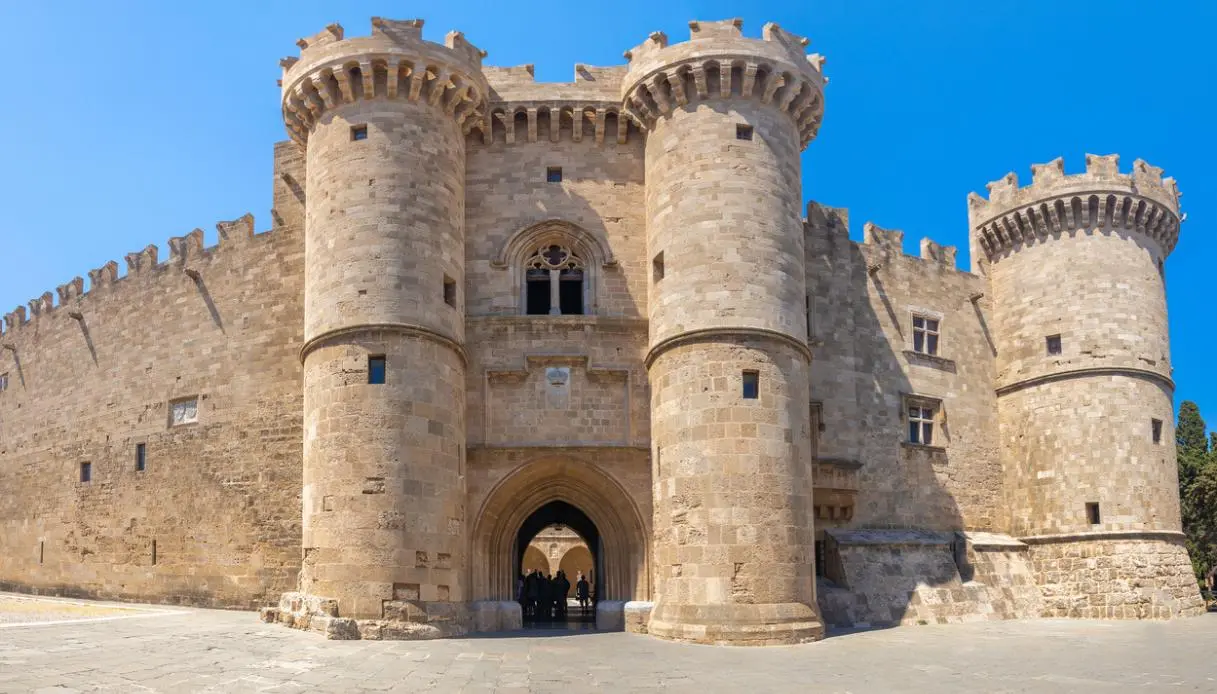
As much for the blinding light and the salty scent that threads through the alleys of lava-stone and limestone, the city of Rhodes (on the island of the same name) welcomes travelers with a majestic city wall that tightens around the historic center. There are pale stones that soak up the Aegean sun and the streets that seem to accompany the visitor toward another era. And then, at a certain point, in the distance at the end of the famous Knight’s Street, there appears the Palace of the Grand Master of the Knights, the island’s most important monument and one of the greatest examples of medieval European military architecture.
The name can cause a bit of confusion: Governor’s Palace, Grand Master’s Palace, Rhodes Castle and Palace of the Grand Master of the Knights all refer to the same extraordinary complex. Its most effective nickname, though, remains the “Fortress within the Fortress”, due to its imposing towers, battlements, and thick walls. Here the power of the Order of the Knights Hospitaller of Saint John had its heart.
The complex rises at the foot of the ancient Acropolis, above the area occupied by a Byzantine fortress dating back to the 7th century. In the 14th century the Knights Hospitaller of Saint John, after conquering Rhodes, transformed this area into a true citadel. Then there is the part that makes the visit particularly intriguing: the castle we see today looks medieval in appearance, but its architectural history traverses different eras and bears a strong Italian imprint.
Brief history and legends of the Palace of the Grand Master
The construction of the palace dates to the first half of the 14th century and was linked to Grand Master Hélion de Villeneuve. The work required more than twenty years. The Knights Hospitaller of Saint John of Jerusalem originated as a religious and charitable order, devoted to hospitality and care for pilgrims bound for the Holy Land. Over time its nature changed profoundly, and the Knights became a Christian military force.
For more than 200 years Rhodes was their base and the Palace stood at the pinnacle of the Order, also because in times of danger it could offer shelter to the population. The undergrounds formed the last line of defense and, after the Ottoman conquest, the complex was transformed into a prison and then abandoned.
The most dramatic blow, however, arrived in 1856: an explosion in the powder magazine connected to the nearby Church of Saint John, Agios Ioannis Prodromos, devastated the palace. The structure remained in ruins for decades. The revival came during the Italian domination. Specifically, between 1937 and 1940, when the architect Vittorio Mesturino led the reconstruction, while other sources cite the involvement of Florestano di Fausto and Armando Bernabiti in the broader Italian monumental restoration program.
The project drew on ancient descriptions of the palace and on historical illustrations. A precious reference was the text of Guillaume Caoursin, the Order’s vice-chancellor, author of a detailed description of the siege of Rhodes. The restoration remained faithful to the medieval image, yet it was also a product of early 20th-century culture.
Italy intended to convert it into a summer residence for Vittorio Emanuele III and Benito Mussolini. A plaque bearing Mussolini’s name is still visible inside. And here history becomes uncomfortable, layered, impossible to reduce to a simple medieval tale. Greece obtained Rhodes in 1947, under the Peace Treaty, and from 1948 the Palace of the Grand Master was turned into a museum.
Real legends tied to the castle are fewer in number than the myths of ancient Rhodes. The mystery arises mainly from the continual changes of power and the idea of a fortress capable of protecting an entire city. But perhaps the most fascinating tale concerns the Laocoön: in the room dedicated to the sculptural group one can see a copy of the work kept at the Vatican Museums. The sculptors of the original, according to a well-regarded tradition, were in fact tied to Rhodes. The story thus seems to return to its starting point.
Visiting the Palace of the Grand Master
The main entrance already makes a statement of power, with two towers, the battlements, and the Grand Master Hélion’s coat of arms welcoming visitors to the most recognizable part of the complex. Some elements of the southern access are among the few original portions remaining after the 1856 destruction. On the western side there stands a rectangular tower built toward the late 15th century.
Beyond the entrance, the great inner courtyard opens up with a perimeter colonnade, while the floor is paved with marble tiles arranged in geometric patterns. On the northern side, Greek statues from the Odeon of Kos appear. The museum presents Rhodes’ medieval history, with particular attention to the island’s commercial role.
A section also recounts the Byzantine era. The Roman mosaics transferred from Kos constitute one of the strongest surprises of the itinerary, because the visit brings together artifacts from several Aegean islands. The first large hall preserves 5th-century choir stalls and a late Hellenistic mosaic on the floor.
Then comes the Laocoön Room, with the copy of the famous sculpture. In the Medusa Room the head of the Gorgon stands out, made in Hellenic mosaic, accompanied by Chinese and Islamic vases. A second hall with a transverse vault guards a 5th-century mosaic from Kos.
The Hall of the Colonnades is even more spectacular thanks to two rows of arches leaning on the columns. Here you can see 5th-century Paleochristian mosaics. Yet the most precious impression comes in the Hall of the Nine Muses, with the famous mosaic dedicated to the goddesses of the arts.
The visit requires time, and a well-prepared guide can help distinguish medieval parts, archaeological finds, and Italian reconstructions. It is wise to check updated hours before departure, as they change with the season and holiday openings. Generally, information indicates a broader opening between April and October and reduced hours in the winter months.
Where it is located and how to reach it
The Palace sits atop Via Ippoton, the famous Knight’s Street, in the heart of Rhodes’ Old Town. The historic area is enclosed by medieval fortifications and features cobbled, irregular streets. To reach it from the center of the modern city, you can walk to the gates of the fortified town and then follow the route toward Knight’s Street.
The location makes it perfect for a visit together with Medieval Rhodes. The route begins at the walls and access gates, weaves through the labyrinth of alleys, and arrives at Knight’s Street, one of the island’s most famous roads. Then the castle appears almost at the end of the journey inside the fortified city. And it is there that Rhodes stops being merely turquoise sea, beaches, and sunsets over the Aegean.