
Emilie (a pseudonym) comes to Saint-Honorat Island every year, not to holiday, but to work as a volunteer at the reception of the monastery’s hotel that hosts travelers in search of peace and quiet.
The peculiarity is that the Île Saint-Honorat, one of the two Îles de Lérins off the coast of Cannes on the French Riviera, is a private property and belongs to the Congregation of the Cistercians of the Immaculate Conception; in practice the island’s only inhabitants are monks.
The smallest island of the archipelago covers an area of just 40 hectares (it is 1.5 km long and 400 meters wide at its widest point). A tiny natural paradise where silence — unlike the nearby Île Sainte-Marguerite — reigns supreme, where the monks live according to the Rule of Saint Benedict, dividing their day between prayer and work (they meet seven times a day, plus one at night, to pray together, even with guests and visitors who wish to join).
They manage the 8.5 hectares of vineyards, harvest olives from 120 trees that are over 800 years old — whose products include wine (35,000 bottles per year of red and white, in addition to 300 bottles of a special wine called “Le Clos de la Charité,” sold each year from the last Saturday of September to early October), olive oil (between 800 and 900 liters), and some liqueurs such as Lérina Verte, a green herb liqueur produced by the monks for a hundred years, whose secret recipe is known to only two monks (it is said to be made with 44 different herbs), and Lérincello, a liqueur similar to limoncello but based on mandarin with a hint of lavender. These are then sold in the official boutique — and for the rest of the time they live a monastic life.
We took the Planaria ferry — owned by the abbey — from the Quai Laubeuf in Cannes, opposite the Palais des Festivals and the tourist office, and went to the island to understand what is so special about this place that someone would give up their vacation to come here for a workation.
Staying at the Saint-Honorat Monastery
“There is a calendar,” Emilie explains, “which is shared throughout the year and we volunteers agree on the week we’ll come based on our availability. I’ve been doing it for several years and I’m happy about it.”
In exchange for her availability, every volunteer receives meals in the communal refectory — breakfast, lunch and dinner — in total silence to respect the 23 monks who live on the island all year round, and accommodation, which Emilie kindly shows me: her room is a single, though there are also double rooms for couples, for a total of 35 guests, with private bathroom, shower and toilet, a built-in wardrobe concealed by a curtain, a small desk with chair, and insect screens on the windows (essential because Saint-Honorat’s vegetation is very dense). No frills or amenities, after all we are in a monastery, but nothing is lacking. There are also rooms with a shared bathroom in the old wing of the monastery, very evocative, carved out of what used to be the monks’ cells, where, apart from the absence of a bathroom, the basics are still present. There is also a room suitable for people with reduced mobility.
Approximately 4,000 people come to stay each year, seeking a bit of serenity. It isn’t a spiritual retreat. Those who wish can attend the Masses and pray — there is a small chapel open 24/7 — but it isn’t mandatory. There are also visitors who come to the island on holiday to enjoy the small wild beaches (in a hidden corner of one of the two gardens there is a “sechoir” where you can dry your swimsuit and beach towel, along with the clothes you want to wash).
Visitors have access to two inner gardens hidden within the cloisters — those who visit the island from morning to night don’t see them — a library largely filled with religious books, but not only; those who want can leave the book finished and make it available to the community, and the cleaning room. Yes, because there is no room service like in a grand hotel; everyone takes care of cleaning their own room and must leave it as they found it.
“Anyone can stay at the Hôtel de l’Abbaye Notre Dame de Lérins: Christians, atheists, Muslims, men, women,” explains the Père Abbé – Jean-Marie Gervais – who, after sixteen years at Sénanque, returned to Saint-Honorat to lead the abbey. As the abbey’s site states: “In its Regula monachorum, Saint Benedict of Norcia specifies that Christ should be welcomed in guests.” The only ones who cannot stay are children below a certain age and dogs, to prevent noise, which is banned here.
Like the island, the abbey’s 30 accommodations are open year-round (except the first Sunday after All Saints’ Day until mid-December and the week preceding Palm Sunday) and always cost the same; there is neither high nor low season, in short. Prices range from a minimum of 47-57 euros per person per night depending on the type of room, but it is at the guest’s discretion and everyone can contribute what they can according to their means. A minimum stay of three nights and a maximum of seven nights is requested. Guests are advised to bring their own sheets and towels.
Because the custom is to share the life of the accommodation, guests are involved in some tasks, carried out “with simplicity and joy,” as the site puts it: washing dishes, setting the tables, tidying their room and, if necessary, the common areas, before departure. Meals are eaten in the refectory, in silence (accompanied by music or readings) and everyone together. The cooking is simple and varied to satisfy the tastes of most people.
It should also be noted that there is no Internet in the hosting building, only Wi-Fi in a limited area and mobile phones must be used outside the buildings. To book, every withdrawal request must be addressed to the Père Hôtelier by letter or email three months in advance of the desired period.
The History of the Abbey of Notre Dame de Lérins
The community of monks has been on Saint-Honorat island for more than sixteen centuries. It was in the year 410, in fact, when St Honorat arrived and founded a monastery inspired by Eastern monasticism, a Christian spiritual movement born between the 3rd and 4th centuries as a form of withdrawal from the world through solitude, asceticism, and prayer. According to the legend, once he reached the desert island rendered uninhabitable by an incredible number of snakes, St Honorat dug a hole in the earth with his staff and found water, which allowed it to be inhabited.
Still with his staff, the Saint managed to drive away the serpents after sheltering himself on a palm tree (today the palm is a symbol of martyrs, the abbey’s symbol, and also of the city of Cannes, from which the famous Palme d’Or award for the best films at the film festival originates). After clearing the ground and cultivating this small desert, Honorat established a community there. The history of its settlement is well documented thanks to the “Vita di Onorato,” preserved by Ilario of Arles.
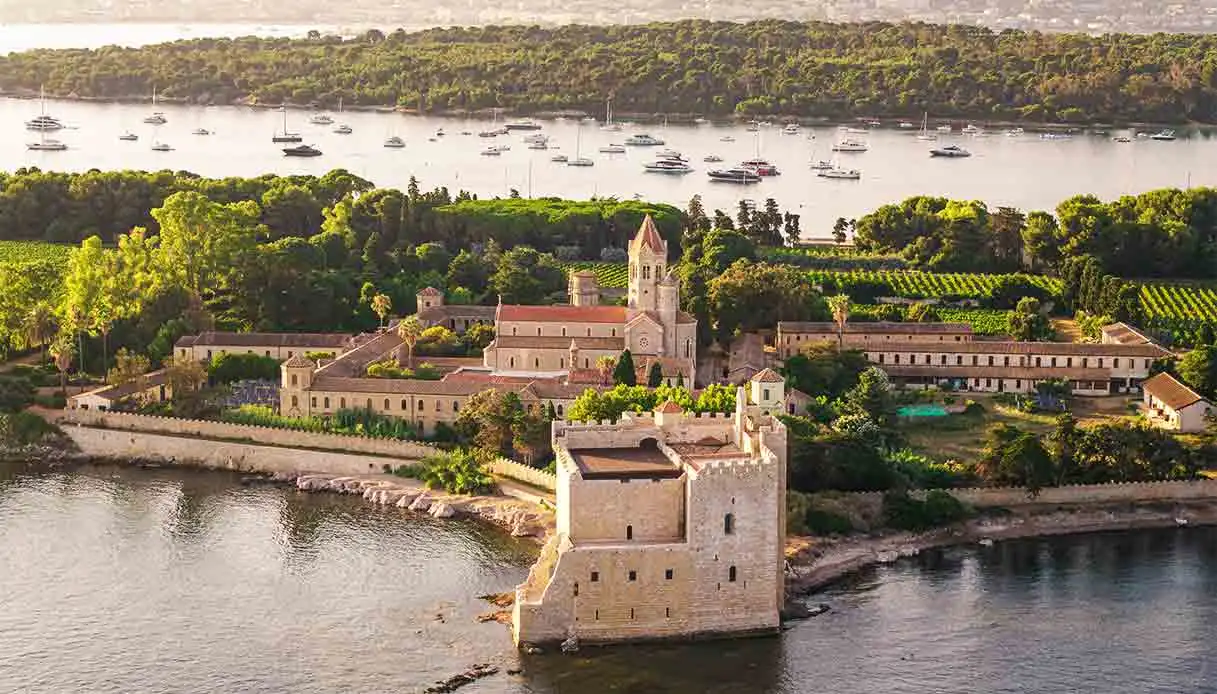
The monks lived in isolation but peace until between the 8th and 10th centuries there were the first invasions that forced them to flee. Faced with repeated threats from the sea, the monks gradually felt the need to protect themselves by erecting a fortified tower, the Tour-Monastère, on a rocky spur on the island’s southern side. Over time, this extraordinary construction became the center of life on the island, so much so that the monks moved there to live and transformed it into a true monastery.
For this reason, the first thing that was built was the cloister (three tiers), and everything developed vertically rather than horizontally, including the interior chapel (which housed the relics of St Honorat) and the cells destined for the monks. The abbey was destroyed three times in its history before being definitively rebuilt between 1874 and 1878 in a neo-Romanesque style. It still preserves a large part of the XII-century monastic complex, including the chapter house and the cloister.
After a period of abandonment at the end of the XVIII century and during the first half of the XIX century, in 1859 the Bishop of Frejus managed to buy back the island and restore a religious community. In 1869 Cistercians from the Sénanque Abbey arrived, two abbeys that are still connected today.
But the island’s history is even older. Some archaeological excavations conducted in recent years have unearthed artifacts predating the monk’s arrival, including an ivory cap likely part of a divine amulet from the pre-Roman era. The name of the Lerins archipelago itself derives from the ancient names of the two islands, Lero and Lerina, cited by many authors beginning with Pliny the Elder in the 1st century AD.
What to See on Saint-Honorat
On the monastic island of Saint-Honorat one typically goes to visit the fortified monastery of Lérins, built in 1073, which includes several cloisters and seven chapels from different eras forming a tourist circuit and a religious pilgrimage and the Abbey of Lérins. The complex, located on the opposite side from the island’s ferry dock, is wonderfully striking; the entrance, wrapped in plants, flowers and palms, presents a stunning contrast with the rest of the island’s wild vegetation, except for the cultivated vineyards. It truly feels like stepping into Paradise.
All around the island, along the few walkable paths (the circuit around the island measures 3.4 km), you encounter the various religious buildings, some rebuilt atop the original ruins: as soon as you land at the island’s port you are welcomed by the statue of the Virgin of the Port and the Arc du Triomphe from the XIXth century; here lie the remains of the ancient Chapelle St Michel, but along the paths you encounter the high: Capelle Saint-Pierre, Capelle Saint-Caprais (dedicated to the one who accompanied St Honorat to the island), Capelle Saint-Sauveur and Capelle de la Trinité (the last two are the only medieval ones still intact, and the first is said to have risen on the ruins of a V century building).
Near the abbey there are other structures: the Spanish vestiges of the XVII century, the casemate from World War II, the ovens for cannonballs laid out by Napoleon Bonaparte in 1794 (one at the eastern end and one at the western end), the boutique and the statue of Saint Anthony of Padua. Besides the religious complex, another imposing building on the island is the Tour-Monastère, which has just reopened after six years of restoration.
As of June 2026, the Abbey of Lérins, the first of the Monument historique in France designated by the writer and historian Prosper Mérimée, who was also the Inspector General of France’s historic monuments, inaugurated the restoration of the Tour-Monastère, the archipelago’s symbol. Dominating the coast of Saint-Honorat, the tower-monastery dating from around 1080 represents one of the principal testimonies to the abbey’s centuries-long history. A place of defense, of monastic life, and of memory, it embodies the exceptional history of the monk community. Formed by three buildings built in different periods, it served as the monks’ refuge from the late 14th century until 1788.
The works focused in particular on securing the building against moisture intrusion, including the addition of two new roofs — one contemporary and one traditional —, restoration of the walls and the installation or replacement of doors, grilles and windows. They also enabled the installation of lighting to enhance the spaces, improved safety and the visitor experience, as well as the liturgical arrangement of the Chapelle Sainte-Croix on the tower’s first floor, conceived as a dedicated project. This was entrusted to frater Charles Desjobert, a Dominican monk and architect specialized in historic heritage, and includes the creation of eleven stained-glass windows and a tapestry designed by the centenarian artist Vera Molnár, who passed away just after the work’s completion. Until the French Revolution, this was the main church since the abbey had been destroyed.
During the works some spaces that had remained concealed under the debris for centuries were uncovered, such as the wine cellars in the tower’s oldest section. The white limestone building was expanded and fortified over the centuries, so that by the late fifteenth century it had become a very distinctive and unmatched edifice: a tower-monastery that vertically gathered all the functions of monastic life, with a cloister on two levels, internal chapels, the refectory and the monks’ dormitory, the abbot’s chamber, storehouses and a cistern for potable water.
Today, after restoration, the Tour-Monastère has become a beautiful museum — currently free — with ample interior spaces, the modernized chapel (on September 14, 2026, after 634 years, it will also be consecrated), staircases, walkways and magnificent terraces that overlook the sea, offering a splendid view of the island from above and of the coast all the way to St Tropez.
To complete the tower, a bell was also placed at the top, donated by Prince Albert of Monaco, a link that goes back to the late Middle Ages, thanks to two members of the Grimaldi family who led the Abbey of Lérins as commendatory abbots. With these new works, the monastery island of Lérins – Saint-Honorat – officially aspires to become a UNESCO World Heritage site.
For day visitors — about 100,000 tourists annually — there are some picnic areas and a single restaurant, which is recommended to book in peak season.
