
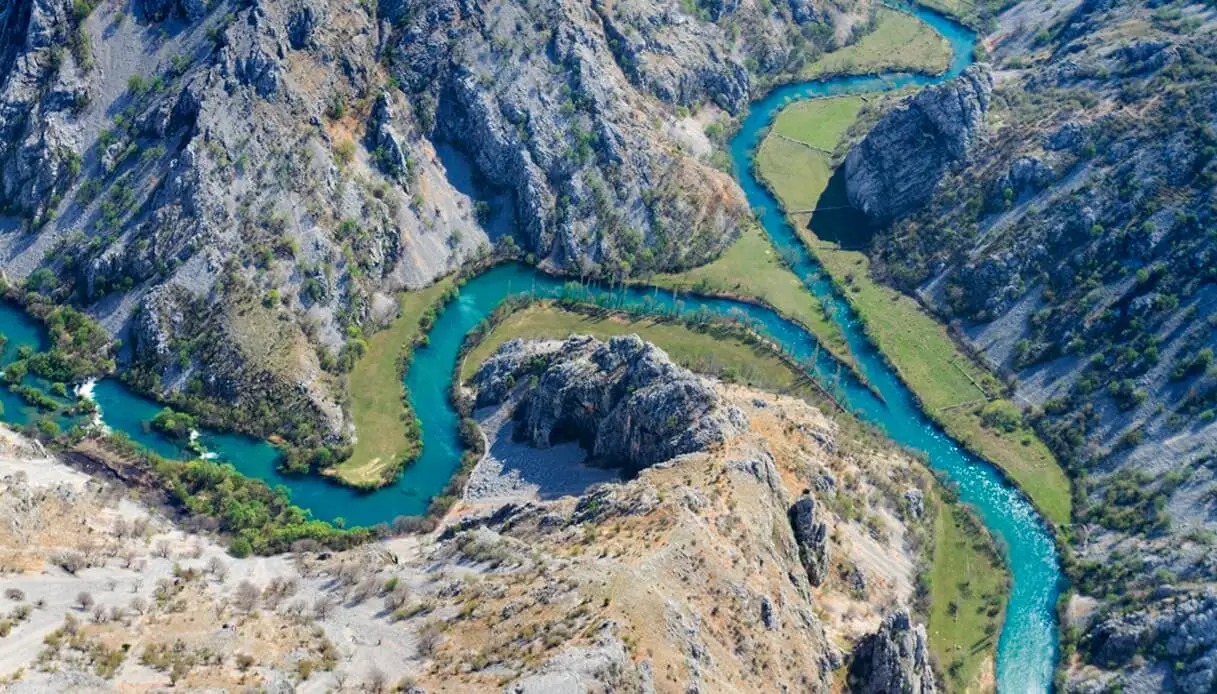
To the meticulous eye, when one talks about the Balkans one should refer to that mountain range that separates Bulgaria and Serbia. For a long time, however, the term has come to denote broadly the peninsula that stretches from Croatia down to Greece, with its eastern edge formed by Bulgaria and European Turkey. It is, therefore, a vast region covering over 500,000 square kilometers, inhabited by roughly 55 million people, and characterized by a landscape rich in history, but also wild nature, sparsely populated, and particularly tied to the fusion between mountain ranges and watercourses.
From Bosnia to Albania, passing through Montenegro, Croatia and Serbia, there are plenty of freshwater spots that dot the region, notably immense gorges and rocky and spectacular canyons, carved over millennia by rivers and torrents. Many of these places remain unknown to mass tourism, becoming an ideal destination for trekking and late-summer excursions far from the crowds.
Sutjeska Canyon, Bosnia and Herzegovina
The Sutjeska National Park is the oldest in Bosnia and Herzegovina. Established in the mid-1960s, it conserves today the Perućica forest, one of Europe’s last primeval forests, home to a multitude of ancient trees, some over 300 years old. It also hosts Maglić Mountain, the country’s highest peak at 2,386 meters. Within the park, the homonymous river has, through the centuries, carved a vertiginous gorge: walls of rock rise more than a thousand meters above the watercourse.
The park is reachable in about two hours by car from Sarajevo and offers several trekking opportunities, but the must-do route for lovers of gorges and freshwater is the hike toward the Ugljesin viewpoint, from which the gaze embraces the entire Sutjeska River canyon, framed by the Zelengora mountains, a spectacular, wild, and little-frequented mountain range on the border with Montenegro.
For those seeking something more adrenaline-laden, the nearby Hrčavka stream lends itself to canyoning among turquoise pools and small waterfalls. The park also preserves a slice of recent history: in 1943 one of the bloodiest battles of World War II on Yugoslav soil was fought here, commemorated by an imposing monument at Tjentište, from which a beautiful hiking route also starts.
Osum Gorge, Albania
They say it’s the Grand Canyon of Albania: the Osum Gorge extends for over 26 kilometers near the town of Çorovodë in the south of the country. Here limestone walls, some sections reaching up to about 80 meters in height, enclose a river with crystal-clear waters, dotted with caves, potholes, and subterranean passages.
It is one of the most accessible yet spectacular canyons in the Balkans: in spring, dramatic waterfalls descend from the tops of the rock faces, while in summer the lower flow makes the Gorge a true canyon to explore. From the viewpoints along the rim you can admire the full expanse of the gorge, while those who prefer a more direct encounter can descend to the river to walk along the banks or to climb part of its bed, or even tackle a raft-guided excursion on rapids that are as beautiful as they are gentle, within reach of everyone, even without special rafting experience.
The small town of Çorovodë, with its provincial-town atmosphere, serves as the ideal base from which to head toward the Osum Gorge and its surroundings, such as nearby Berat, a UNESCO World Heritage city known for its Ottoman houses facing the river.
Mrtvica Canyon, Montenegro
About 40 kilometers north of Podgorica and 30 from Kolasin lies one of Montenegro’s wildest and most spectacular, yet least frequented corners: the Mrtvica Canyon.
The river that gives it its name, a tributary of the Morača, flows for roughly eight kilometers through rapids, springs, and small waterfalls, in a setting of dense vegetation and crystal-clear waters.
The trek that crosses the canyon is a long route of about seven kilometers, to be walked without hurry to savor the beauty of the river, with its emerald and swirling waters, and the surrounding natural context. You pass the Danilov Most, the King Danilo’s Bridge, built in the nineteenth century in honor of the Montenegrin ruler’s mother, and you then reach Kapija Želja, the Portal of Wishes, a natural rock arch tied to local legends.
Beyond the Portal, a series of spectacular cascades brings a graceful closure to the most straightforwardly visitable part of the canyon, which then narrows progressively, until it becomes inaccessible.
Holta Canyon, Albania
Less well known than Osum, Holta Canyon lies in central Albania, among the hills of Gramsh, a town tradition holds as the origin of Antonio Gramsci’s family.
The Holta River has carved in this stretch a narrow and deep gorge, about three kilometers long, where the cliffs rise up to around a hundred meters above the water. It is a captivating place, enchanting yet at the same time instilling a certain reverential awe, as one must sometimes feel toward natural places.
What makes this canyon special is the combination of cold alpine-origin waters and some thermal springs that bubble along the route. Trekking paths run along the tops of the surrounding rock walls that frame the gorge, but there’s also the possibility of canyoning with a guided tour that lets you explore the canyon by walking in the riverbed, among turquoise pools, rock formations, and thermal springs.
Krupa Canyon, Croatia
The Krupa Canyon is a spectacular karst gorge located in northern Dalmatia, Croatia. It was carved over millennia by the Krupa River, precisely: an emerald-green watercourse, the main tributary of the Zrmanja River.
Measuring only about twenty kilometers in length, it has nevertheless generated over time nineteen waterfalls, some of which recall, on a smaller scale, the atmosphere of the far more famous Plitvice Lakes National Park.
Around the gorge there are a series of hiking paths that allow visitors to obtain a splendid panoramic view of this particularly evocative canyon, with the gaze able to embrace the river’s course and to admire the beautiful waterfalls from above, as well as to reach the bank, where one can encounter a small and entertaining via ferrata, with anchors to help overcome a narrow stretch of the riverbed, but also the scenographic Kudin Medieval Bridge and the so-called Deveterci, a sequence of small waterfalls likened to a necklace of water pearls.
The Krupa River flows into the Zrmanja, another watercourse of great charm, giving rise to a spectacular confluence between two canyons.
Temštica Canyon, Serbia
The Stara Planina, or the Old Mountain, is Serbia’s longest mountain range, located in the southeastern part of the country near Bulgaria. Here runs the Temštica River, able to make its way through the reddish rock of this land and carve a canyon, known as the Little Colorado.
The river originates from the confluence of three different springs that descend from the peaks of the Stara Planina, near the village of Topli Do, a small, quiet village in rural Serbia.
This area also hosts some of Serbia’s tallest waterfalls, such as Pilj, which drops more than 65 meters in a setting still surprisingly wild, four kilometers from Topli Do.
It is a corner of the Balkans still largely untouched by mass tourism, ideal for those seeking a late-summer trek in total tranquility, perhaps combined with a visit to the nearby Pirot, a town known for its handmade kilim carpets, woven by hand and protected by UNESCO.