
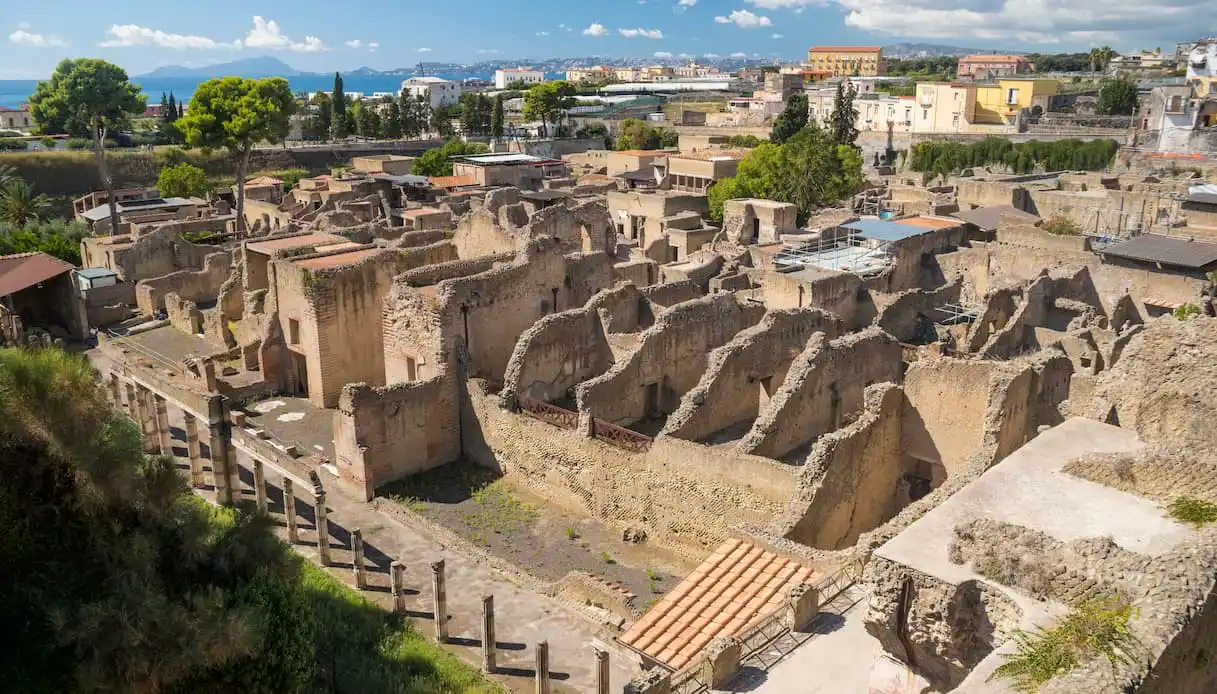
Even today, certain places seem frozen in bygone centuries, guarding stories that are waiting to be told. This is the case with Herculaneum, where two extraordinary testimonies of life in ancient Rome are preparing to welcome visitors once again. After decades of closure, the House of the Mosaic Atrium and the Timber-Framed House are finally becoming accessible again, offering the chance to discover domestic interiors, decorations, and architectural solutions that survived the eruption of Mount Vesuvius in AD 79.
The reopening will be officially presented on November 5, 2026 by the Herculaneum Archaeological Park, directed by Federica Colaiacomo, and marks a new milestone of the Domus Project, dedicated to the conservation and enhancement of some of the ancient city’s most important residences.
What to See in the Two Domus of Herculaneum
The two residences offer contrasting glimpses of Roman society, ranging from the grandest townhouses to those tied to everyday urban life. The House of the Mosaic Atrium, sprawling over roughly 1,200 square metres, stands as one of Herculaneum’s most captivating dwellings. It lies along Cardo IV, and preserves precious wall paintings in the fourth style and floors enriched with geometric and floral motifs.
Its most distinctive element is the atrium, where the mosaic floor still bears the distortions inflicted by the violence of the Vesuvius eruption. At the center sits a marble-clad impluvium, used to collect rainwater. Equally evocative is the peristyle, a garden bounded on three sides by columns, featuring a marble fountain and rooms decorated with mythological frescoes. Among these scenes appear episodes such as the Punishment of Dirce and the myth of Diana and Actaeon.
Completely different is the Timber-Framed House, a building of about 180 square metres that derives its name from a distinctive construction technique: a wooden framework filled with building materials and then plastered. The dwelling preserves a characteristic balcony, partly original, supported by three brick columns. The presence of a workshop on the lower floor and living spaces on the upper level shows how private life and commercial activity could coexist within the same structure in ancient Herculaneum.
When the Domus of Herculaneum Reopen
The event marking the return of the two residences is set for Thursday, November 5, 2026, when the reopening will be officially presented at the Antiquarium of the Herculaneum Archaeological Park. The project is part of the Domus Project, a program of conservation-based restoration involving six important houses at the site, developed in collaboration with the Packard Humanities Institute, through the Packard Institute for Cultural Heritage.
The initiative has already allowed the public to reconnect with the House of the Tuscan Colonnade and the House of the Wooden Shrine, reopened in March 2025, followed by the House of the Charred Furniture in July 2026. With a total funding of €5 million, drawn from the Vesuvio – Pompei – Napoli Institutional Development Contract funds, the project aims to once again make spaces of exceptional archaeological value accessible to visitors.
For those wishing to visit Herculaneum, these reopenings thus represent an opportunity to discover up close not only the history of the city destroyed by Vesuvius, but also the habits, architecture, and environments in which the lives of its inhabitants unfolded.
