
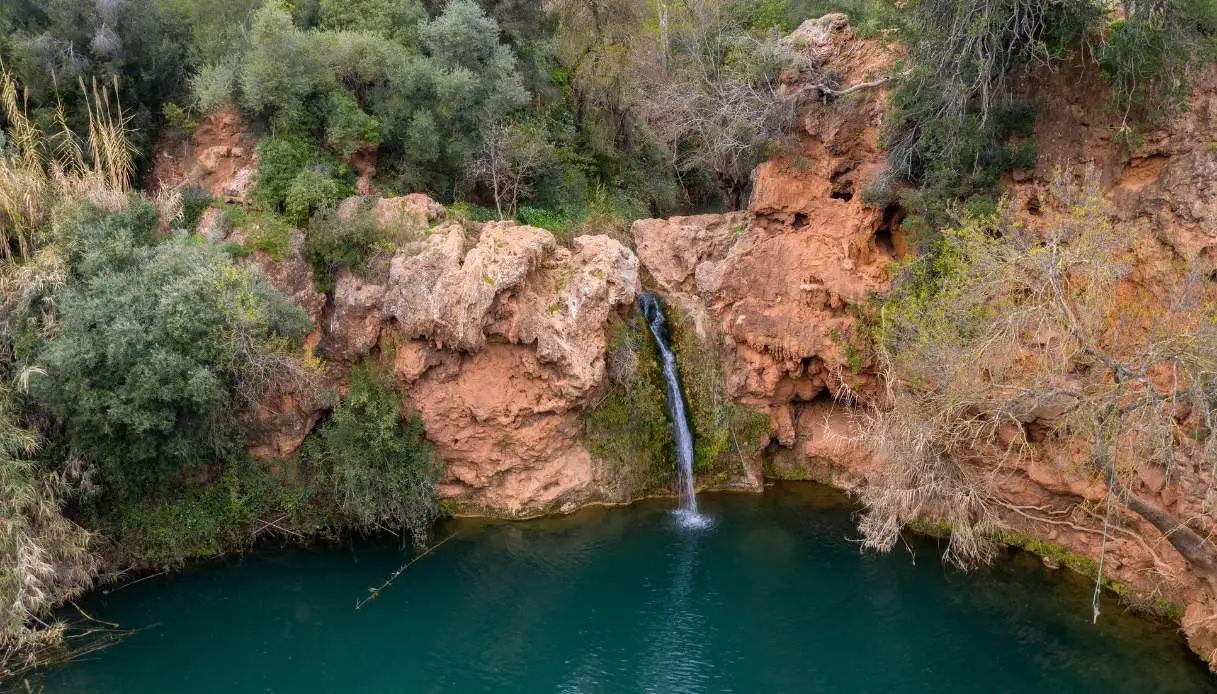
The name Algarve is often paired with golden, endless beaches, but the truth is there is also a side to this region of Portugal that often escapes the typical postcard images. Moving a little away from the coast, indeed, you encounter a landscape entirely different, made of small waterways, valleys carved in rock, and vegetation that grows lush around the springs. And it is among the countryside of the town Tavira that one of the region’s most peculiar natural wonders hides: Pego do Inferno, an olive-green pool fed by a small waterfall.
Trees, shrubs and reeds wrap around the banks, while sunlight passes through the foliage and draws changing reflections on the surface. Even the color seems to shift during the day, moving from deep green to lighter shades, influenced by depth and the surrounding vegetation.
The Pego do Inferno Waterfall, also known through the Italian translation Cascata del Pozzo dell’Inferno, rises to just 3 meters in height. A modest measure, you might say, but we can assure you it is enough to give rise to a scene with a surprising personality.
Origin, Formation and Legends of Pego do Inferno
The Pego do Inferno belongs to a natural system formed by three waterfalls along the Ribeira da Asseca, a stream that crosses this portion of the Algarve. The other two are the Cascata do Pomarinho, also known by the evocative name of Pego do Amor, and the Cascata da Torre.
It is a geologically interesting ensemble, developed along a stretch of about 1.5 kilometers of the river. What unites these formations is the presence of calcareous tufa, a sedimentary rock produced by the accumulation of calcium carbonate transported by the water.
When mineral-rich water releases part of the dissolved carbon dioxide, calcium carbonate can precipitate on surfaces, incorporating plant fragments and contributing to the growth of natural barriers. Over time, these accumulations modify the profile of the stream, creating ledges and small basins.
When you stand in front of it, it is truly fascinating to think that the small visible fall today is the result of transformations that have lasted for millennia. Beside the scientific explanation (as the name suggests), a significantly darker legend survives.
According to local lore, many years ago a wagon drawn by animals plunged into the pool, dragging its occupants with it. People who arrived at the scene tried to recover the bodies and the vehicle, but the searches proved in vain. The story continues with the arrival of some divers, unable, according to tradition, even to locate the bottom.
From that episode arose the belief that the basin was directly connected to Hell. An abyss seemingly without end, ready to swallow anything that fell into its waters. Other versions of the legend even speak of underground passages connected to the Guadiana and Gilão rivers.
Visiting the Pego do Inferno
The pool of the Pego do Inferno presents a rounded profile, framed by irregular rocks and vegetation. The olive tones derive from the interaction of depth, soil characteristics, aquatic organisms, and the reflections of surrounding plants. On sunny days the contrast between the lighter walls and the dark water becomes especially evident and absolutely pleasant to observe.
We recommend paying attention also to the calcareous tuf surfaces: their irregular shapes preserve traces of the mineral deposition processes that built the fall, such as small cavities, crusts and projections. Over the year, clearly, the appearance of the waterfall changes quite a bit.
Between the late winter and spring, especially after rainy spells, the stream generally shows a higher flow. It is precisely that season that is about to arrive, therefore the most suitable time to appreciate the water drop and observe the vegetation in one of its most lush phases.
During the summer, however, the landscape can take on different characteristics: rainfall decreases and the flow sometimes reduces to a thin trickle. In particularly dry years the waterfall may even dry up, revealing mainly the rocky structure.
A key aspect, though, concerns the ability to access the site. Until 2012 Pego do Inferno had infrastructures for visitors, including boardwalks, a wooden staircase, a bridge and facilities for enjoying the bathing area. A fire that broke out in July of that year destroyed much of the structures and damaged the surrounding vegetation. For this reason, the Tavira Municipality ordered the closure of the space and the equipped path remained unusable.
In the following years, nature progressively reclaimed the area, while the construction of new access routes faced several obstacles. Among them, for example, the presence of private land, the conditions of the watercourse, and the difficulties related to drought.
The Pego do Inferno remains without an officially reopened public access. The Municipality has set the recovery of the site and its landscape valorization among its goals. Additionally, the water analyses cited by the administration indicate conditions unsuitable for swimming.
Although some people still reach the basin spontaneously, informal visitation must be distinguished from the availability of an authorized and safe path. While awaiting reopening, it is necessary to respect any prohibitions, private property and access restrictions.
Where it is located and how to get there
The Pego do Inferno Waterfall is located in the parish of Santo Estêvão, within the municipality of Tavira, about 10 kilometers northwest of the town center. We are in the Sotavento Algarvio, the eastern part of the Algarve, in a rural belt between the Atlantic coast and the inland hills.
Tavira is undoubtedly the main reference point for reaching the area. From the town center you head northwest toward the area of Santo Estêvão and the Ribeira da Asseca. The waterfall is marked on major map applications, but the presence of a digital signpost should be distinguished from the actual accessibility of the site.
Before organizing a specific trip to this corner of Portugal, it is therefore advisable to consult the Tavira Municipality’s updates, verify the possible reopening of an authorized itinerary, and consider the weather conditions. Heavy rains can render the areas near the stream unstable, while drought periods directly affect the presence of the waterfall.
