
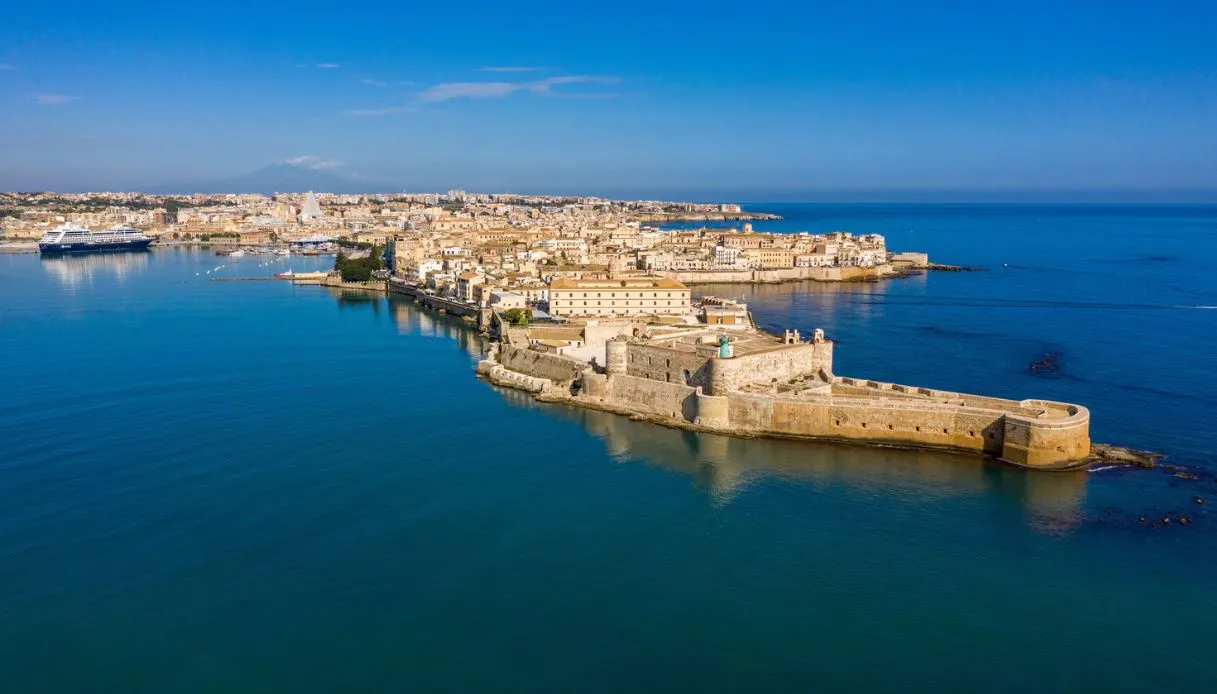
New hypotheses are prompting a rewrite of the Greek-origin past of the Sicilian island; archaeological research is fueling some curiosities. An ancient sanctuary could have existed in the area of the Abela Barracks in Ortigia, a short distance from Maniace Castle. The idea is driven by traces that emerged during recent archaeological investigations in the historic center of Syracuse. The identified elements would seem to indicate the presence of a space dedicated to worship in the Greek era on what is today the island.
For now, however, archaeologists remain cautious: there are still no confirmations of the existence of a temple. The traces are under the review of scholars, who seek to understand what the area’s function was and what role it played in the religious organization of ancient Syracuse.
The discovery of a possible sanctuary in Ortigia
A circular structure, traces of burning and deposits of materials connected to possible ritual practices: the excavations in the area of the Abela Barracks, at the southern tip of Ortigia, open a new line of inquiry into Greek Syracuse: in this part of the island there might have existed a place of worship. What intrigues archaeologists are especially some finds that seem to have a function different from dwelling. Remains of animals, vessels perhaps intended for offerings and libations, signs left by fire.
The hypothesis formulated by the Professor of Classical Archaeology at the University of Catania Massimo Frasca is that it was an area used for conducting religious ceremonies; to reach this idea he connects the evidence from the Abela Barracks with other remains of monumental structures found near Maniace Castle. The connection, if confirmed, could change the archaeological reading of this part of the Sicilian island. Not merely a place destined for individual ritual practices, but perhaps a broader sacred area, with monumental buildings and even a temple.
For now it remains a working hypothesis. Further investigations will be needed to understand what the function of the discovered structures was and whether the various finds can indeed be traced to a single religious complex.
Why the discovery matters
To understand the importance of the possible traces of a sanctuary near Maniace Castle, one must look at the origins of Syracuse. Precisely at Ortigia, in the 8th century BCE, colonists from Corinth arrived and founded Syracuse, destined to become one of the Mediterranean’s major powers. The potential presence of a sacred area in this zone would raise new questions about the city’s organization in its early centuries of life. And it could offer valuable clues about where religious sites stood and how urban spaces were occupied.
For now, however, we remain in the realm of hypotheses. Additional archaeological investigations will be needed to establish whether the remains identified can indeed be linked to a religious complex.
There is also the link with Corinth; a relationship that went far beyond trade and also involved artisanal crafts, cults, and cultural habits. It is also for this reason that the hypothesis of a sanctuary near Maniace Castle deserves attention. Any potential confirmation would allow a more precise reading of a phase of Syracuse’s history that still holds several aspects to be clarified.