
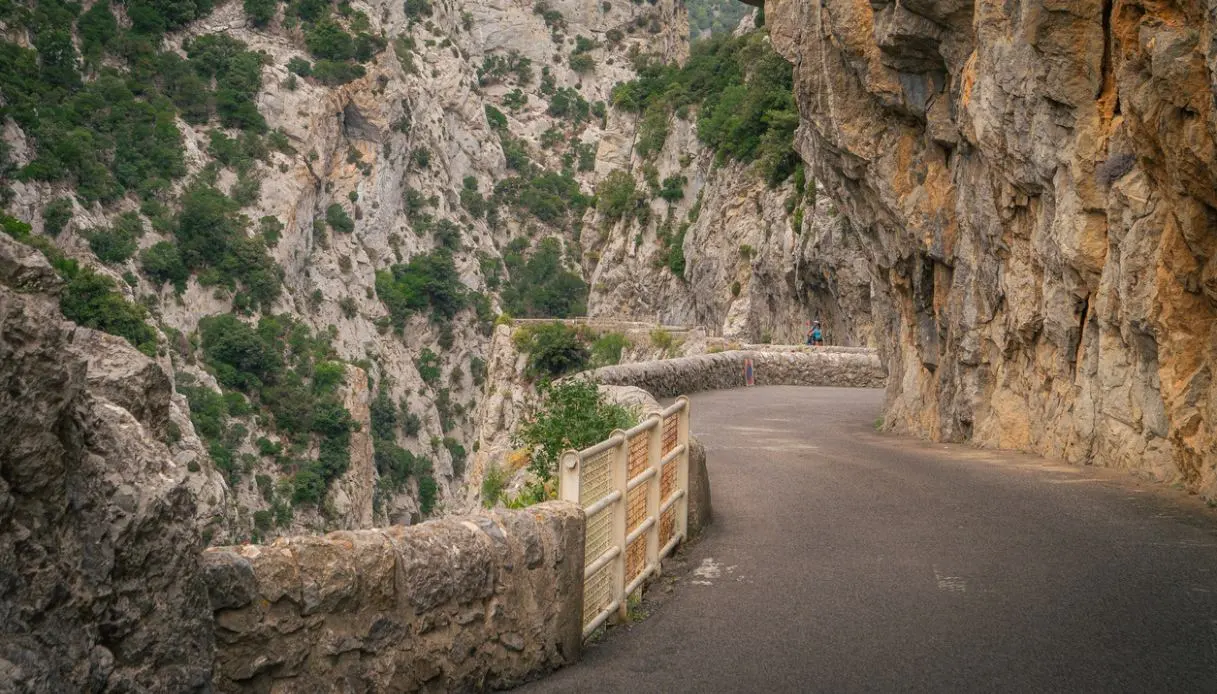
We’d be lying if we told you otherwise: the impact of standing before this extraordinary European landscape is immediate and disarming, overwhelming the senses. There is a road that narrows, then a rocky wall that seems to close in, and right after that a low stone railing beyond which lies a breathtaking precipice. This is how the Galamus Gorges present themselves, in the south of France, a region known as Fenouillèdes where the Agly River has cleaved a gigantic fault in the terrain, giving rise to one of the most spectacular canyons in the Corbières.
The road itself, carved straight into the mountain, is so narrow in several spots that only one car can pass at a time, creating an environment whose thrill defies simple description. Curve after curve, the roadway follows the irregularities of the cliff, passes through a tunnel, and slips beneath massive rock overhangs.
Then, almost suddenly, a small cluster of stone buildings comes into view, gathered around a natural cave. It is the Eremo di Saint-Antoine de Galamus, an ancient religious refuge that seems to belong to the mountain itself, as if it were born by Nature’s hand (though not quite).
Origin and Formation of the Galamus Gorges
Are you ready to jump back millions of years? Yes, because this incredible corner of France began to take shape when the landscape of the Pyrenees underwent profound geological transformations, roughly ten million years ago. It was then that the waters of the Agly began to cut into the region’s limestone formations, progressively deepening their bed.
The action of the water carved walls that, when considering the entire relief, reach depths of several hundred meters. The most spectacular segment features an exceptionally narrow passage, while the landscape cut by the river unfolds for about 5 km.
At the bottom, the river caresses the land among natural basins, tiny cascades, and rocks worn smooth by time, taking on hues ranging from emerald green to turquoise, while raptors such as the peregrine falcon and the royal owl make their homes among the cliffs. On the slopes, holm oaks, junipers, and the rare Balearic cyclamen thrive, blooming in spring.
Natural history interwoven with long-standing religious legends: the canyon’s hollows are said to have hosted hermits as early as the 7th century, though documentary evidence of the sanctuary dates to the late Middle Ages. According to tradition, these men sought solitude and contemplation following the example of Saint Anthony the Abbot, a central figure in Christian monasticism.
The most famous episode dates back to 1782, when Saint-Paul-de-Fenouillet was struck by an outbreak of suette, a feverish illness characterized by fever and intense sweating. The inhabitants organized a procession to the sanctuary and attributed the subsequent cessation of the epidemic to the intercession of the saint.
As a token of gratitude, the chapel was enlarged and a plane tree was planted, still growing among the hermitage’s rocks—a detail that continues to surprise given how inhospitable this setting appears to vegetation.
Visiting the Galamus Gorges
The most evocative route to discover the Galamus Gorges follows the narrow panoramic road that threads through the canyon. A tip: really try to place yourself in the past, because imagining how this engineering marvel was built at the end of the 19th century can send chills down your spine. Some workers faced the cliff faces, secured to ropes and equipped with iron bars to carve into the rock.
The road was completed in 1892, with the construction of the tunnel on the Saint-Paul-de-Fenouillet side. Above the entrance, a few verses in Occitan by the local poet Léonce Rives were engraved, commemorating what had truly been a historic achievement.
Today the carriage still follows that bold route, wedged between the mountain and the precipice. Do pay close attention, though, because the wind can race through the canyon with considerable intensity, especially on days with unstable weather. If you want to enjoy a 360-degree view, you can leave your car in the parking lots at the ends of the narrow stretch and continue on foot along the road (watching out for oncoming vehicles). From the viewpoint, you can discern the hermitage tucked into a hollow of the limestone wall.
Access to the Sanctuary of Saint-Antoine de Galamus is via a short downward path from the panoramic parking area, about a 10-minute walk, or via a stair carved into the rock. Inside you discover a small cave-chapel, with masonry adapted to the natural contours of the cavity.
Belfry, sacred spaces, and terraces form a minimal yet essential architectural ensemble, in which the rock remains an integral part of the spaces: the atmosphere is intimate, and is inevitably heightened by the light filtering through the openings.
Among the more curious details is an inscription bearing the Sator Square—an ancient puzzle formed by the Latin words SATOR AREPO TENET OPERA ROTAS, arranged so that it can be read in multiple directions. The true meaning of this formula remains debated and, as one might imagine, has spurred numerous symbolic interpretations.
The visit to the hermitage is free, though it generally opens from March 15 to November 15, with hours from 10:00 to 17:00 in spring and autumn and from 10:00 to 19:00 between May and September.
An entirely different experience is canyoning, practiced along the Agly’s course during the favorable season. The watery route winds through natural pools, small stone slides, and sections requiring swimming. Some passages include optional jumps, and the itinerary is considered suitable for beginners when accompanied by qualified guides.
Specific equipment and adherence to local regulations are required for this activity, because water conditions can change quickly after heavy rains. It is advisable to rely on authorized operators.
Where They Are and How to Get There
The Galamus Gorges are located in southern France, inside the Corbières-Fenouillèdes Regional Natural Park, between Saint-Paul-de-Fenouillet and Cubières-sur-Cinoble. The area lies within Occitania and sits to the west of the famed Peyrepertuse and Quéribus castles, medieval witnesses to the Cathar country’s history.
The main reference point for reaching them is Saint-Paul-de-Fenouillet, situated along the D117, the road connecting Perpignan to Quillan via Axat. From the town, take the D7 toward Cubières-sur-Cinoble and continue for about 5 km to the canyon’s access area.
Coming from Carcassonne or Limoux, you can reach Cubières-sur-Cinoble via the department roads that traverse the Aude, then head toward the northern slope of the gorges.
