
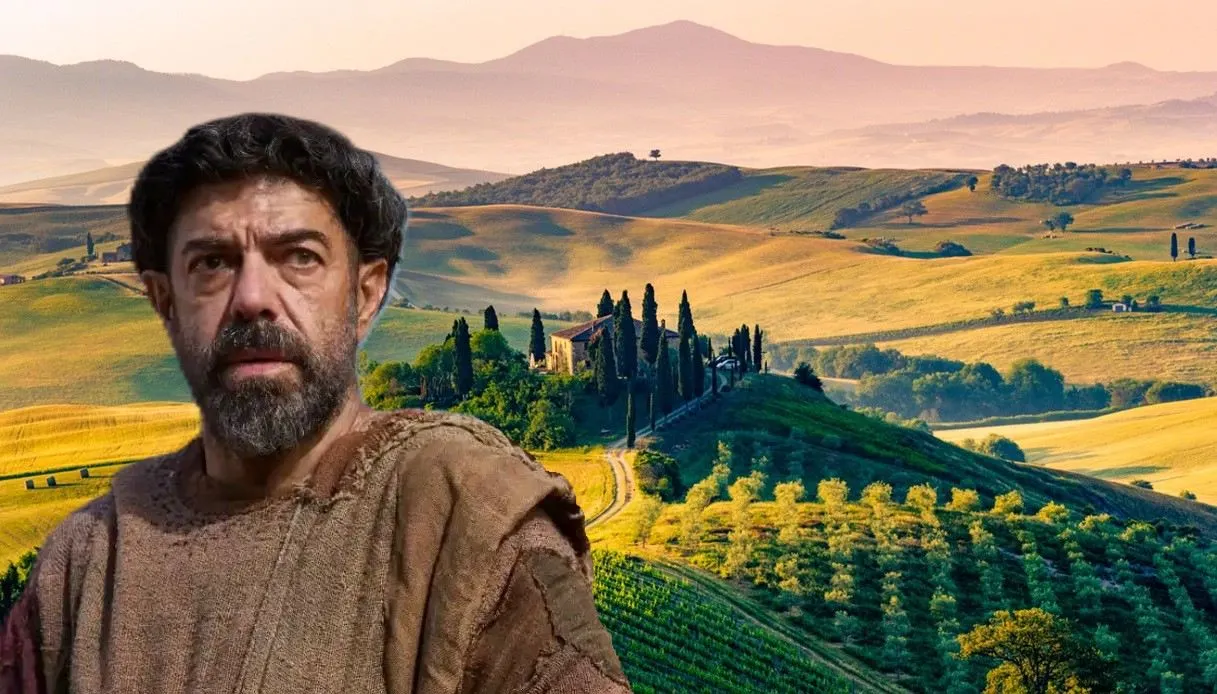
The new film Dio ride by Giovanni Veronesi, in theaters from October 29 2026 after being presented out of competition at the 83rd Venice Film Festival, tackles universal themes such as faith, freedom, and the relationship between man and power.
It does so with an exceptional cast of Italian actors like Pierfrancesco Favino, Silvio Orlando, Paolo Rossi, and with captivating settings capable of evoking a distant past, yet never truly past. A story that continues to come to life in rural villages, in ancient abbeys, in convents, in the refined aristocratic palaces that have survived to our time. We reveal to you the real locations of Dio ride.
What is it about
It is the seventeenth century, and between Umbria and Tuscany there is a man, Friar Leopoldo da Casamacchia (Pierfrancesco Favino), who speaks of God as no one has ever done before: he preaches the Gospel with joy, tries to give relief and hope to those who listen, and above all to convey the idea of a God who is close to people and able to laugh with them. Soon his voice spreads, and the faithful come to listen to Friar Leopoldo from neighboring villages, precisely as churches are emptied and traditional doctrine loses its appeal.
It doesn’t take long for Rome to notice what is happening: Pope Innocenzo X entrusts the case to Cardinal Maculani (Silvio Orlando), one of the most authoritative and intransigent inquisitors of the era. During the trial, the simplicity and charisma of Friar Leopoldo manage to challenge even the beliefs that seemed unshakable, those of people who have often confused faith with fear and guidance with control. The episode is freely based on a true story.
Where the film was shot
Produced by Indiana Production, Piper Film and Ogi Film in collaboration with Netflix, Dio ride was filmed in highly evocative locations across Italy, between Tuscany and the Lazio.
Tuscany
In Tuscany, the places where Dio ride was shot are mostly located in the provinces of Pisa, Siena, Pistoia, and Arezzo, as confirmed by the Tuscany Film Commission, which, together with the Regione Toscana’s Cinema and Audiovisual Call, supported its production.
Abbeys and parish churches
More specifically, the opening scenes, where Friar Leopoldo tries to save the convent’s prior at Bevagna (Paolo Rossi) from fire and plague, were shot at the Pieve di Ponte allo Spino in Sovicille: one of the most important and best-preserved examples of Sienese Romanesque architecture.
At the Badia Camaldolese of Volterra, however, the interior scenes were filmed inside the (imaginary) convent of Santa Flora where the two clergymen seek refuge upon their arrival in Tuscany: from the ancient monastery just outside the Etruscan walls of the city and not far from the dramatic cliffs of the Balze di Volterra, you can see on screen both the remains of the outer walls and the interior spaces.
Thermal baths and natural landscapes
Contrary to what one might expect from a historical film about a friar, the religious buildings are not the predominant focus in Veronesi’s new film with Favino and Orlando. In keeping with the character and the spontaneity of Friar Leopoldo, among the locations of Dio ride there are striking sites nestled in the lush Tuscan countryside.
Near Castelnuovo Val di Cecina, in the area commonly known as the Valle del Diavolo for its fumaroles and other geothermal manifestations and said to have inspired Dante’s Inferno, some scenes depicting Friar Leopoldo’s escape were filmed.
Another evocative location in the film is the Falesia di Celsa, still near Sovicille: a former circular quarry of yellow marble and limestone, today frequented mainly by sport climbers.
Some of the most moving scenes, those in which the friar washes the body of his prior after death, were filmed at the Bagni San Filippo: natural hot springs near Castiglione d’Orcia, set in the woods and famous for limestone formations such as the one nicknamed the “White Whale” because its shape and color resemble a cetacean.
Tuscan villages
Among the destinations that have long made Tuscany a beloved tourist destination, many Tuscan villages also stand out among the locations of Dio ride.
Casole d’Elsa and, more specifically, the hamlet of Gallena was transformed into the aforementioned Santa Flora, where Friar Leopoldo and his prior find refuge shortly after arriving in Tuscany: here the remains of an ancient castle, stone towers, and a Romanesque church helped the production recreate a seventeenth-century setting.
In the ghost village of Montingegnoli, in Radicondoli, the fictional place where women deemed to have lost their wits were imprisoned was reconstructed: here, everything—the manor house, the crenellated tower, the semicircular square—appears to have stayed as it was in the old days, imbuing the atmosphere with a certain mysterious quality.
Castles, towns, aristocratic mansions
The power that Friar Leopoldo opposes with joy is represented in Veronesi’s new film by old castles, aristocratic residences, and government palaces chosen to represent another facet of seventeenth-century society.
The Castello della Chiocciola in Monteriggioni, a medieval fortress built atop an earlier Etruscan settlement, has been transformed into the countess’s villa portrayed in the film by Alma Noce.
The cardinal’s private residence, played by Silvio Orlando, is Villa Torre Fiorentina: a neo-Gothic complex surrounded by a large Italian-style garden, part of the heritage of Italian historic dwellings.
Some sets were built inside Villa Chigi Farnese (better known as Villa Volte Alte): a splendid Renaissance residence on the outskirts of Siena designed in the sixteenth century for the Chigi family.
The process of Friar Leopoldo before the Rome Tribunal was filmed in the Main Hall of the Palazzo Comunale in Pistoia: a building known since the late 13th century as the seat of the city’s government.
At the Palazzo Comunale in Monte San Savino, some scenes depicting the friar’s imprisonment were filmed.
Lazio
In Lazio, the main locations of Dio ride are situated between Viterbo and Rome.
Viterbo
In Viterbo, among the places where Veronesi’s new film was shot, is the Palazzo dei Priori: in its halls—especially in the Sala Regia—long a symbol of temporal power, many scenes featuring Pope Innocenzo X, a figure of another enduring power, were filmed.
Rome
Some of the final scenes, those that redeem the figure and legacy of Friar Leopoldo, were filmed in the newly renovated Piazza Pio, at the foot of Castel Sant’Angelo in Rome: another highly symbolic site for Catholicism and its followers.
