
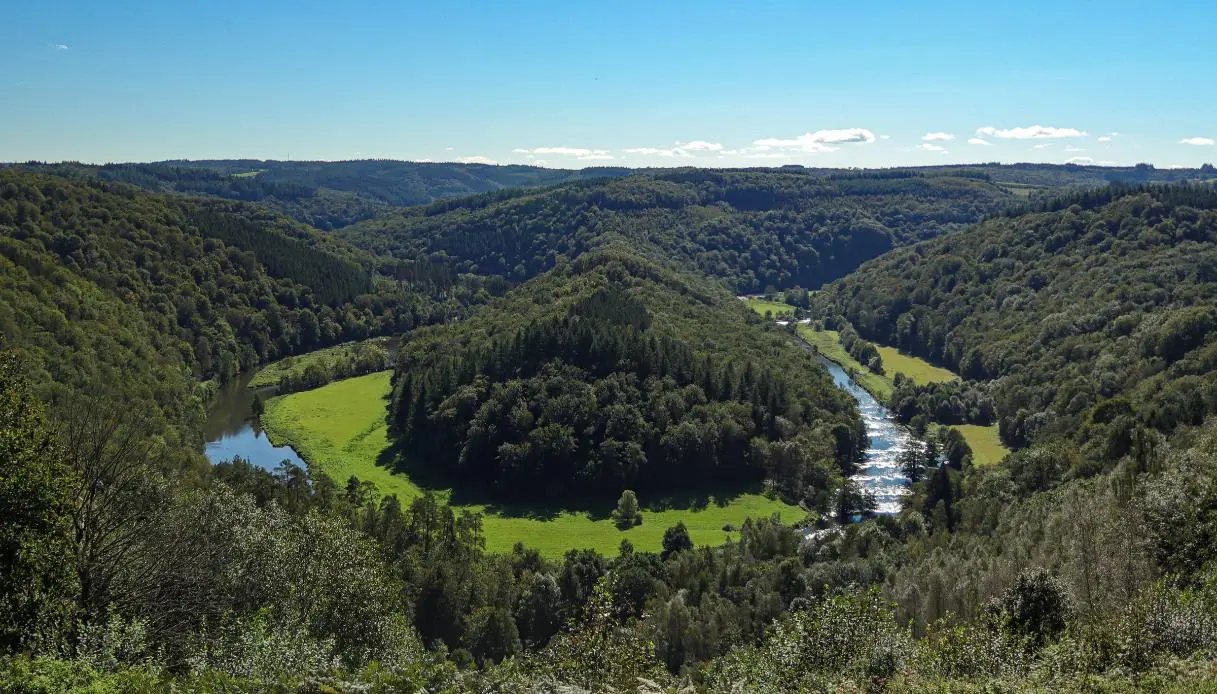
From the height of Botassart’s belvedere, the Semois River draws a long curve around a hill covered with forests, squeezing it almost completely between its waters. While the vegetation follows the contour of the ridge, an elongated, regular silhouette emerges, so distinctive that over the centuries it has inspired a name destined to become famous: The Giant’s Tomb, the Tombeau du Géant.
We are in the Belgian Ardennes, a region characterized by deep valleys, wooded elevations and watercourses that have shaped the landscape. The Semois winds through this territory with a sinuous route and, near Botassart, forms one of its most spectacular meanders. You only have to know that the central hill rises to about 250 meters in height and appears almost isolated compared to the surrounding slopes.
Brief History and Legends of the Tombeau du Géant
The name of this extraordinary site in Belgium belongs mainly to popular tradition. The most famous story speaks of a giant Treveran warrior, i.e., a member of the Treveri, a Celtic people settled across a broad area of northwestern Europe during the Roman era.
The legend is linked to the Gallic Wars and the Battle of the Sabis, an episode recounted by Julius Caesar in the De Bello Gallico. Local tradition has associated this clash with the Sambre, although sources note that such an identification is probably mistaken.
According to the tale, after the defeat to the Romans the giant would have preferred death to captivity. From the nearby Rocher des Gattes he would have hurled himself into the void, choosing a voluntary end rather than being led by the victors toward a fate in the arenas of the Roman world.
< /ask-ai-widget>
The body would have been found by an elder, who would have asked the help of some youths to bury him on the hillside. From that moment the hill would have taken the name Tombeau du Géant.
Another version of the legend ascribes the warrior’s death to the action of a centurion in Labienus’s army. The story thus preserves several variants, while the core remains the same: a warrior of extraordinary size, the escape from the Romans, the leap from the Rocher des Gattes, and the burial on the hill.
The geographical reality tells, as one may imagine, a somewhat different but no less fascinating story. Beneath the vegetation there is not the tomb of a giant. The name, in fact, stems from the hill’s silhouette, surrounded by the Semois meander and resembling, when viewed from above, the body of a man lying down.
The origins of this formation go back to distant times, when tectonic forces and river erosion began shaping the schistose rocks typical of the Ardennes massif.
It is precisely this meeting of a natural form and popular memory that has made the place so recognizable. An episode of Roman conquest becomes narrative material, and the landscape’s silhouette provides the legend with its perfect setting.
Visiting the Tombeau du Géant between a belvedere, woods and the Semois
The visit can begin at the Botassart Belvedere, a privileged vantage point for observing the famous meander. The panorama is immediate and spectacular, especially in the seasons when the forest changes color. Spring brings brighter green tones, while autumn turns the valley into a canvas of warm colors around the Semois.
From the belvedere, several itineraries depart, with hikes roughly ranging from 3 to 13 km. There is clearly the option to choose different routes depending on physical conditioning and the time available. The main route reaches 13 km and is marked with red and white blazes.
The longer route crosses woods, slopes and stretches along the Semois’ banks. The gradients can become significant, and some passages feature narrow, unpaved or slippery ground after rain. Good hiking gear thus makes the visit much easier.
The full version offers a different reading of the landscape: from the viewpoint you observe the great figure of the Tombeau du Géant, while along the route the perspective changes continually. The Semois appears close, then hides again among the vegetation; the valley tightens and the slopes gain greater presence.
Among the most interesting spots on the walk is Frahan, a village visible from above, nestled in the valley’s landscape. Another characteristic element is the footbridge at the Moulin de l’Épine, which adds a distinctive passage to the hike.
Whoever wishes to extend the experience can also reach the Bouillon Belvedere, from which the view changes direction and includes the town with its medieval castle. Therefore, a visit to the Tombeau du Géant can become part of a broader itinerary in the Semois valley, up to Bouillon.
For families with children, the shorter excursions, roughly 4 to 6 km, are especially recommended, while the full route requires good physical condition. Strollers are unsuitable for the trails, which feature natural ground and narrow sections.
Access to the belvedere is particularly easy relative to the length of the hikes. The large parking lot beside the viewpoint allows quick access to the spot from which to observe the famous hill. The parking is free, though it can fill up quickly during peak periods.
Where it is and how to reach it
The Tombeau du Géant is located at Botassart, a hamlet connected to the Bouillon area, in the Belgian province of Luxembourg, in the heart of the Ardennes. The viewpoint overlooks directly the great meander of the Semois and represents the most well-known observation spot for recognizing the hill’s shape.
Those arriving by car can set their navigator to the address , indicated for the Tombeau du Géant’s free parking. From there the belvedere is quickly reached.
The area is also connected to hiking, cycling and equestrian routes. For those staying in Bouillon and preferring public transport, one option is to take the train to Libramont and then bus 8 towards Bouillon, a journey of about 45 minutes. From Bouillon you continue along the route to Botassart.
The viewpoint requires little time to reach, while the valley invites you to linger much longer. Before your eyes remains the nearly perfect curve of the Semois, the green hill in the center, and a legend that continues to give a human face to a landscape form.