
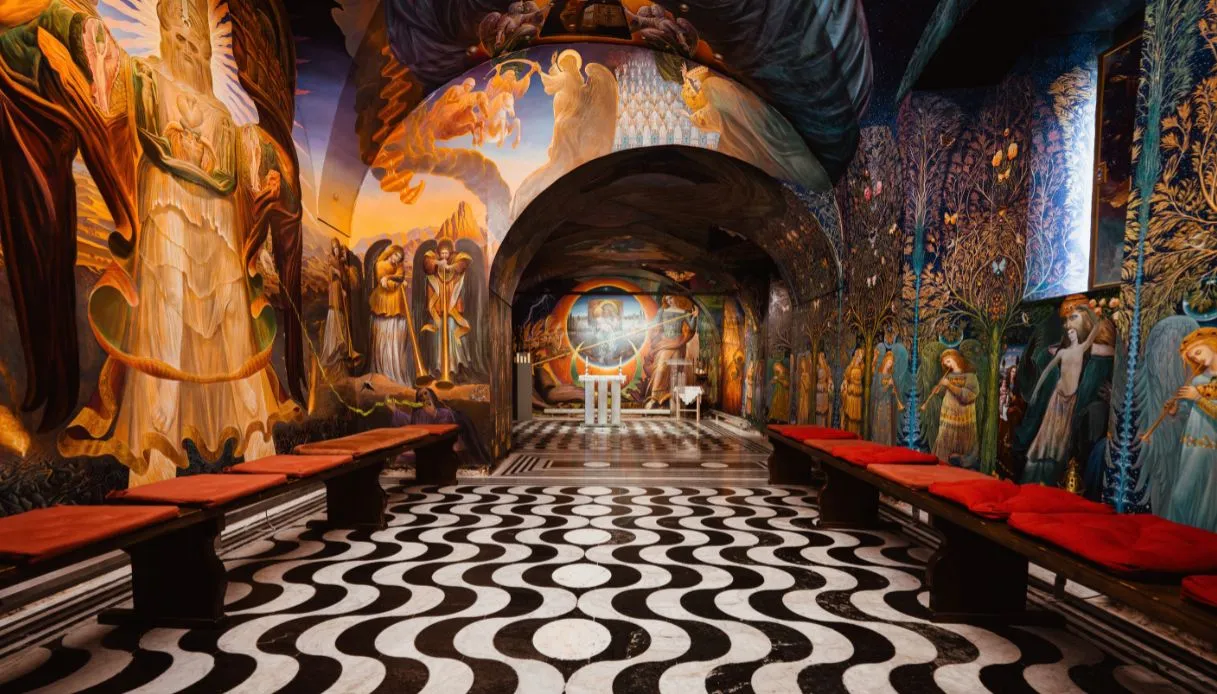
Klagenfurt is an elegant Austrian city in Carinthia that, at first glance, seems to cradle mainly the solemnity of the Baroque tradition. Yet, behind a door of the St. Egidio Church, an artistic universe opens up that has little to do with the classic image of a religious building.
You find yourself facing walls and a ceiling that glow with turquoise, red, violet, gold and green, while angelic figures, monstrous beings, and references to modernity intertwine in a breathtaking narrative. It is the Fuchskapelle, also known as the Apocalypse Chapel, one of the country’s most unusual artistic treasures.
There are comparisons with the far more famous Sistine Chapel, but the most substantial difference lies in the fact that the tones are pop and psychedelic. The reason for this comparison lies in the richness of the paintings that cover walls and ceiling. Yet there is an even more intriguing detail: Ernst Fuchs, the man who brought this marvel to life, would invoke the Sistine Chapel whenever someone showed impatience with the duration of the work.
A Brief History of the Fuchskapelle, Ernst Fuchs’s Masterpiece
The year in focus is 1989, the moment when Ernst Fuchs began working on the southern chapel of St. Egidio. Born in Vienna in 1930, the painter was already a leading figure of the Viennese School of Fantastic Realism, an artistic movement characterized by visionary imagery, meticulous detail, and allusions to myth, religion, and the unconscious.
His output had also won the admiration of Salvador Dalí, one of the major figures of Surrealism. Fuchs shared with the renowned Spanish artist a taste for enigmatic representations, although his figurative universe was deeply tied to Christian symbolism and to the techniques of the great masters of the past.
The undertaking in Klagenfurt proved particularly demanding. During the long years of realization, in fact, the painter spent on average 2 to 3 months a year in the Carinthian city, dedicating himself to a project that required study, precision, and continual reflection. It will not surprise you to learn, therefore, that to deepen the meaning of the images he even engaged in numerous debates with theologians and scholars of religions.
The project was completed after more than 20 years and on September 30, 2010, with a solemn ceremony presided over by the diocesan bishop Alois Schwarz. That day marked the completion of the work and the blessing of the renewed prayer space. During the homily, the bishop interpreted the cycle of paintings as a testimony of hope, emphasizing that the biblical Apocalypse also speaks of divine judgment and the fulfillment of human history.
What to See in the Fuchskapelle and Visiting Guidelines
The first impression upon entering this Austrian treasure is one of visual abundance. The surfaces seem to lose their boundaries, transforming into a single narrative that envelops the whole environment. The gaze travels from monumental figures to fantastic creatures, then lingers on tiny, almost microscopic details.
Much of this effect stems from the technique of glazing painting, used by the artist to layer thin, transparent colors: a process that lends depth to the images and produces delicate variations of light. On the eastern wall appears one of the main episodes of the Apocalypse, drawn from Revelation, chapter 12. It depicts a woman about to give birth, pursued by a dragon with seven heads. The scene then proceeds with the intervention of the archangel Michael.
Also emerging are the four horsemen of the Apocalypse, the book sealed with seven seals, the fall of the infernal dragon, and the New Jerusalem, the image of the divine city described in the Bible’s closing pages. On the painted surfaces, astronauts, satellites and military aircraft appear, elements that turn the biblical narrative into a reflection on contemporary civilization.
Among the depictions there is something that almost all of us know well: the sinking of the Titanic, inserted into a catastrophe scene. The famous liner, wrecked in 1912, becomes part of a figurative universe populated by symbols of destruction and human fragility.
Equally provocative is the representation of the Babylonian prostitute, an apocalyptic figure traditionally associated with corruption. Fuchs also links it to consumer culture and the imagery of pin-ups, offering an interpretation that engages with the contradictions of modern society.
On the western wall, there is the Old Testament episode of the sacrifice of Isaac. Abraham, called to sacrifice his son, is stopped by divine intervention. According to the artist’s explanation, the scene alludes to the shift from human sacrifice to animal sacrifice, further expanding the spiritual themes addressed in the chapel.
The ceiling presents a contrast between the sky of biblical tradition and the earthly sky transformed by human activity. The whole creates a fascinating interweaving of epochs and meanings, intensified by the rich colorism of the compositions. The Fuchskapelle is accessible only through a guided tour, lasting about 1 hour. The guide helps visitors recognize the biblical scenes, delve into the artist’s technique, and spot details that require a particularly attentive gaze.
Where It Is Located and How to Get There
The chapel is located in the historic center of Klagenfurt am Wörthersee, the capital of Carinthia, a region in southern Austria situated near the borders with Italy and Slovenia. It is thus near Lake Wörthersee, one of the country’s most famous lakes, surrounded by Alpine elevations and renowned for its turquoise-hued waters.
The church’s address is Pfarrhofgasse 4, 9020 Klagenfurt am Wörthersee, just a short walk from the city’s main squares. From Italy, Klagenfurt is reachable by car through the Tarvisio Pass and the Austrian A2 motorway. Alternatively, there are train connections, with itineraries and connections varying according to the departure city.
Once you reach the center, St. Egidio makes an ideal stop to pair with visits to the historic squares and Renaissance-era buildings that characterize the capital. Yet the stark truth is that, among the city’s architectures, the small painting chapel by Ernst Fuchs preserves a completely distinctive identity.
