
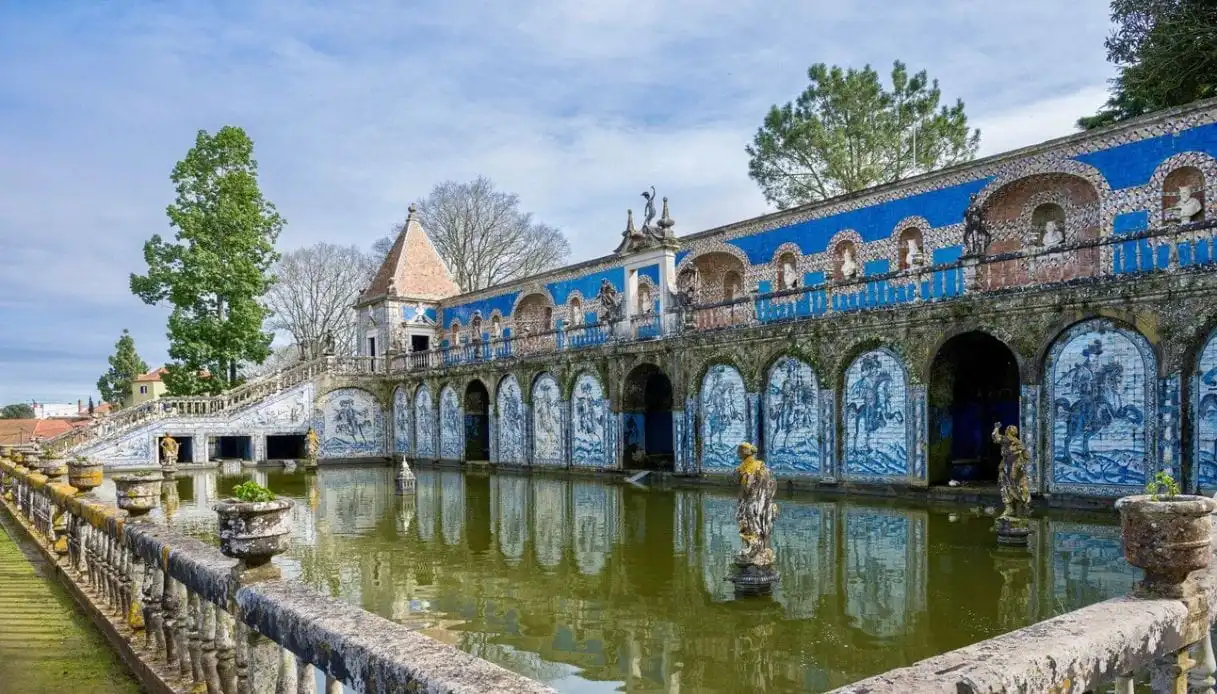
Walls covered with azulejos that recount ancient battles, sumptuous decorated halls, Baroque gardens enriched by sculptures and fountains: in Lisbon, the Palace of the Marquesses of Fronteira is an authentic masterpiece of Portuguese architecture, a place where the charm of history meets the allure of grand cinema.
Its beauty, in fact, has not gone unnoticed by directors and producers: from the romantic encounters in James Bond to the aristocratic atmospheres of Spanish cinema, up to the famous series “La Promesa,” which in 2026 chose this extraordinary residence as the setting for the wedding journey of Curro and Ángela.
The history of the Palace Fronteira, the residence that survived the earthquake
In the São Domingos de Benfica district, far from the hustle and bustle of the historic center, rises one of Lisbon’s most captivating noble residences: the Palace of the Marquesses of Fronteira was built around 1670 at the behest of João de Mascarenhas, the first Marquis of Fronteira, and his wife Madalena de Castro, as a summer dwelling where pleasant sojourns among gardens and terraces could be enjoyed.
However, its fate changed on November 1, 1755, when a violent earthquake, followed by a tsunami and fires, devastated much of the city: the family palace in the Chiado district was destroyed, while the Fronteira residence, located farther from the center, survived. The marquesses decided to move there permanently, expanding and adapting the building to meet new living needs.
Since then, the residence has continued to be tied to the same family and, even today, is inhabited by the descendants of the first Marquis, while remaining open for visits thanks to the Fundação das Casas de Fronteira e Alorna.
What to see in the Palace, between azulejos and sumptuous halls
The real treasure of the Fronteira Palace is its astonishing 17th-century azulejo collection, regarded as the largest still preserved in the place for which it was originally created: the famous Portuguese decorative tiles tell stories, celebrate military feats, and depict mythological episodes, turning walls and galleries into a picture narrative.
Among the most spectacular rooms stands the Hall of Battles, where eight large ceramic panels illustrate eight episodes of the Portuguese Restoration War, fought to recover independence from Spain. Scenes of knights, soldiers, and clashes also recall the deeds of the first Marquis, a central figure of that historical era. Also noteworthy is the Panel Room, adorned with Dutch azulejos, mythological representations, landscapes and hunting scenes.
The visit also reveals the Hall of the Four Seasons, the Hall of Juno, the Library, and other spaces where decorated ceilings, eighteenth-century stucco, paintings and historic furniture bear witness to the elegance of aristocratic life in the country.
The marvel continues outside, where the Palace Fronteira gardens sculpt a scenographic landscape with geometrically designed flowerbeds, clipped hedges, terraces, fountains and ceramic claddings. The Formal Garden, dating from the Seventeenth Century, features five fountains and leads to one of the most photographed viewpoints, the Gallery of the Kings, a monumental structure decorated with busts of Portuguese sovereigns and splendid azulejo panels. At its base lies a large water basin, the Tanque dos Cavaleiros, which reflects the architectures and sculptures, amplifying their beauty.
Equally evocative is the Garden of Venus, on a higher level, where vegetation alternates with surprising ornamental elements and the House of the Fresco, a small pavilion enriched with shells, stones and decorative fragments, testifies to the whimsical taste of seventeenth-century noble gardens.
From James Bond to La Promesa, the palace becomes a film set
With such extraordinary natural scenery, it is no surprise that the Fronteira Palace has become a sought-after filming location: as early as 1969 its gardens appeared in “On Her Majesty’s Secret Service,” the James Bond film with George Lazenby as James Bond and Diana Rigg as Tracy. The residence served as the backdrop for a romantic stroll between the protagonists, accompanied by the notes of We Have All the Time in the World by Louis Armstrong.
In 1996 it was Spanish director Pilar Miró who chose the palace for some scenes of “The Dog in the Manger,” an adaptation of Lope de Vega’s comedy, which evokes a curious link with “La Promesa”: indeed, the creator of the series, Josep Cister Rubio, told Novo Estilo magazine that he had seen The Dog in the Manger when he was fifteen and had been fascinated by the Portuguese residence.
Many years later, while looking for a location to stage Curro and Ángela’s wedding journey in Lisbon, he recalled that palace and decided to visit it: thus, after an authentic love-at-first-sight moment, in 2026 the Palace Fronteira became the summer residence of the Duke of Buenaventura in the famous Spanish series, lending its gardens, halls and walls clad in ceramics to the scenes of the two leads.
Where the Fronteira Palace is and how to visit it
The palace towers at Largo São Domingos de Benfica 1, in Lisbon, near Monsanto Forest Park, and it is possible to reach it by subway, getting off at the Jardim Zoológico stop on the blue line and walking about fifteen minutes, or by the bus 770.
The gardens are freely visitable, even with an audio guide, while access to the interior rooms is allowed only with a guided tour; the ticket for palace and gardens costs 17 euros, while that for the gardens alone starts from 8 euros, with the option of choosing the audio guide at 10 euros.
Before the visit it is advisable to consult the official site of the Foundation to verify hours, availability and access modalities.