
Sonogno, the little village, wins hearts at once with its cobbled streets, stone houses, and the small gardens tucked between ancient walls and sturdy roofs that compose it. It is the last inhabited settlement in the Verzasca Valley, in the Canton of Ticino, perched at a height of 918 metres. Here the road ends just a little beyond the village, and this end-of-the-line geography is immediately evident, not least because a powerful roar reaches you.
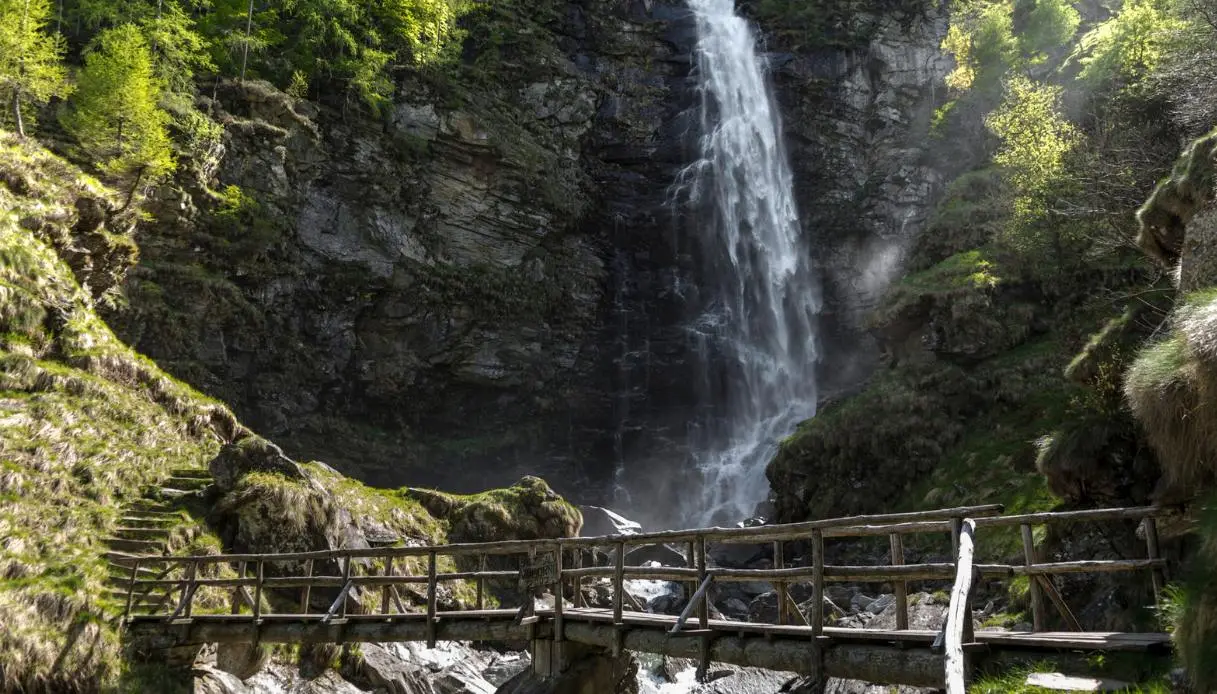
First a distant rumble, muffled at times by the wind and the trees, then a full, continuous, deep sound. That is the “welcome” of the Froda Waterfall (or La Froda Waterfall), which appears white against a dark wall, with a drop of about 100 metres that many describe as the most spectacular in the valley.
The lower point is located around 990 metres above sea level, and the water plunges into a green rocky basin, lifting a very fine mist on days of greater flow. Its force varies considerably throughout the year: spring and early summer typically offer the most vigorous display, thanks to the melt of snow accumulated at higher elevations; in winter the same wall assumes a stern character, with snow and ice along the slopes; between late summer and dry periods the flow can decrease. Yet, in essence, it is this very variability that makes it interesting.
Origin and Formation of the Froda Waterfall
The landscape of the Verzasca Valley bears the marks of the great glacial masses that, during the cold phases of the Quaternary, occupied the Alps and helped carve valleys, smooth rocks, and emphasize abrupt vertical drops. As they retreated, the glaciers left a morphology made of basins, thresholds, and steep walls. The watercourses seized those natural steps and, at points of greatest altitude difference, spectacular leaps were born.
The Froda belongs to this geography: the water arrives from the water system of the Val Redorta, a side valley relative to the Verzasca’s main axis, and it drops rapidly near Sonogno. The wall forces the flow to plunge almost vertically before gathering in the lower basin. On sunny days, the spray droplets can create small iridescent arches above the basin.
Granite and gneiss typical of the Ticino territory contribute to the place’s austere appearance. Grey surfaces, fissures, blocks covered in moss and dense vegetation form a natural amphitheatre that amplifies the noise. Just a few metres from the flow the perceived temperature drops and humidity rises; on nearby stones a damp patina often remains, a detail to consider when approaching the basin.
The Visit Between Sonogno, the Torrent, and the Basin at the Foot of the Drop
It doesn’t take much time to visit the roaring Froda Waterfall, nor does it require a lot of physical effort, at least along the direct route: from the village, follow the signs toward the drop and the Val Redorta. The route runs on an asphalt road or along a flat path and brings you face to face with this marvel of Switzerland in about 25 minutes.
Beyond the last houses, the paving gives way to vegetation, the torrent accompanies the path, and the Froda wall gradually appears in the line of sight. Wooden footbridges and stretches between rocks and trees add variety to a short route, while in the final stretch some passages may be damp and slippery. For this reason, shoes with good grip are a sensible choice, especially after rain or during periods of higher flow.
Reaching the vicinity of the bridge, the drop is seen straight on. From there you can continue toward the lower basin and approach the spot where the water explodes onto the rocks. This is the moment when the roar drowns out almost every voice, the air turns cold, and tiny droplets reach the face and clothes. More impressive than the height listed in a guide is the scale between the wall and the people standing at the base.
Those who wish to lengthen the hike can add it to the Sonogno–Corte–Sonogno loop. The official track measures 5.7 km, takes about 1 hour and 40 minutes, and features a total climb of 194 metres. After Froda you continue along the Val Redorta to Corte, then return on a secondary road. The route is rated T2 and allows a broader view of the Alpine landscape surrounding the village.
Back in the historic core of Sonogno, the Val Verzasca Museum and the House of Wool deserve time. The former preserves testimonies related to daily life and the valley’s traditions; the latter keeps alive the bond between the village and a textile craft rooted in local culture. For families there is also the BoBosco, a playful path with wooden marble tracks that winds through the valley and includes several stations near the village’s playground area.
Where It Is and How to Get There
Sonogno sits at the northern tip of the Verzasca Valley, in the Canton of Ticino, just above 900 metres of altitude. From Locarno you ascend the valley, passing Tenero, Vogorno, Lavertezzo, Brione, and Frasco up to the end of the drivable road. The journey already makes part of the day, because it threads a territory sandwiched between steep slopes, stone nuclei, and the turquoise course of the Verzasca.
By car you reach the entrance to Sonogno, but you should keep in mind that the historic centre is closed to ordinary traffic. There are, however, external parking areas, so the last stretch must be walked. In the summer months the parking lots can fill up quickly, and public transport often represents the most practical solution.
From Locarno, the PostBus 321 departs directly toward Sonogno, with connections that cross the entire Verzasca Valley. Once you reach the terminus, a short pass through the village and about 25 minutes along the Val Redorta bring you to Froda.
It’s wise to plan for more time than just a visit to the waterfall: Sonogno is small in size, and yet invites you to stay. A weathered stone façade darkened by the years, a balcony heavy with geraniums, the torrent that runs behind the houses, then that rumble that returns as you approach the side valley.