
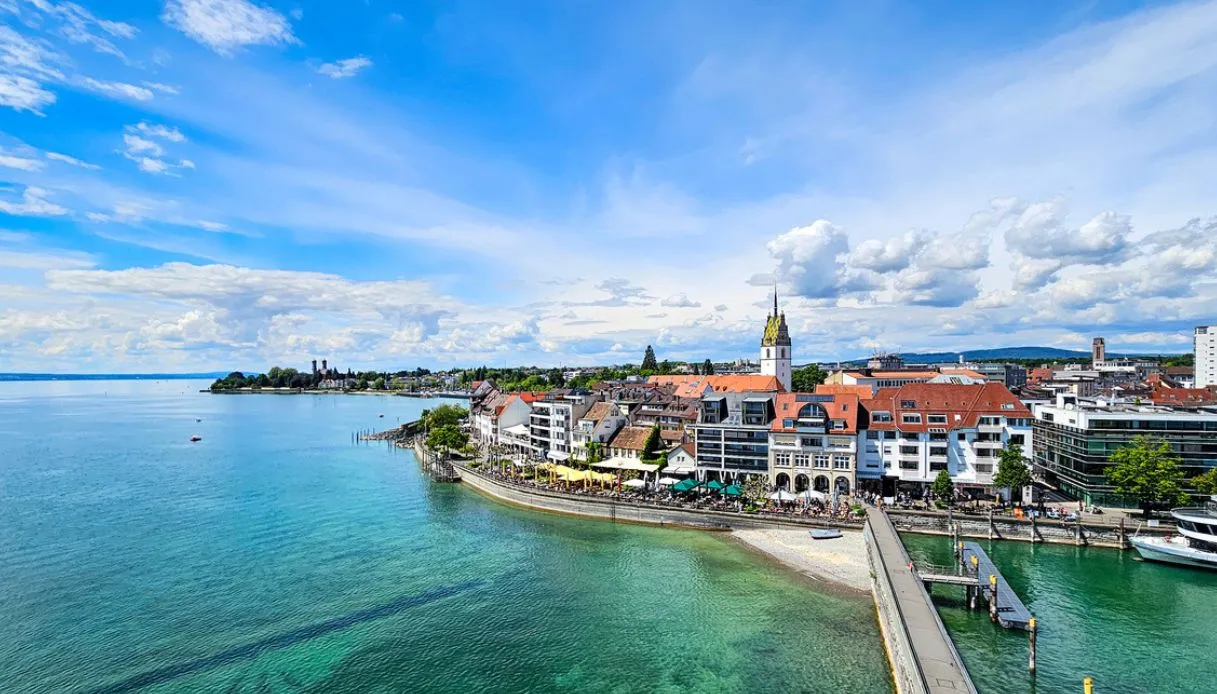
A long stroll along the shores of Lake Constance, with the Alps rising on the horizon, elegant historic buildings and a relaxed atmosphere that invites you to savor every moment: Friedrichshafen is one of the pleasant surprises of southern Germany, a city where tradition and modernity coexist in a landscape that wins you over at first sight.
And, from 2027, reaching it from Italy will become even easier: Ryanair has announced a new direct connection from Bari, set to operate from the end of March with two weekly flights, on Tuesdays and Saturdays.
In Baden-Württemberg, Friedrichshafen is also an important industrial and technological hub, and yet, alongside its innovative vocation, it preserves historical testimonies, baroque architectures, cafés, restaurants and viewpoints that deserve to be captured.
So let us discover the attractions not to miss.
The Zeppelin Museum, a journey through the history of the giants of the sky
The unmistakable symbol of Friedrichshafen is the Zeppelin Museum, one of its most important attractions, dedicated to the fascinating history of airships that revolutionized the way travel through the skies was imagined.
It rises right on the shores of Lake Constance, inside the former harbor station, a remarkable modernist building inaugurated in 1933, whose architecture recalls the functional principles of the Bauhaus. The museum opened its doors on July 2, 1996 and houses an extraordinary collection of testimonies, models, documents and objects linked to the era of airships.
The centerpiece is undoubtedly the partial reconstruction, 33 meters long and to scale, of the famous LZ 129 Hindenburg, one of the most famous airships in history, which became tragically known for the 1937 disaster: visitors can enter the recreated passenger compartments according to the original designs, discover the cabins, the salon, the spaces dedicated to reading and writing and imagine what it must have felt like to cross the Atlantic aboard an authentic giant of the sky.
The exhibition path also delves into the technical principles of flight, the innovations that made those extraordinary feats possible, and the role airships played in the industrial development of Friedrichshafen. It also features an artistic collection that accompanies the tale of the technology.
The Friedrichshafen Castle, ancient royal residence on the lakeside
Another stop worth noting is Schloss Friedrichshafen, the castle that testifies to the city’s prestigious past and its ties to the royal family of Württemberg.
Its origins are connected to the ancient Hofen monastic complex, founded in medieval times; between the 17th and early 18th centuries, the building took on new architectural forms, but it was especially in the 19th century that it underwent a decisive turning point: from 1824, the king William I of Württemberg had the former monastery adapted as the summer residence of the royal family.
The castle remains in the Württemberg family and, being a private property, is not open for interior visits. Instead, the nearby Schlosskirche deserves to be admired, the splendid baroque church recognizable by its two towers about 55 meters tall.
The promenade along Lake Constance, Alpine panoramas and romantic atmospheres
If there is a place that captures the essence of Friedrichshafen, it is undoubtedly its Uferpromenade, the lakeside promenade considered among the most beautiful and longest around Lake Constance.
The route runs along the shore, from the mouth of the Rotach river to the Schlosskirche, offering views that, on clear days, become spectacular: the blue expanse of the lake stretches before the eyes, while in the background rise the majestic Austrian and Swiss Alps.
Along the avenue, cafés, restaurants and ice-cream shops line up, ideal for an outdoor break during the warmer days when the promenade comes alive with locals and visitors; but the charm of the stretch does not fade even in winter, when the atmosphere becomes more intimate and the snow-capped mountains provide an unforgettable panorama.
If you wish to admire Friedrichshafen from a different perspective, the Moleturm, a panoramic tower about 22 meters tall at the port, offers a splendid view of the city, the lake and the alpine range.
The Church of St. Nicholas, a witness to Friedrichshafen’s history
In the heart of the town, another building that deserves a visit is the Church of St. Nicholas (St. Nikolaus), an important religious and architectural landmark whose history spans centuries and tells the transformations of Friedrichshafen.
The first records of a chapel on the site date back to 1293, while in 1325 there is a documented reference to its dedication to St. Nicholas. During the 15th century it was enlarged according to the late Gothic style, with the construction of the tower and the choir; it underwent further changes, adopting a Baroque imprint in the 18th century and, in 1883, Neo-Renaissance architectural elements.
Its story is also marked by one of the most dramatic chapters in the city’s history: the bombardments of World War II, which in April 1944 devastated much of the building along with the historic center. Reconstruction began in the postwar period, and the church was reconsecrated in 1949.
