
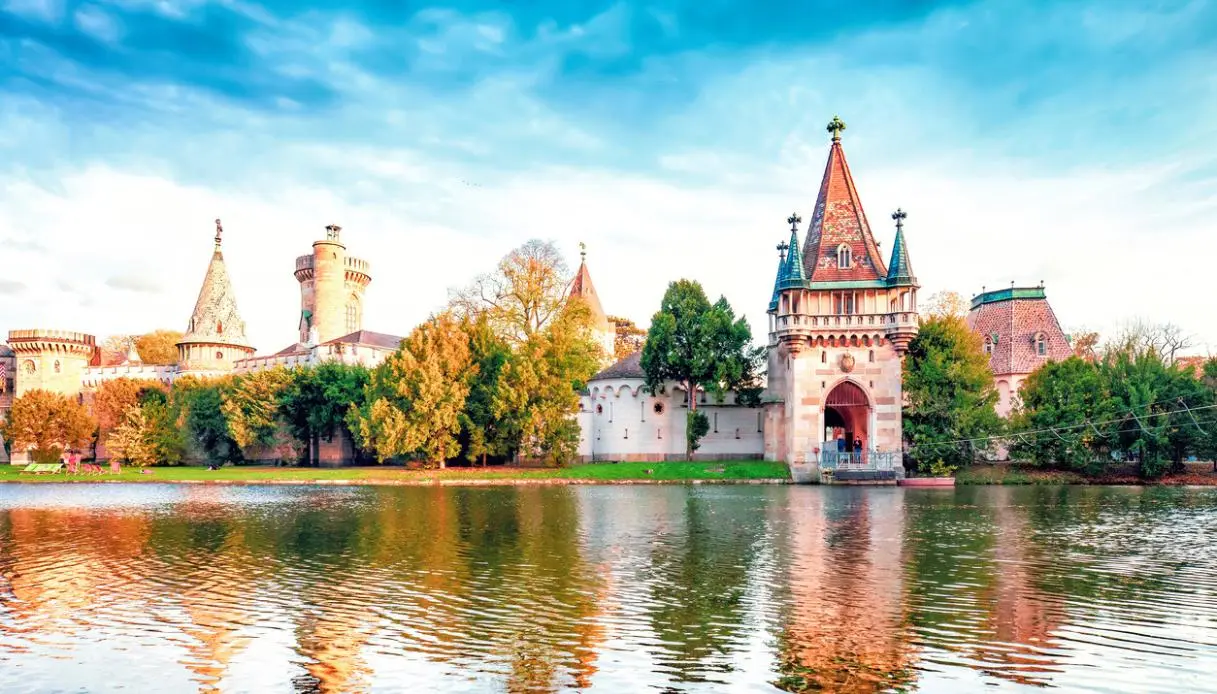
We are used to thinking of European capitals as a tangle of traffic, chaos, and (often) daily stress. But the truth is that, very close to them (in certain circumstances), there are places that are incredibly the opposite. This is what happens less than 20 km from Vienna, where on a small island, connected to the mainland by bridges and a ferry, rises the fairy-tale Franzensburg Castle.
Yes, it is truly a world apart from the city, a treasure commissioned by an emperor at the end of the 18th century to give shape to his own idea of the Middle Ages. We are in Laxenburg, inside one of Austria’s most important landscaped parks. Around the fortress, in fact, stretch about 250 hectares of meadows, groves, waterways and paths, laid out according to the taste of English garden design.
Among footbridges, small temples and vistas designed to surprise, the surroundings seem to slowly prepare for the encounter with the most singular building of the entire estate. Consider that its nickname is the “The Little Chest of Austria” and that it is one of the most fascinating examples of the country’s architectural romanticism.
A Brief History of Franzensburg Castle
At the end of the 18th century, when Laxenburg had already been a beloved spot for the Habsburgs for centuries, the dynasty decided to transform one of its properties into an important place of leisure and representation. Specifically, it was Emperor Francis II who wished to create a grand English garden full of irregular perspectives, vegetation and decorative architectures.
Work began in 1798, on the design by architect Johann Ferdinand Hetzendorf von Hohenberg, but over time there were subsequent enlargements that gave the complex much of the appearance we can enjoy today. That, however, was a period when Europe endured the dislocations of the Napoleonic wars, and for this reason the castle gradually became a device to narrate the continuity of the Habsburg power, through portraits, symbols and references to the great protagonists of the family.
One of the most curious aspects is precisely that, rather than merely reproducing ancient decorations, the designers recovered original parts from monasteries, churches and aristocratic residences, such as ceilings, coverings and stained glass from historic buildings, later moved to Laxenburg and inserted into the new construction.
These elements are called spolia, a term used to indicate architectural fragments reused in different contexts. This choice makes Franzensburg a sort of museum built with authentic pieces of the past, while raising today questions about the removal of such works from their original sites.
Also the surrounding area was transformed into a knightly quarter, the Rittergau, with land ideally designated for tournaments, monuments dedicated to knights and Gothic bridges. At the same time, underground passages, knightly rooms and enigmatic-looking spaces were conceived to provoke curiosity and wonder.
A historical detail makes the tale even more interesting: the chapel was consecrated on October 15, 1801 and a few days later the first guided tours began. The castle, in fact, was designed to be shown to the public, rather than to become a true imperial residence.
Visiting Franzensburg Castle and What to See
After crossing the vast park of Laxenburg, the silhouette of this enchanting Austrian fortress appears among the trees and is reflected in the waters of the artificial lake. It should come as no surprise that one of the most thrilling ways to approach it is by taking a small ferry that leads to the island (when in service).
From that perspective, the towers overlap, the walls seem to rise straight from the water, and the rooflines change depending on the viewing angle. Once the complex is reached, the visit continues through spaces that recount the history of the Habsburgs, though, and it is worth noting, the interiors are accessible only through guided tours.
The first route includes 18 historical rooms and allows visitors to observe the furnishings, artworks and architectural details. It’s impossible not to be spellbound by the Throne Room, which greets entrants with an elaborate wooden ceiling, large portals and a golden throne draped in red velvet. Next to it are the Hall of the Habsburgs and the Hall of Lorraine, dedicated to the dynastic families through statues, paintings and genealogical references.
Special attention is also due to the Dining Hall, which is a crowd of colorful stained glass and architectural decorations. Not to be overlooked are the wooden ceilings recovered from the Zwettl Abbey and the Rappottenstein Fortress, as well as the ancient coverings from the Capella Speciosa of Klosterneuburg, dating back more than 800 years.
Then there are the Lady-in-Waiting’s Chamber, the Armory, the rooms dedicated to the squires and even a prison, all spaces embellished with armor, objects and decorations.
The second itinerary, instead, leads to the High Tower, the Hoher Turm, via a climb of 165 steps. The route also includes a passage above the fortress roofs along a crenellated walkway from which you can closely admire the building’s intricate layout.
From above, the view opens to 360 degrees over the park and the surrounding territory. On clear days, the Schneeberg range, the Viennese Forest and other mountains of Lower Austria can be seen. Below the tower, the lake reveals the shape of the artificial island and the arrangement of the gardens.
Both visits last about 50 minutes and admission tickets can be bought online or at the museum shop, located in the fortress courtyard. It should be noted, however, that availability is limited, especially for the panoramic route (which, among other things, takes place only in favorable weather conditions).
Before or after the visit, it is worth taking time to enjoy the surrounding landscape. The park houses, in fact, other elements of the imperial project, including the Lion Bridge, small ornamental buildings and ponds that let you breathe deeply the atmosphere of the great aristocratic European gardens.
Where It Is Located and How to Get There
Franzensburg Castle is located in Laxenburg, Lower Austria, about 20 kilometers from Vienna’s city center. By car it typically takes around 30 minutes, following the A2 motorway and taking the Wiener Neudorf exit. The main navigation reference is Schlossplatz 1, 2361 Laxenburg, the address of the park’s main entrance.
Three free parking areas are available, identified as P1, P2 and P3. The first is located at the main entrance, while the others run along Münchendorferstraße.
Those who prefer public transportation can depart from Vienna’s central station, Wien Hauptbahnhof, and take bus 200 toward Laxenburg Franz-Josephs-Platz. The journey lasts nearly 30 minutes, followed by a short walk to the garden entrance. Additional connections allow reaching the site from Mödling and Wiener Neudorf.
