
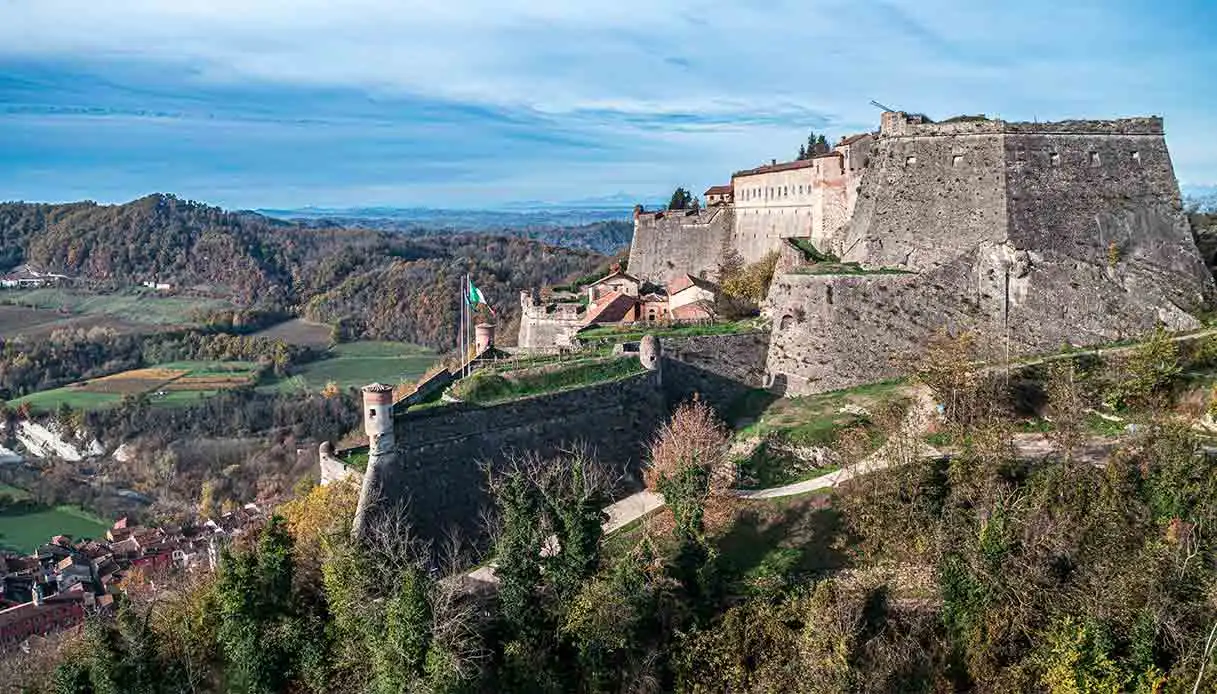
Straddling three regions—Liguria, Piedmont, and Lombardy—the Oltregiogo Fortress of Gavi dominates a vast territory also known by that name, dating back to before the year 1000. After centuries, this impregnable fortress—and from which escape was nearly impossible—remains as striking and austere as ever, and has recently reopened its doors following a major renovation, ready to be explored.
Four centuries after the project that transformed the old medieval castle into the imposing modern fortress began, the Fortress of Gavi inaugurated a new phase in its history. And we went to discover it.
The History of Fort Gavi
The earliest written documents testifying to the existence of the Gavi castle date to 972–973. At that time it was a small medieval castle with towers. To pass along this stretch of land, traversed by two important Roman roads, the Via Postumia and the Via Aemilia Scauri, one had to pay toll. Consequently, it served more as a border outpost than a fortress.
Over the centuries, the castle followed the political fortunes of the area. In 1191, the Emperor Henry VI, son of Frederick I Barbarossa, granted the castle and the village as a fief to the Republic of Genoa. In 1418, it passed under the rule of the Visconti of Milan; after further changes of ownership, in 1528 it definitively returned to the Republic of Genoa, which kept it until 1815, when the Republic fell and it was annexed to the Kingdom of Sardinia. It was under Genoese rule that the castle was transformed into one of the most imposing fortresses in northwestern Italy.
The first major renewal work was carried out around 1540, when the military engineer Giovanni Maria Olgiati completely redesigned the defensive system, rebuilding the ramparts, constructing new bastions, and consolidating the entire complex. In the following century, the Fort reached its greatest extent thanks to the project of the Dominican friar Vincenzo da Fiorenzuola, better known as Gaspare Maculani, a celebrated inquisitor in Galileo Galilei’s trial, but also an expert in military architecture, what we would today call an archistar.
Between 1626 and 1629, the structure was enlarged and reinforced, with works that continued into the early 19th century. The Monte Moro redoubt was built, linked to the Fort by an underground gallery, along with new accommodations for soldiers and officers, cisterns, powder stores, guard posts, and drill yards. Some of the era’s most important military engineers contributed to these works.
In 1854, the Fort definitively lost its defensive function, was disarmed and transformed into a civilian prison. During World War I it became a military prison, housing both Austrian prisoners and Italian soldiers. In the interwar years, some of its embankments were converted into experimental vineyards, giving the complex an unusual agricultural vocation.
During World War II, the Fort resumed its role as a detention site as a high-security prison. Known by the prisoners as “Bad Boys Camp” or as “Stone Box” or as “Camp 5,” it was reserved for British officers who had already attempted to escape from other detention camps. Among the most famous inmates were David Stirling, founder of the Special Air Service (SAS), Jack Pringle, major of the VIII Reggimento degli Ussari Reali Irlandesi, a figure in a spectacular escape attempt that is the subject of a docufilm shown in a Fort room, and Alastair Cram, a Scottish officer and serial escaper who attempted to flee 21 times, including the sensational escape from the Fort of Gavi, recounted in a book titled Un hombre en fuga – The true story of Lieutenant Alastair Cram, written by David M. Guss.
The Structure of Fort Gavi
Fort Gavi features a magnificent three-level layout, so vast that it spans an entire hillside. Its towering outer walls and the bastions, each irregular and distinct, built of earth to absorb the shock of potential blasts, impart a sense of majesty and an impregnable character.
Entering through the main gate (if you arrive before your scheduled visit time, you’ll find it closed), you descend a long stone corridor that leads to a second heavy wooden door opening onto the courtyard where the Lower Fort lies, the military citadel that could house around a thousand soldiers and which later accommodated prisoners.
You can enter some of the cells that remain intact, while others host temporary exhibitions. At the far end of the courtyard is the church, which was never truly used for religious purposes; instead, it was employed by officers to shower.
Yet everything begins in the Alto Forte, the highest part of the fortress, a section entirely reminiscent of a castle, reached through a separate route. It is very likely that initially a Roman fort stood in its place, over which the medieval fortress later rose.
The Restoration of the Fort
On March 11, 1626, the interventions began that would shape the current fortified structure, one of the most significant examples of military architecture of its time: a complex defensive machine on three levels, with bastions and curtain walls designed to endure sieges and stand the test of centuries.
In 1946 the Fort was entrusted to the Soprintendenza per i Beni Architettonici del Piemonte. Since 1978 it has been the subject of a continuous program of restoration and enhancement that has restored one of the most significant examples of military architecture in Europe. Today, four hundred years later, it has been completely renewed with exhibition spaces inside the cells, in the interior rooms, in the attic and in the courtyard, where there are outdoor installations, and visiting routes that include a permanent exhibition and the integration of new digital technologies for a monument narrative accessible to all.
The Legend of Gavina’s Ghost
As in many castles, legends are not missing at Fort Gavi. It tells of the daughter of a Frankish king, Gavia or Gavina (from which the municipality of Gavi takes its name), who was forced to marry a suitor chosen by her father. She, however, was in love with the stableman, so the two decided to run away, leaving no trace. Arriving in this area, where they found a nearly deserted castle, they chose to live there. The princess was very beautiful and very gentle, so the people of the village of Gavi grew fond of her. But the fear was that the father, once he found them, would kill them both or, at least, would kill the stableman and bring his daughter home to marry her to the chosen suitor. It was Amalasunta, daughter of another Frankish king, who kept them hidden and saved the couple by allowing them to live in the Fort.
Tradition holds that Gavina was buried in the Alto Forte, most probably inside the tower. And there are those who claim that her ghost still roams the castle walls. Until a few years ago, Gavi hosted a grand historical reenactment each year with a costume parade at the end of which the year’s Gavina princess was crowned.
How and When to Visit
To visit Fort Gavi, you must book online, but payment is made at the on-site ticket office upon arrival for the guided tour, which is mandatory (the whole visit costs just 5 euros, 2 euros for ages 18 to 25, and it is free for those under 18, people with disabilities, and their companions). The Fort is open from April to September; on weekdays tours run at 08:30, 10:00, 11:30, 16:00, and on holidays at 09:30, 11:00, 16:00, and 17:30.
The guided tour, essential to discover all the anecdotes tied to the Fort, does not always include the Alto Forte; this part is open to the public only on the second and fourth weekends of the month, with two daily visits (10:30 and 13:00) and requires a separate ticket. The visiting route is mainly outdoors, so it is advised to wear appropriate clothing and footwear.
If you arrive early, you must wait outside the gate as admissions are tightly timed. There is a parking area in a small lot just outside, accessible by driving up a narrow and steep road. Outside the castle there is little else—just a few private houses that once formed part of the Fort and served as outposts; therefore, if you are early, the recommendation is to stay in the town of Gavi, which is very charming to explore, with wine bars serving the famous Gavi wines from local cellars and several trattorie where Piedmontese specialties are superbly served.
The Fortress of Gavi, in the province of Alessandria, is easily accessible from Turin, Milan, and Genoa and from the major northwestern centers, and is set in a context that each year attracts millions of visitors thanks to a history and landscape heritage of great value, to exceptional food and wine experiences, and to the presence of the Serravalle Designer Outlet that each weekend draws a large number of shopping enthusiasts.