
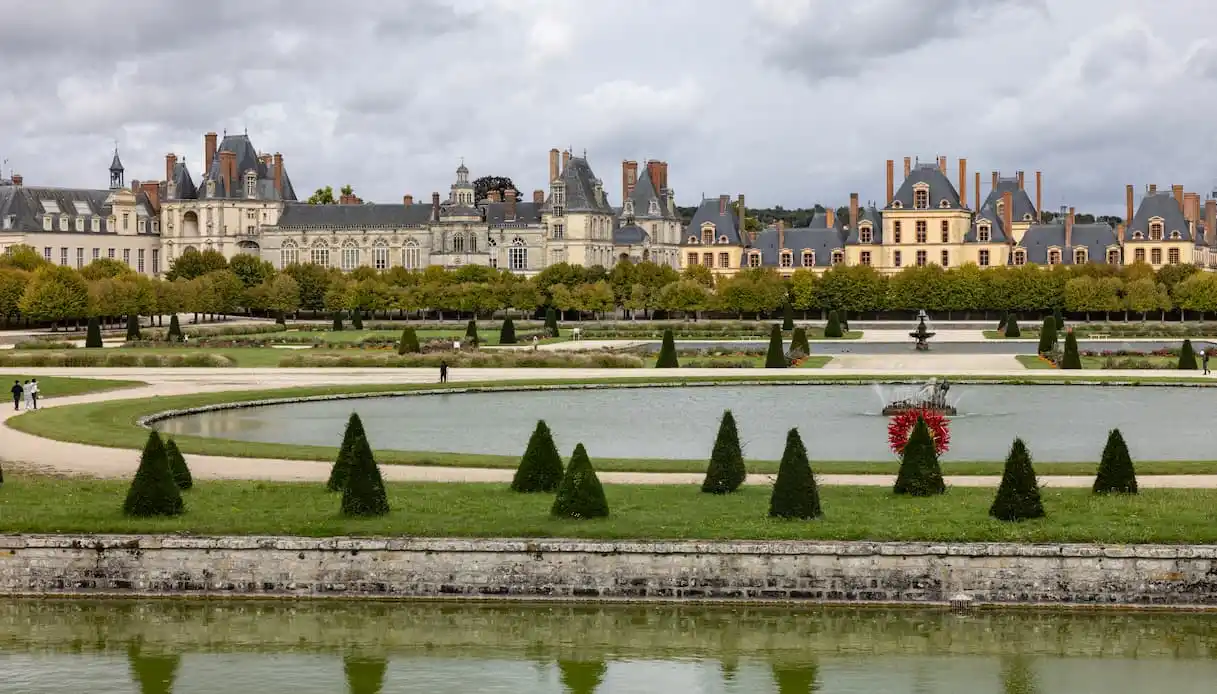
It is not the best-known royal residence in France, yet this ancient and noble castle absolutely deserves a visit. Less than an hour from Paris lies a place that has traversed almost the entire history of the French monarchy. Fontainebleau Castle, declared a UNESCO World Heritage Site, was the preferred residence of kings, queens, and emperors for more than eight centuries, long before Versailles became the emblem of the French court’s splendor.
Frescoed halls, Renaissance galleries, imperial apartments and vast gardens narrate the transformations of a palace that, even today, retains the charm of great royal residences.
The history of the castle and what to see during the visit
The origins of Fontainebleau Castle date back to the 12th century, when Louis VII had a fortress built in the heart of the forest. It was, however, Francis I, in 1528, who transformed it into a magnificent Renaissance palace, inviting none other than Italian artists such as Rosso Fiorentino and Primaticcio and giving life to the famous Fontainebleau School, which profoundly influenced European art.
Over the centuries the castle has been home to 34 kings of France and two emperors, becoming one of the monarchy’s most beloved residences. Here sovereigns were born such as Francis II, Henry III and Louis XIII, while Louis XV celebrated his marriage in the Chapel of the Trinity. Napoleon Bonaparte also left an indelible mark: he restored the palace, transforming it into an imperial residence and, right here, in 1814, he saluted the Imperial Guard before his exile to the Isle of Elba, a moment that entered history in the famous Cour des Adieux, the Courtyard of Farewell.
Today it is possible to visit 121 rooms out of the more than 1,500 that make up the complex. Among the most spectacular spaces stand out the Gallery of Francis I, decorated with Renaissance frescoes and stucco, the Ballroom, the Chapel of the Trinity, the elegant imperial apartments, and the only Napoleon’s Throne Room still preserved in France. Outside, a stroll through the historic gardens, the long ornamental canal, and the famous Horseshoe Staircase—one of the castle’s symbols and among the most photographed spots in the entire complex.
Where the Castle of Fontainebleau is located and how to reach it
The Castle of Fontainebleau is situated in the town of Fontainebleau in the Île-de-France region, about 55 kilometers southeast of Paris, making it an ideal destination for a one- or two-day excursion. Getting there is straightforward even without a car. From Paris’ Gare de Lyon station, direct trains run to Fontainebleau-Avon, with a travel time of roughly 35–40 minutes. From the station you can reach the castle by urban bus or on foot after a stroll of around 30 minutes through the park and the historic town centre.
After the visit, it is worth dedicating some time to the surroundings. Fontainebleau’s town center hosts boutiques, cafés, restaurants, and a lively market, while the Forêt de Fontainebleau, spanning more than 220 square kilometers, offers hiking and cycling trails and is one of the world’s best-known destinations for bouldering, the sport of climbing on boulders. Those who wish to deepen the region’s historical heritage can also visit the nearby Château de Vaux-le-Vicomte, regarded as the source of inspiration for Versailles.
The castle is open all year round, except Tuesdays and certain holidays. Access to the parks and gardens is free, while the admission ticket allows visits to the royal apartments and the Napoleon I Museum, completing a journey through more than eight centuries of French history.