
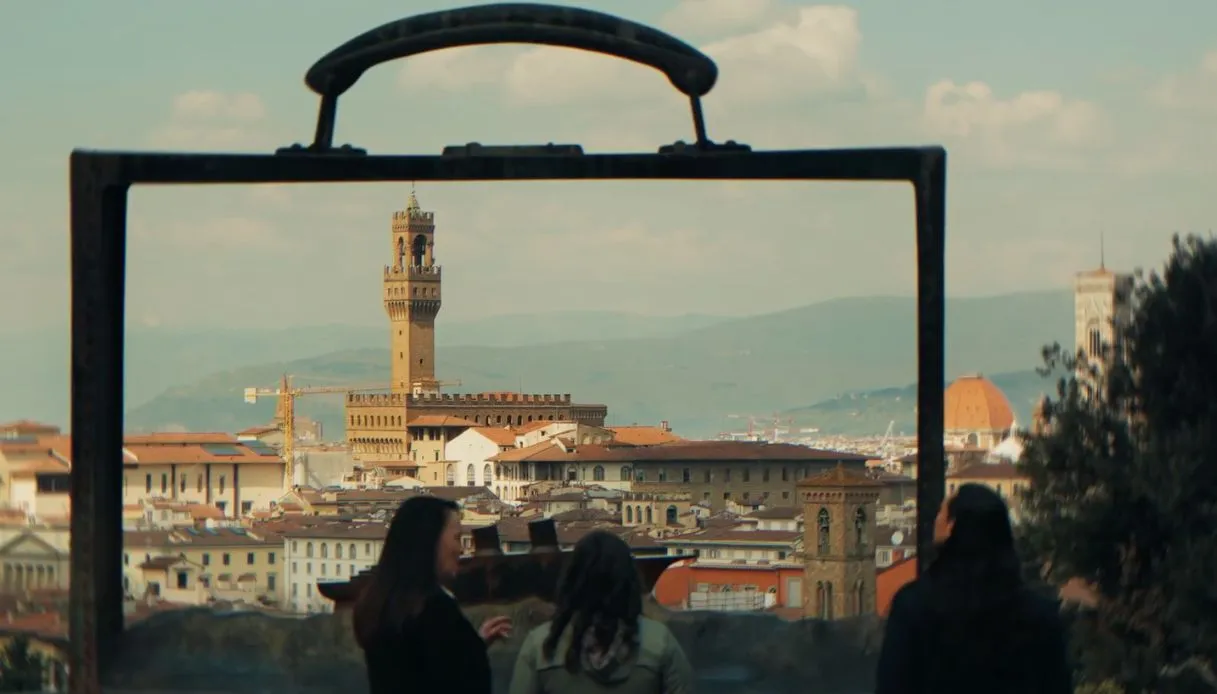
Florence has never been merely a city: it is a threshold, a place where beauty does not simply decorate space but pervades it, where every stone preserves the memory of those who had the courage to transform necessity and beauty into something tangible and resilient in the face of life’s inevitable changes.
Since its founding, the Tuscan capital has welcomed those who have made the fine arts their highest vocation. And it has never ceased to do so: it is in this city, for instance, that soon one will be able to admire the exhibition Senza Fine, marking the return of painter Janet I. Traub. Florence, for her, is not a picturesque backdrop: it is the place where two chapters of her life—separated by thirty-two years of silence—finally find a common name.
Senza Fine, an intimate and immersive journey
And it is truly worth dwelling on the show. Culture-loving travelers know that, while every artistic expression is undoubtedly worthy of consideration, there are exhibitions you visit and exhibitions you walk through. Senza Fine belongs to the second category: it is a journey that is not born merely to be looked at, but to enchant, to be admired, to ensure that those moving through the rooms pause and let the details speak.
And the details worth reflecting on are many. For example, the exhibition (free admission) unfolds in two stages, both in the heart of Florence. And the choice of venues is not random. From June 27 to 29 its home will be the Hotel Helvetia & Bristol and, more precisely, the evocative Winter Garden Room: the very place where Janet I. Traub first felt that creative spark that would shape the entire painting cycle.
Visiting the works here is not simply looking at paintings: it is entering the origin of something. And, starting from 2:30 PM, it becomes a moment more deeply connected with human presence, beauty, and conviviality, thanks to live classical music curated by Firenze Classica, to aperitifs, to food and wine tastings, and to informal opportunities to dialog with the artist.
And the second? The second stop, from July 1 to 15, will be a embrace from Geko Art Studio, a space dedicated to contemporary art and culture, where the pace becomes more relaxed and the gaze more concentrated. And, it must be said, Geko Art is much more than a gallery.
It is a place of gathering, education, and inspiration open to anyone who wishes to approach the world of art or refine their techniques, born with a clear mission: to curate stimulating artistic experiences, offer enriching lessons that ignite creativity, and leave a lasting impact on those who experience them.
For Senza Fine, Geko Art Studio is not a mere exhibition container: it has been an active participant in the project from the outset, co-producing the video artwork that accompanies the show and providing the painterly research of Janet I. Traub with a space capable of dialoguing with it.
The Distinctive Features of the Exhibition
Returning to the Winter Garden Room, room 274 of the Helvetia & Bristol… what happened inside there? It all began with a pomegranate, from its image, which asserted itself as the beating heart of an entire painting cycle, with an extraordinary delicacy. And the pomegranate is not a mere decorative subject: it is one of the oldest and most layered symbols of Mediterranean culture, evoking Persephone, love, fertility, fragility, and rebirth.
In Traub’s painting all of this condenses and transforms: the seeds guarded within a hard rind become a metaphor for inner life, for feelings that mature over time, for beauty that does not reveal itself all at once but unveils itself slowly to those patient enough to wait.
And indeed, waiting can be spoken of in the case of the works of Senza Fine in Florence. Traub endured thirty-two years of creative silence, not out of abandonment but necessity: life, motherhood, daily urgencies took the brush’s place. Yet during those years she did not stop watching: she visited museums and galleries and kept alive inside herself something waiting for the right moment to return.
When that moment arrived, she did not settle for less and drew on all the experience gathered during her studies at the Charles H. Cecil Studios in Florence, at the Florence Academy of Art, still in Florence, and at the Academy of Realist Art in Edinburgh: three of the most rigorous schools for European realist figurative painting.
The result is a painting style that combines the solidity of classical technique with the vibrancy of something deeply personal: intense colors, a light that seems to emanate from within objects, figures and still lifes that do not merely exist but appear to have something to say. The works are oil paintings where the depiction is never an end in itself: they embody the presence of someone who paints because they need to.
Visiting Hours
As mentioned, the first stop, at the Winter Garden Room of the Helvetia & Bristol Firenze, is accessible from June 27 to 29, every day from 10:00 to 14:30. On June 27 there will be a vernissage, with a private invitation-only reception from 18:00 to 20:00.
From July 1 to 15, the exhibition continues at Geko Art Studio, open Monday to Friday from 10:00 to 13:00 and from 14:00 to 19:00. Weekend visits are available by appointment. Geko Art is a space open to everyone, from the curious beginner to the artist who wants to deepen their technique, to the extent that it offers painting, sculpture, and fresco courses, live drawing sessions, Leonardian drawing lessons, and fixed monthly workshops. Lessons are held in person and online, in individual or group formats, with short- and long-term tracks, evening classes, and activities geared toward children.