
One cannot fault the millions of travelers who every year flock to Sicily’s beaches. The island at the southern tip of Italy is a fabulous place, with crystal-clear seas, millennia of history, and charming villages. Its strength lies precisely in its variety, so much so that it can feel like a continent, rather than a mere patch of land emerging from the sea.
It is this very variety that suggests there is room not only for tourism focused on discovering cities or seaside resorts. The inland of Sicily, for instance, is a vast treasure chest of nature, filled with hills, forests, and mountain ranges. Among them lie some beautifully stunning waterfalls: no one would expect to come to Sicily to discover freshwater sites, and yet there are notable cascades, often set in an unusual natural panorama that makes them true wonders not to be missed.
Oxena Falls
In 2025 Militello in Val di Catania was elected Borgo dei Borghi. A handsome Baroque town located to the south of the Etna region. Its territory caresses the foothills of the Hyblean Mountains, where the Oxena torrent flows, having carved its bed over millennia inside a canyon of volcanic origin.
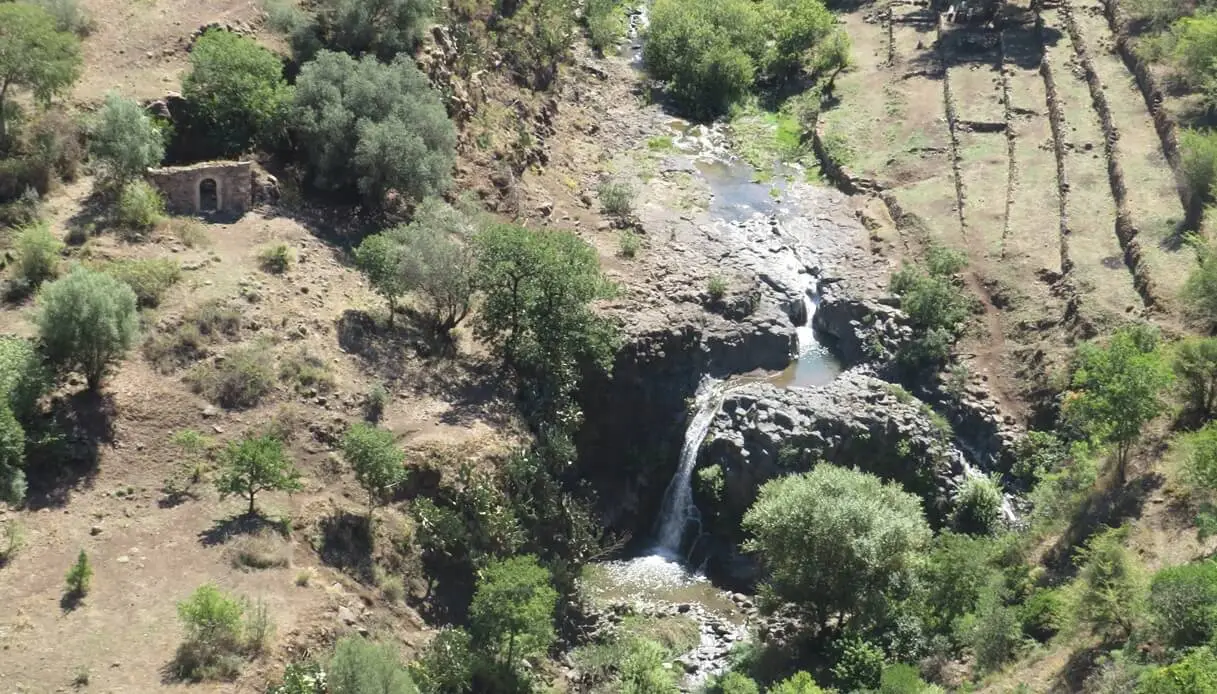
Not far from Militello lies a splendid waterfall (even though they are known as Oxena Falls, the main cascade itself is a single drop, in an area nevertheless characterized by smaller cascades and rapids), fed by numerous springs opening along the banks of the river, even in periods of prolonged drought.
The surrounding landscape is distinctive. It alternates green areas where herds of cows graze with barren zones where a reddish earth emerges bearing olive trees, carobs, and prickly pears.
Oxena Falls can be reached on foot or by bike from Militello in Val di Catania, about five kilometers away. A shorter approach, instead, is from the last point accessible by car: you reach it in roughly 15 minutes on foot from Contrada Bognanni, a narrow road from which you can enjoy an initial view from above of the waterfall.
Two little cascades precede the descent to the main drop, roaring against basalt rock that rises black from the ground around the stream. Descending to the lower level, a lovely little beach shaded by oleanders and tamarisks allows you to best savor the contemplation of the waterfall.
San Nicola Waterfall
About a half-hour drive from Palermo, in the territory of the small municipality of Bolognetta, lies one of the lesser-known waterfalls in western Sicily: the San Nicola Waterfall. It is the work of the Milicia torrent, which originates in the Ficuzza Forest area near Corleone, and flows into the Tyrrhenian Sea between Casteldaccia and Altavilla Milicia.
The best period to visit the waterfall runs from October to May, when the water flow is more abundant, but in summer the San Nicola Waterfall usually holds its own, and the beautiful emerald pool at its base remains a refreshing oasis.
The setting around the drop is spectacular: a broad rocky gorge dominated by ochre hues, with most of the greenery represented by the ubiquitous prickly pears. The stream represents a lifeblood in an otherwise arid territory. The path to reach it is about a fifteen-minute walk from the paved road and crosses rocky stretches and unmarked trails, though it is clear where to pass thanks to well-worn tracks.
Waterfall of the Valley of the Stone Castle
The Vallone del Castello di Pietra is one of the most hidden and wild places in Sicily. It is a small canyon carved by a torrent within which you can admire the remains of a prehistoric fortification (the Castle of Stone, indeed), a massive example of the holm oak, and a beautiful waterfall set in lush greenery.
It is not the easiest place to reach. It lies south of Partanna, a town not far from Castelvetrano, in the island’s southwestern region. You must reach the Baglio Vecchio agriturismo, isolated amid cultivated fields and countryside, and here request the keys to open the gate that provides access to the Vallone.
Beyond the reserve’s gate, a staircase immersed in vegetation leads to the bottom of the gorge. Here a path runs along the canyon. In one direction you reach the waterfall, in the other you arrive at the centuries-old holm oak and the point from which you can identify the fortress ruins. The setting, with cliffs carved by the elements, combined with a lush abundance of greenery along the riverbank, makes it a scene more unique than rare for western Sicily.
Angara Falls of the Piristeri
On Sicily’s eastern flank, where Mount Etna dominates the panorama: between the Peloritani and Nebrodi mountains, in the municipality of Roccella Valdemone, a tributary of the Alcantara River named the Roccella stream gives life to one of Sicily’s tallest waterfalls, the Angara Falls of the Piristeri, also known as the Palazzolo Angara. The drop stands at about twenty meters as the water plunges against a stunning rock wall, forming a wide pool at its base surrounded by a dense forest and lush vegetation.
The waterfall is spectacular, but so is the beautiful hike required to reach it. It starts near the wind turbines at Pizzo Perino, following a descending trail that offers splendid panoramas, initially of Etna in the distance, then of the valley slopes as you descend.
The descent lasts about an hour, with a notable incline on the return. The natural setting, however, more than makes up for the effort. Once you reach the level ground at the bottom of the gorge, you instinctively locate the waterfall by following the stream upstream to the majestic drop.
Catafurco Falls
Visiting the Catafurco Falls is a true mountain experience in Sicily. The cascade is tucked away among the folds, peaks, and sides of the Nebrodi, in the territory of the commune of Galati Mamertino. Here the San Basilio torrent has sculpted the rocks over the centuries so that today it confronts a drop of roughly thirty meters, extremely scenic because it occurs inside a kind of chimney, at the base of which a small pool forms where you can enjoy a sort of natural shower.
The trail leading to the waterfall is beautiful. Four kilometers of path from the San Basilio fraction of Galati Mamertino, along a comfortable dirt road that then becomes a trail, with railings and steps in the final stretch. You pass small goat, pig, and donkey farms along the way, and a stop is well worth the visit to the village of Molisa, a rural settlement built entirely in dry stone, with the characteristic straw huts once used as shelters by shepherds.
The route, largely sun-exposed, is nonetheless punctuated by several springs of fresh water and invites the eye to wander along a splendid, narrow valley.