
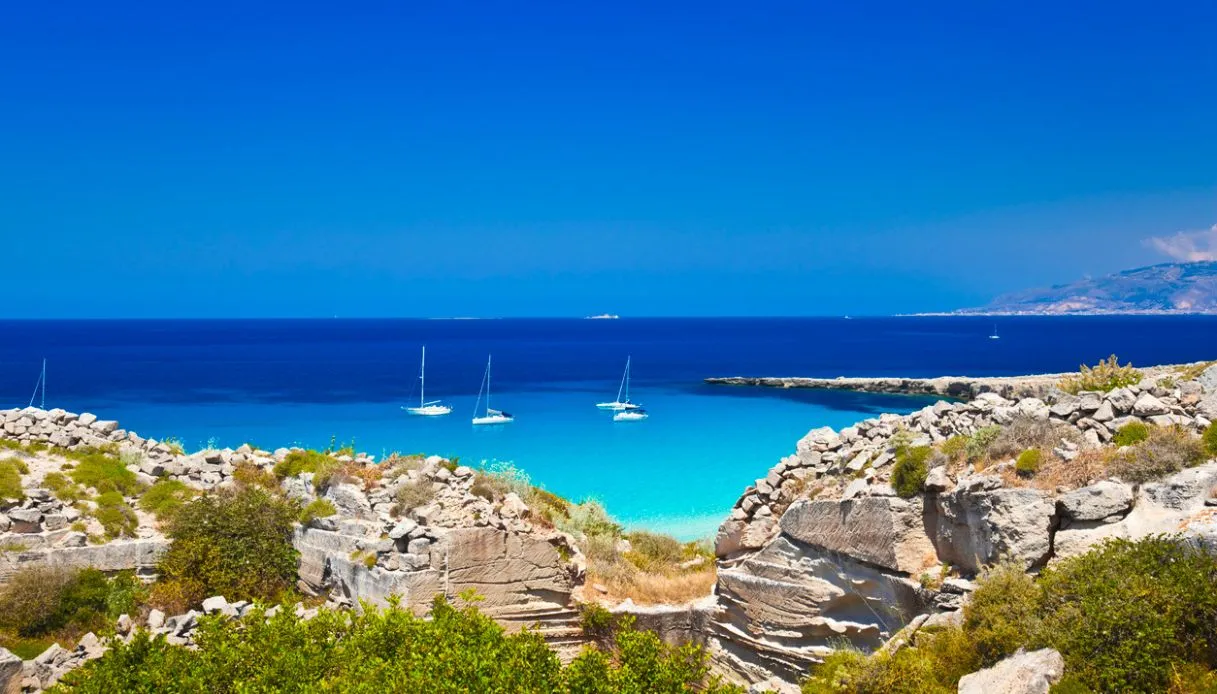
Favignana, the largest and most famous island of the Egadi archipelago, is one of the most fascinating and sought-after destinations in western Sicily. A few kilometers off the coast of Trapani, it rises in the Mediterranean with a distinctive profile and a succession of wild coves, light-colored cliffs, and transparent waters that change hue with the light, ranging from azure to the deepest turquoise.
Visiting it means letting yourself be won over first and foremost by the sea, but stopping only at its beaches would be reductive: it boasts a history linked to tuna fishing, calcarenite quarries, the Florio family, and a landscape shaped as much by nature as by human labor. No wonder it is also known as the “butterfly on the sea”: observed from above, its shape really resembles two wings spread over the waters of the Mediterranean.
Not only: today Favignana also has a new cinematic face: Christopher Nolan chose it among the locations for his Odyssey, transforming it on the big screen into the homeland of Odysseus, Ithaca.
Favignana beyond the sea, from the Forte di Santa Caterina to the quarries
The silhouette of Favignana is dominated from above by the Forte di Santa Caterina, also known as the Castello di Santa Caterina, which rises atop the hill of the same name at about 310 meters above sea level: visible even from Trapani and Erice, it remains a landmark of the island and tells centuries of sightings, defense, and territorial control.
Its history begins in the IX century, when the Saracens built on the summit a watchtower: the Normans later transformed it into a small fortress, enlarged in the XV century by Andrea Riccio, then lord of Favignana. In Bourbon times the structure served as a prison and then as a military outpost, until its abandonment in the last century.
Since then, time seems to have stood still within the walls of the ancient fortress, while its location remains spectacular: from above the view embraces Favignana, the other Egadi, and the western coast of Sicily, with the sea stretching all around and making the island’s distinctive shape even more evident.
Another key stop is the Ex Florio Plant: with its 32,000 square meters, three-quarters covered, it was among the largest tuna canneries in the Mediterranean and today represents a true jewel of industrial archaeology. In 1841 the Florio family leased the tuna works from the Pallavicini family of Genoa, inaugurating a chapter destined to leave a deep mark on Favignana’s history. The vast spaces that were once central to the tuna operation help illuminate how tuna fishing helped shape the local community and how the Florio name remains tied to the island’s identity today.
But Favignana’s history is also etched in stone: for a long time people mined the rock to extract blocks of calcarenite, commonly called tuff, forming quarries, galleries, and sheer walls that forever altered the island’s face.
With the extraction activity finished, some quarries were abandoned and reclaimed by vegetation: from this unusual meeting of nature and human intervention arose the underground gardens, one of Favignana’s most remarkable features.
The most fascinating case is the Gardens of Villa Margherita, the result of the vision of Maria Gabriella Campo, daughter of a quarryman: with passion and determination, an old disused quarry of tufo was cleaned up and transformed into a spectacular garden that today unfolds among tunnels, galleries, and caves dating from the 18th and 19th centuries.
The trail covers about 35,000 square meters and hosts over 300 species and varieties from different parts of the world. Moving through it means stepping into an unexpected landscape, where plants and flowers grow between high stone walls and spaces once carved by quarrymen. On the surfaces you can still see marks left by the various cutting systems used throughout the different quarrying eras.
The same relationship between stone and sea takes the stage again at Bue Marino, one of the coast’s most peculiar places, home to an ancient water-level quarry in which human activity over time has merged with natural elements, creating tunnels, platforms, alcoves, and rocky walls. Light filters through openings, meets the water, and enhances its blue hues: a evocative scene, very different from the typical Mediterranean beach.
Le spiagge più belle di Favignana
Favignana is above all a sea that never ceases to surprise, for along its roughly 33 kilometers of coastline it never presents itself the same: beaches with pale sand give way to coves tucked between rocks, more secluded bays alternate with the ancient quarries, while the water’s hues shift from nearly transparent azure to the deepest blue.
Among all these landscapes, Cala Rossa is probably the one that best embodies Favignana in travelers’ imaginations and can be reached by sea or on foot. In the latter case, the route and especially the descent require a bit of caution and proper footwear, but once you arrive in front of the water the effort fades away. The rock faces, the traces of the old quarrying activities, and the intense color of the Mediterranean compose a scene that sets it apart from the classic sandy beach.
More accessible is Cala Azzurra, also recommended for families with children: the shallow seabed, the light-colored sand with pinkish hues, and the transparent sea create an ideal environment for spending a few hours in the water. Its easy access from the town makes it one of the most convenient stops during a day exploring the island.
A more intimate atmosphere awaits at Cala Rotonda, appreciated by both families and couples seeking tranquility. The most evocative moment to reach it is sunset, when the light softens and transforms the coast’s colors. Under the surface lies a cave known to diving enthusiasts, its entrance located at about eight meters depth.
If you prefer a true sandy expanse, Lido Burrone is one of the reference beaches: not far from Favignana town, it features a wide stretch of pale sand and shallow waters.
Moving toward the island’s western side you’ll encounter Cala Grande, reachable only on foot by following the direction of the Punta Sottile lighthouse: small stretches of sand and vegetation frame the crystal-clear waters, in a more secluded and less immediately accessible landscape than other beaches.
Even wilder is Cala Faraglioni: a rugged path, walkable only on foot, leads to the rocky beach, sheltered by a towering natural wall. Nearby you can also encounter evocative sea caves that add further charm to this stretch of coast.
Come arrivare a Favignana
Favignana is reachable by sea from the western coast of Sicily thanks to connections departing from Marsala and, especially, from Trapani.
Trapani itself is one of the most convenient departure points: opting for the hydrofoil, the crossing lasts about 30 minutes; alternatively you can choose the ferry, a solution also useful for transporting a vehicle during periods and under the conditions in which boarding is permitted.