
He passed away on November 12, 2026, at the age of 77, Toni Capuozzo, a journalist, writer, and veteran war reporter for Tg5. From the Balkans to Afghanistan, he narrated conflicts by closely following the lives of those who endured them. In Sarajevo, during the siege, he met Kemal, a child wounded in a bombardment, and he managed to bring him to Italy for treatment.
To trace his story one can start in Palmanova, the star-shaped fortress town where he was born, and reach Trieste, his mother’s city to which he dedicated several pages in Small Homelands. From there the narrative moves to the Balkans, to , where he followed NATO bombardments in 1999, and to Sarajevo, where his work as a correspondent intertwined with Kemal’s personal story.
Palmanova, the birthplace of Toni Capuozzo
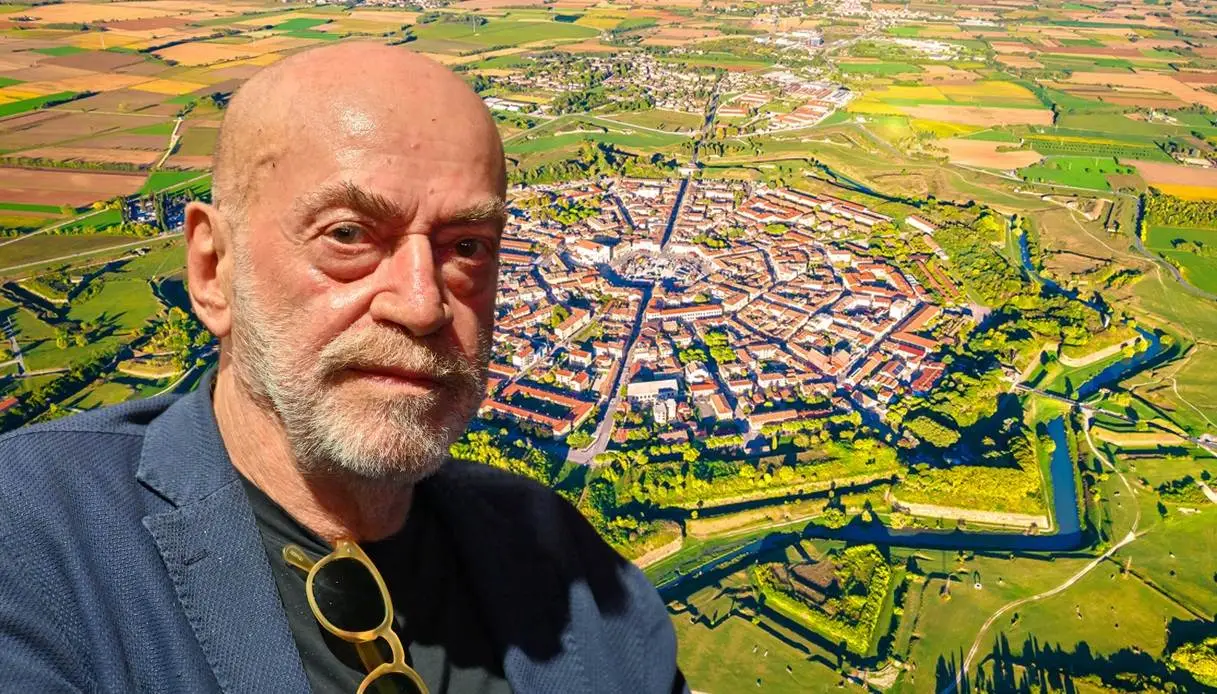
Toni Capuozzo was born on 7 December 1948 in Palmanova, in the province of Udine, to a Neapolitan father and a Triestine mother. It is the starting point of his biography and a city that is instantly recognizable from above. The nine-pointed star plan answered a defensive project of the Republic of Venice. Today the fortress is part of the UNESCO site dedicated to Venetian fortifications.
On foot, the geometry of the city unfolds starting from Piazza Grande, at the center of the town, and by following the streets toward the monumental gates. On the ramparts, the circular patrol path winds between moats, embankments and vantage points. Aerial photography reveals the star’s shape, while walking helps to understand how that form functioned on the ground.
Trieste, the city of Small Homelands
Trieste was his mother’s city and one of the places Capuozzo felt at home. In Small Homelands, a collection of articles published in 2020, he told it through memories that range from the docks to the story of the penguin Marco. In 2025 he returned to the city to present Border Lives at the Link Media Festival. On that occasion he explained how the eastern border, part of his childhood, was linked to a theme he encountered repeatedly in his work as a correspondent—the borders and the consequences that conflicts have on the people who live there.
To rediscover the Trieste of the docks you can start from Piazza Unità d’Italia and reach Molo Audace, which extends into the gulf in front of the center. It’s a short walk, perhaps with his book in hand, to bring today’s city closer to the one of his memories.
Belgrade, the NATO bombings of 1999
When the 24 March 1999 bombardments began as part of the Kosovo War, Capuozzo was in Belgrade. He later recalled the first night and the many others spent in the capital, where he followed the raids’ effects on the population. In his reflections on that experience he also returned to the loneliness of those who opposed Slobodan Milošević, a portion of Serbian society that risked being erased from the war’s narrative.
To orient yourself in today’s Belgrade, a good starting point is Kalemegdan. From the fortress you can see the confluence of the Sava and the Danube and understand why this promontory has held a strategic role for centuries. From here you can move toward the city center and the National Museum, to broaden the view of the city’s history beyond the years of reporting.
Sarajevo, the siege and the story of the boy Kemal
Today Sarajevo is a tourist destination and the heart of the visit often centers on Baščaršija, the old bazaar district. Between the copper shops and the venues where Bosnian coffee is served, one encounters the city as it is today. But here in Sarajevo, in the early months of the siege, Capuozzo met Kemal, a baby of a few months who had lost his mother and a leg in a bombardment. After speaking with his father and grandmother, he managed to get him out of the city by hiding him in a car beneath a bulletproof vest. He brought him to Italy for care and cared for him until the reunion with his father. Thirty years after the siege began, he returned to tell Sarajevo in the television special 1992-2022 – Return to Hell.
Two places help to understand what it meant to live in the besieged city. The Tunnel of Hope, today a memorial, recalls the underground connection that allowed supplies to arrive. The War Childhood Museum begins instead from objects and testimonies of those who experienced the war as children. It is a stop that reconstructs the context of Kemal’s story through the perspective of those who, like him, knew the conflict in childhood.
