
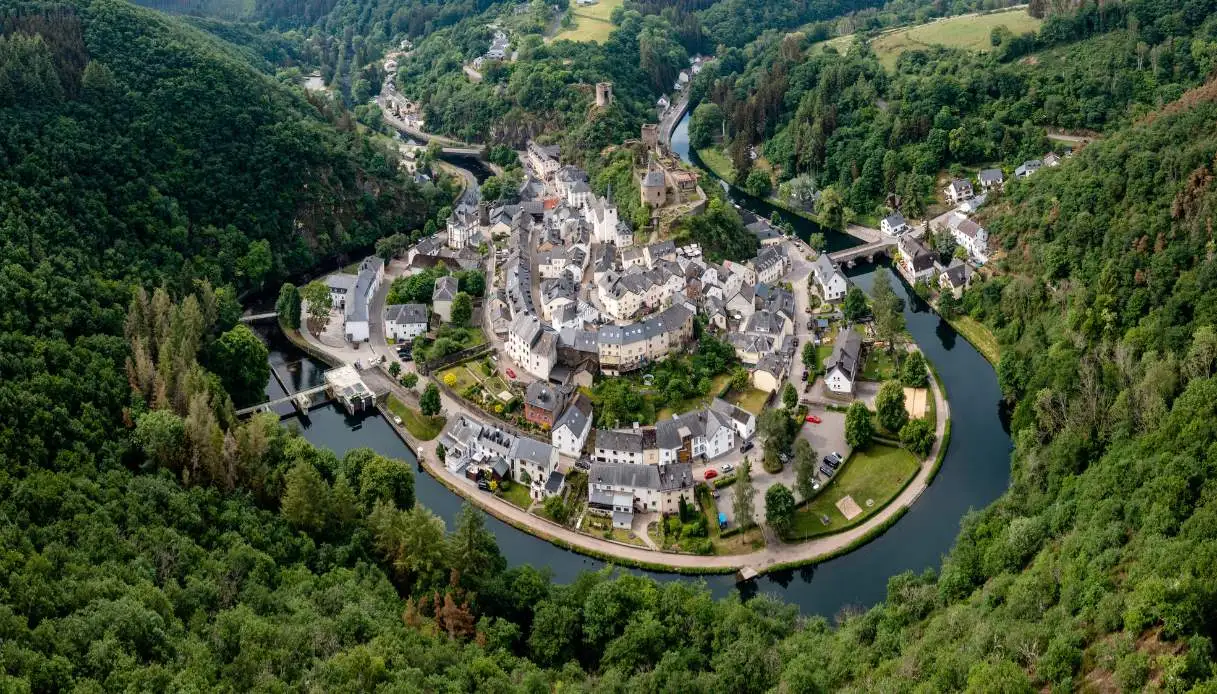
To reach Esch-sur-Sûre, one must cross a landscape that seems determined to protect the small settlement, almost hiding it from view until the very last moment. The Sûre flows at the foot of the mountains, inside a deep gorge carved over millennia, while the steep walls rise in places directly over the water.
We are in the north of Luxembourg, in the Ardennes region characterized by wooded uplands, river valleys and shale outcrops, and its historic center gathers in a tight bend of the river at the foot of the ruins of a fortified castle. Stone houses, narrow lanes and green slopes compose a medieval scene of great charm.
Making the approach even more distinctive is the shape of the terrain itself: the main road crosses two tunnels, one dating back to 1850 and the other built in 1954, necessary to overcome the mountain without interrupting the connection with the village.
What to See in Esch-sur-Sûre
The charm of this Luxembourg town reveals itself especially in the details. Even before reaching the viewpoints, it is worth observing the relationship between the houses, the rock, and the watercourse, because this compact structure tells the long history of the settlement.
The Ruins of Esch-sur-Sûre Castle
Up above the village roofs, the castle ruins dominate the valley with an unmistakable silhouette. The ascent is short but steep and leads to the remains of the fortress, freely accessible. From the summit, the panorama embraces the houses gathered along the Sûre, the rocky outcrops and the narrow bend of the river.
The castle’s origins go back to the High Middle Ages and the period of the First Crusade. Esch was the center of a lordship led by a count, whose authority extended over 19 villages and hamlets, reaching as far as Diekirch. The fortress was expanded over the centuries, following the evolution of military needs.
The Maison du Parc and the Drapery Museum
Along the Sûre, at the foot of the castle hill, a historic building tells a different chapter of local life. The old drappery, today home to the Maison du Parc, preserves the memory of artisanal wool-working, an activity that for centuries has played an important role in the region’s economy.
The museum, dedicated to the traditional production of wool blankets, guides visitors through the various stages of the process, from the raw material to the finished fabric. Restored machines and period tools make the understanding of a craft tied to manual labor and local resources more tangible.
The building also houses the tourist information center and a shop with regional products. The guided tour lasts about 1 hour and requires a reservation, while the audio guide allows visitors to explore the spaces independently.
The Esch-sur-Sûre Dam
Just outside the village, the dam stands as one of the most significant works of the contemporary landscape. Its arch structure, set among the green slopes of the valley, creates a striking contrast between engineering and nature. The construction of the reservoir profoundly altered the surrounding environment, giving rise to a water reserve essential for the country and a space dedicated to leisure.
The Upper Sûre Lake spans about 380 hectares and reaches a surface of nearly 4 square kilometers. Its waters are destined for potable water production, which is why environmental protection plays a central role.
The Sainte-Croix Chapel, Also Known as the Loch Chapel
Outside the center, along the route to Eschdorf, the Sainte-Croix Chapel (also known as the Loch Chapel) adds a spiritual and legendary element to the territory. The stone building dates from the 18th century and was built on the site of an ancient medieval wooden cross.
Inside, it houses a Gothic limewood calvary, with Christ on the cross flanked by two thieves at life size. This is a notable testament to Luxembourg’s cultural heritage. A lime-tree avenue leads to the entrance and enhances the place’s quietness.
What to Do in Esch-sur-Sûre
A slow visit is recommended, as the surrounding landscape invites you to linger. Between trails, water and viewpoints, the area offers activities suitable for a short hike or a whole day outdoors.
- Follow the Éislek Pad Esch-sur-Sûre: a circular route of about 6.5 km that crosses forests, slopes and viewpoints. The elevation gain is more demanding than the distance might suggest, especially on the ascent to Kuelebierg, but from the summit comes an extraordinary view of the horseshoe-shaped valley.
- Explore the local trails: a network of about 90 km of marked itineraries for hikers and mountain bikers winds through Esch’s hills and the lake. Shorter routes are also available for those who want to discover the area without undertaking long hikes.
- Engage in water sports on the Upper Sûre Lake: the basin is dedicated to swimming in authorized areas, fishing, diving and gentle boating. Kayak, sail and windsurf allow you to experience the water in an environmentally friendly way.
- Reach the lake’s beach areas: the equipped zones are located at Lultzhausen, Insenborn, Baschleiden, Liefrange and near the Burfelt forest center. They are reference points for spending a day between water and nature.
- Discover regional flavors: the area’s restaurants offer local specialties and menus inspired by Sûre products, including meats, vegetables, herbs and herbal infusions. Among regional beverages you can find Heiderscheid beers and organic productions from Brasserie Simon.
Where It Is and How to Get There
Esch-sur-Sûre is located in the northwest of Luxembourg, in the Éislek district, within the Upper Sûre Nature Park. The village sits along the Sûre River, just a few minutes from the Upper Sûre Lake and the dam.
By car, the access route is particularly scenic, with the road following the valley between rocky walls and waterways. The terrain’s configuration makes the approach part of the experience, thanks to the two tunnels that cross the mountain.
For those arriving by train, Wiltz Station represents one of the main reference points in the area, to be complemented with a road connection to the village.