
Overlooking the small Gera river, Erfurt has the kind of historic center that makes the eye slow down. The capital of Thuringia, in fact, brings together wide squares, narrow alleys, half-timbered houses, religious towers, and ancient bourgeois buildings, creating an urban landscape that remains strongly tied to the Middle Ages.
We find ourselves in central Germany, along ancient trade routes that connected important European territories, to such an extent that over the centuries it became a significant religious and commercial hub. The presence of more than 20 parish churches, chapels and ancient monastic complexes, among other things, earned it the nickname “Rome of Thuringia“.
In September 2023 a new chapter of Erfurt’s history reached an international dimension: the city’s medieval Jewish heritage, formed by the Old Synagogue, the medieval Mikveh and the so‑called Stone House, was inscribed on the UNESCO World Heritage List.
What to See in Erfurt
The historic center narrates Erfurt through a sequence of places that are very different from one another. The most interesting aspect emerges precisely in the transitions from one square to the next, when the grand religious architecture allows the eye to rest on shops, courtyards, colorful façades and narrow medieval streets.
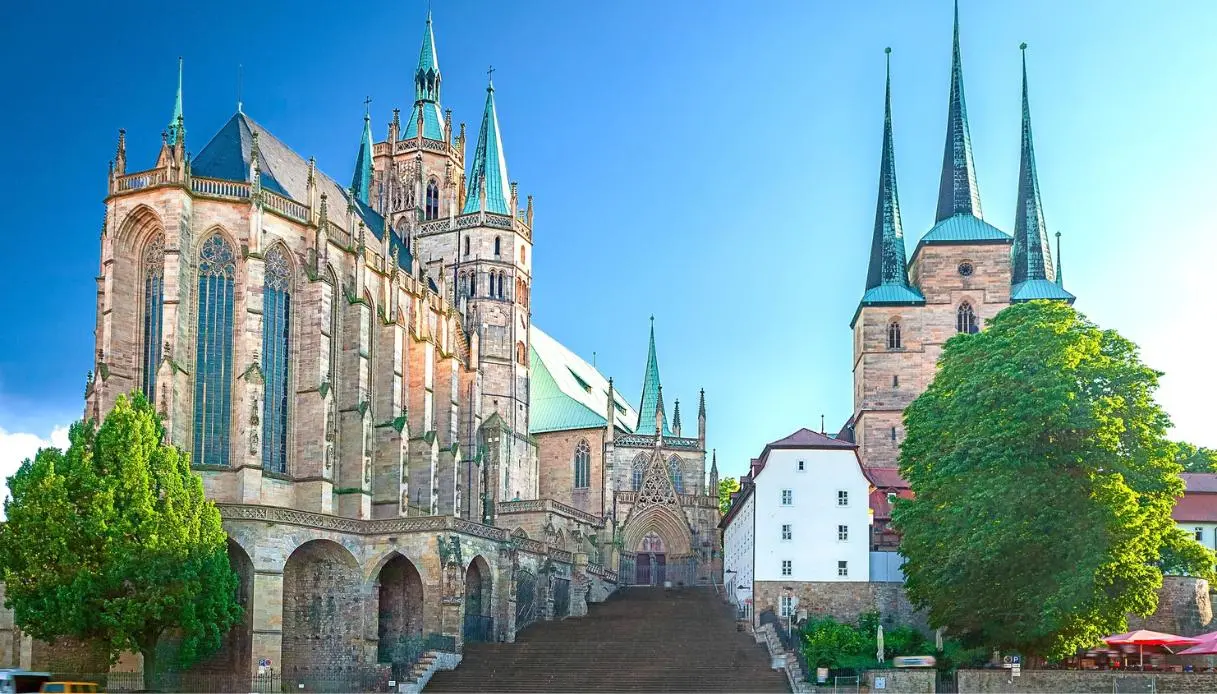
Domplatz and the Cathedral Complex
The Domplatz is the grand stage-like space of this German town. On the western side rises the complex formed by the Cathedral of Saint Mary and the Church of Saint Severus, a monumental presence that dominates the entire area from the top of the hill.
< /ask-ai-widget>
The current building brings together elements from different eras, with a Romanesque tower and a late Gothic choir with a remarkable vertical thrust. Inside, attention is drawn to the 14th‑century stained glass windows, medieval works, bronze sculptures and the Rococo altarpiece.
Krämerbrücke, the Merchants’ Bridge
The Krämerbrücke, the Merchants’ Bridge, represents Erfurt’s most distinctive image: it is stone, crosses the Gera, and supports a living street flanked by half‑timbered houses on both sides.
The houses form a continuous sequence of buildings used for daily life and commercial activities, turning the river crossing into a small urban street. Craft shops, jewelers, ceramics and chocolate shops occupy the bridge’s buildings.
Fischmarkt and the Rathaus
The Fischmarkt introduces a more monumental dimension, with ancient bourgeois façades and taverns surrounding the square, while at the center stands the statue of Saint George, known also through the local tradition of the figure of Orlando.
The Rathaus, built between 1870 and 1875, features neo‑Gothic forms and preserves important murals with scenes depicting episodes from the town’s history, together with references to Martin Luther and the legends of Tannhäuser and Faust.
Augustinerkloster
There is also the Augustinian Monastery dating back to the 13th century and comprising the church, the cloister and the monastic premises. Among the halls are preserved documents and manuscripts of great historical value, while the cloister offers a more intimate atmosphere.
Anger and Angermuseum
Not to be outdone, the Anger follows an ancient commercial axis transformed over time into an elegant city thoroughfare. The façades bear witness to the prosperity enjoyed by Erfurt between the Middle Ages and the modern era, while some buildings recall the presence of important figures in German culture.
At numbers 37/38 stands one of the city’s most interesting Renaissance portals: the building was frequented by Goethe, Schiller and the Humboldt brothers during the period linked to Karl Theodor von Dalberg.
The Angermuseum, housed in a Baroque building from the early 18th century, is home to works of medieval art, paintings from the 17th to the 20th century, and ceramics from Thuringia.
Petersberg and the great Baroque fortress
The Petersberg Hill looms over Erfurt from above and is the cradle of one of the most important fortifications. The Petersberg Citadel was built on the site of an ancient Benedictine monastery and is one of the best‑preserved urban Baroque fortresses in Central Europe.
The defensive system includes bastions, courtyards, military buildings and an underground network of tunnels. Guided tours allow visitors to discover this hidden part of the structure, through routes dedicated to fortifications and military history.
Medieval Jewish Heritage
Erfurt preserves an extraordinary testament to the medieval Jewish presence. The Old Synagogue, the 12th‑century Mikveh and the Stone House, a civil building dating from the 12th and 13th centuries, form the complex inscribed on the UNESCO World Heritage List in 2023.
The Mikveh is especially interesting for its ritual function. The underground water‑based structure helps illuminate the religious life of the medieval Jewish community, while the Stone House documents the civil dimension of that same presence.
Egapark
To the west of the historic center the scenery changes completely with the Egapark, developed on the site of the historic Cyriaksburg, covering about 90 hectares and telling of Erfurt’s vocation as a city of flowers and horticulture. The park also hosts exhibitions, gardening initiatives and seasonal events.
What to Do in Erfurt
Its identity emerges in everyday details, in the city center’s venues and in the cultural events that accompany the city’s calendar.
- Taste Thuringian specialties: to enter the local culinary tradition through Thüringer Klöße, potato dumplings, the famous Thüringer Rostbratwurst and the city’s beers.
- Follow in Luther’s footsteps: helps reconstruct a fundamental part of his formation across the university, the Augustinian monastery and the city churches.
- Attend cultural events: offers opportunities related to music, theatre and local traditions. Among the most important events are the Bach Days, the DomStufen-Festspiele, the JazzMeile and the New Orleans Music Festival.
Where It Is Located and How to Arrive
Erfurt is located in central Germany and is the capital of Thuringia. Its geographical position has long favored commercial links and today it makes it easily reachable from the main German urban centers. The train represents a particularly practical option for those coming from other German cities. The central station is connected to the high‑speed railway network and allows reaching the historic center with a short urban ride.
By car, Erfurt is connected to the motorways A4, A9 and A71, which cross Thuringia and link it with other German regions. The Erfurt‑Weimar Airport is located a short distance from the center and completes the network of connections.
Visitors arriving here are confronted with a place capable of showing many centuries of its history without turning them into mere scenery: the inhabited bridge, the towers, Luther’s monastery, the fortifications and the testimonies of the Jewish community belong to different eras, yet together they compose a single urban landscape.