
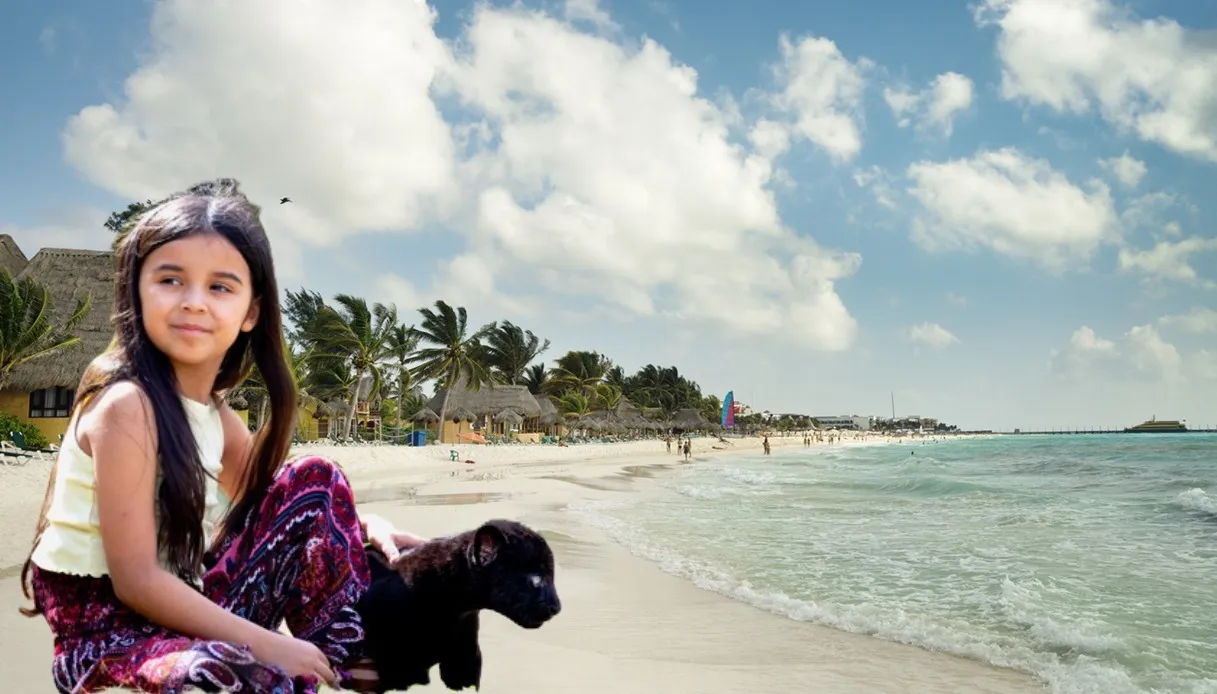
Lush green forests, wildlife, and an unspoiled nature dominating every panorama: it truly feels like being in the heart of the Amazon, amid thriving vegetation, waterways, and landscapes that remain wild. Yet, the spectacular images of Emma and the Black Jaguar come from another corner of the world, equally captivating.
In the film directed by Gilles de Maistre and featuring Lumi Pollack as the young Emma, broadcast in prime time on Rai 1 on Tuesday, August 18, 2026 (and available on RaiPlay), most of the filming took place in a distinctive area of Latin America, granting the movie some of its most evocative settings. The production also moved to another country, through the streets and buildings of a fascinating city.
What it’s about
The story tells of a special friendship between Emma and Hope, a cub of a black jaguar she meets when she is still a child and living with her family in the Amazon rainforest. An immediate, deep bond forms, but a tragic event forces Emma to leave that world and relocate to New York, far from the forest and from her inseparable adventure companion. Yet Hope’s memory never leaves her.
Years later, now a teenager, Emma discovers that her old friend is in danger and decides to return to the forest to save him without a second thought. Together with her biology teacher Anja, she embarks on a journey that takes her back to the places of her childhood, among wild animals, tropical vegetation, and the threats linked to illegal wildlife trafficking. But what begins as a simple rescue mission becomes also an adventure of discovering an unbreakable bond and a tale about safeguarding the environment and wild species, with the spectacular Amazon rainforest serving as the backdrop.
Where the film was shot
The journey following Emma and the Black Jaguar brings together two antithetical settings: the wilds of Mexico and Montréal’s urban landscape, transformed into New York for cinematic needs. It is this play of transformations that makes the film’s locations so fascinating: real places that, through the camera, become something entirely different.
In Mexico, from Playa del Carmen to the Agua Azul Waterfalls
The film’s wild heartbeat lies in Mexico, particularly in one of its most iconic spots: the Playa del Carmen area in Quintana Roo, which brings to life the forest that in the film stands for the Amazon. The Caribbean paradise dreamed by many is, in fact, set within a tropical landscape that allowed the wild atmospheres of the story to be recreated, with dense vegetation, shimmering water, and natural environments capable of presenting on screen a look far removed from the famous tourist town.
Playa del Carmen is worldwide known for its postcard beaches, with light sand and turquoise seas: a landscape that in the film takes on a wilder and more cinematic dimension.
Also among the striking Mexican locations are the Agua Azul Falls, in the state of Chiapas, which appear in some aerial shots: a succession of waterways and waterfalls nestled within dense tropical vegetation.
Montréal, the Canadian city that becomes New York
For the film’s second major shooting area, the setting undergoes a complete shift: Montréal is transformed into the New York Emma moves to after leaving the forest. A stark contrast with the Mexico sequences: on one side a tropical jungle, on the other a large North American city made up of streets, buildings and urban life. Two worlds so distant that accompany the different stages of Emma’s growth.
Among the most recognizable locations is the Pensionnat du Saint-Nom-de-Marie, today a private secondary school in the Outremont neighborhood.
The building, at 628 Côte-Sainte-Catherine Road, was selected for the scenes set at the school Emma attended during the years away from the forest.