
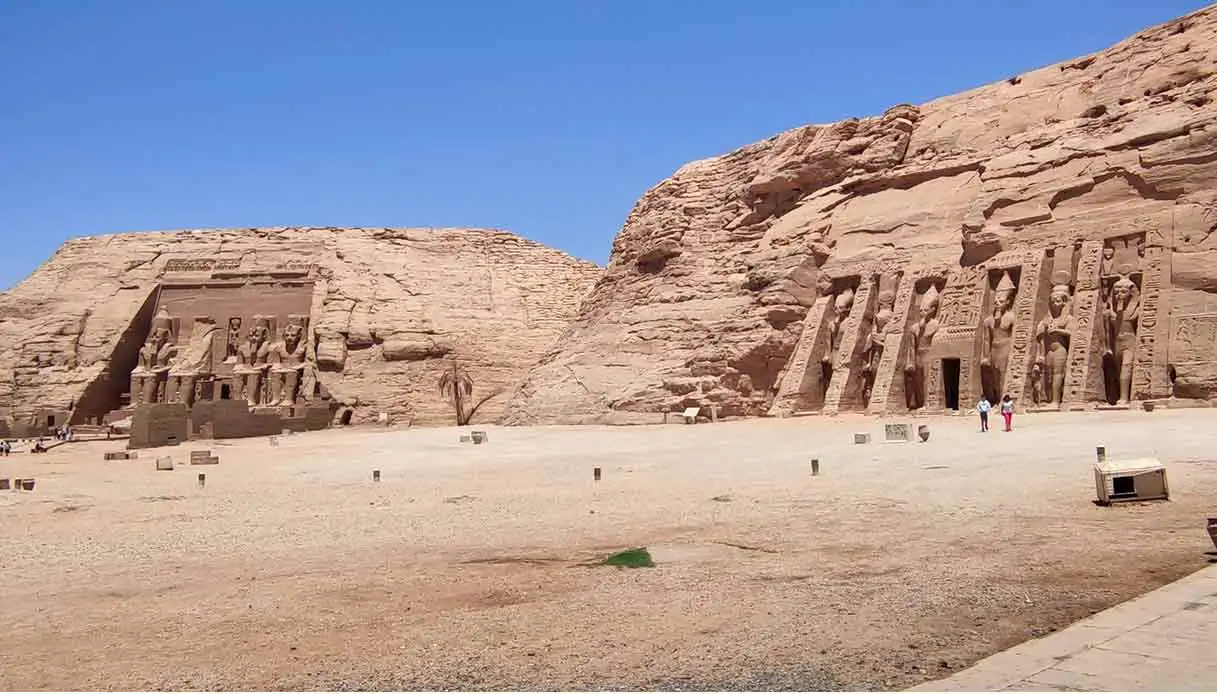
Abu Simbel is one of the most beautiful, most interesting, and most majestic archaeological sites of Ancient Egypt, an absolute masterpiece of pharaonic architecture. Its history, even quite recent, is utterly fascinating. A visit to this place is absolutely worth it, so much so that it is offered as an excursion, sometimes as an extra and doable in a day, during Nile cruises and for those spending a vacation on the beaches of the Red Sea. If you are about to embark on one of these trips, place Abu Simbel among your priorities. The first time I did the cruise I hadn’t included it because of the extra costs and I didn’t always add it when I was on the Egyptian beaches. But I’ve always regretted it. In the end, I went. And here is why you shouldn’t make the same mistake as mine.
The Excursion to Abu Simbel
As I mentioned, Abu Simbel is paired with Nile cruises or with seaside stays in Egypt; in either case the journey is quite long. It is typically an unplanned excursion, although some tour operators include it from the start and therefore it becomes part of the package. As a stopover on a cruise, you usually depart from Aswan where the ship remains docked along the Nile. From there, passengers disembark and the coach journey lasts about three and a half hours. For those traveling by air, there is a small airport near Abu Simbel where scheduled airlines fly; the flight lasts 45 minutes. From the Red Sea coast, the distance is about 650–750 km depending on the starting point, and it is a real punch. But since you’re already there, go ahead and do it anyway.
The best advice is to plan an overnight stay rather than attempting the visit in a single day: it makes the journey less tiring and lets you enjoy the experience fully. What is probably the most beautiful site left by this advanced and mysterious civilization deserves time — because there are actually two distinct temples.
Staying overnight allows you to visit Ramses II’s temple and the temple of Queen Nefertari at a relaxed pace, and then return in the evening for the sound and light show that makes these majestic rock-cut monuments even more evocative. Yes, because staying overnight not only lets you explore the temples of Ramses II and his wife Nefertari at leisure, but you can also come back in the evening for the Sound and Light show that makes these awe-inspiring temples carved into rock remarkably majestic.
What to See at Abu Simbel
The Abu Simbel monumental complex rises in the middle of the desert (remember to bring water, a hat, sunscreen, and I also recommend a handheld fan and a spray can of cooled water) and represents the apotheosis of the reign of Ramses II, with the construction of two temples in honor of Amon-Ra, Ptah, Harmakhis, and of himself, as well as the small temple built for Nefertari, his queen.
Abu Simbel sits on the shores of the Lake Nasser, the vast artificial reservoir formed after the construction of the Aswan Dam. If you happen to be there at sunset, you can enjoy the spectacle of the temples reflected in the lake’s waters.
Visiting Abu Simbel takes about two to three hours, but if you decide to stay until sunset or for the evening Sound and Light show, you could spend the entire day there. In the case of a day trip, the departure back to Aswan is scheduled for the early afternoon.
The Temple of Ramses II
The temple was carved into a mountainside on the western bank of the Nile between 1290 and 1224 BCE. It remained buried in sand for centuries until its discovery, almost by accident, in 1813. The façade is monumental. A short ramp leads from the outer courtyard to the terrace in front of the rock-cut façade, where four colossal statues of Ramses II — each about 20 meters tall and seated on the throne — stand guard at the entrance facing the river. Above the doorway is the figure of the sun god with a falcon head. The great hall is supported by eight columns flanked by more statues of the pharaoh, whose image also appears in the wall reliefs. The ceiling is decorated with soaring vultures, a symbol of Osiris.
The temple’s innermost chamber is the Holy of Holies, which houses representations of the four deities seated on thrones carved into the wall. Inside there are war scenes, in particular the Battle of Kadesh, fought by Ramses II (1279–1213 BCE) against the Hittite king Muwatalli II in the Orontes valley. The temple was designed so that every February 22 and October 22, the coronation and birth anniversaries of Ramses II, at dawn the sun would stream through all the chambers, illuminating Amon and the Pharaoh while leaving Ptah (the god of darkness) in shadow.
The Temple of Nefertari
The temple dedicated to the goddess Hathor and to Queen Nefertari, Ramses II’s beloved wife, is also carved into the rock. In front of the threshold stand six statues: four of Ramses and two of Nefertari, all of the same height — a very rare feature since queens were usually depicted shorter — to symbolize the pharaoh’s extraordinary love for his consort. They are flanked by smaller statues representing princes and princesses. The inner hall’s columns feature Hathor capitals, and the wall reliefs depict the victorious pharaoh and his wife before the gods, interspersed with religious and family scenes. The temple also houses the statue of a cow, symbol of Hathor, protruding halfway from the wall. The admission price to visit Abu Simbel is 14.50 euros.
The Sound and Light Show
Every evening, at sunset, the evocative Sound and Light Show is organized to tell the temples’ story, projecting light effects onto the two colossal façades. The Sound & Light show starts at 8:00 PM and 9:00 PM (there are two performances), lasts about 40 minutes, and costs 17 euros. The audio is available in all languages and is chosen based on the language spoken by the majority of spectators at that show. So, if there are many Italians, it is presented in Italian and is considerably better.
The Incredible History of Abu Simbel
It isn’t only the imposing Abu Simbel complex that captivates visitors, but also its astonishing history. As I mentioned, the temples were built in the 13th century BCE, during the reign of Ramses II, to celebrate the ruler’s power and his divine cult, honor the gods, and — crucially — intimidate the Nubian neighbors by demonstrating Egypt’s military and religious prowess. Abu Simbel indeed arose right at the Nubian border, on the Nile’s banks. Today that is no longer the case: the complex gazes out onto Lake Nasser. And this is where recent history leaves one stunned. Let me summarize it for you.
After the decline of the Ancient Egyptian civilization, essentially with the arrival of the Romans, the temples fell into obscurity and, over the centuries, were covered by desert sands. It was only in 1813 that the Swiss explorer Johann Ludwig Burckhardt reported the site, and a few years later the Italian Giovanni Belzoni managed to enter the main temple. About 150 years after the discovery, the Egyptian government decided to build a large dam to solve drought problems and regulate the Nile’s floods, which, instead of saving crops, often destroyed them. The Aswan Dam was constructed in the 1960s as a grand project. It is a pity that Abu Simbel bore the brunt of this project because the formation of Lake Nasser (named after the Egyptian leader Gamal Abdel Nasser, who championed the project) threatened to submerge the temples.
Thanks to UNESCO’s intervention, the two temples were saved through an equally colossal undertaking, which today allows the world to see Abu Simbel. In practice, between 1964 and 1968 one of the greatest engineering feats in history was undertaken: both temples were completely dismantled, numbered, and rebuilt in a higher position. They were cut into thousands of blocks of stone weighing up to 30 tons each. All this enormous effort served to relocate Ramses II’s temple and Nefertari’s temple 65 meters higher and 200 meters further back. A remarkable operation that saved them and brought them to us.
Today, of course, Abu Simbel is a UNESCO World Heritage Site and, beyond being a place of worship of Ancient Egypt, it also stands as a symbol of the ingenuity of the Egyptian people, who already possessed advanced astronomical knowledge. It also represents the perfect fusion of archaeology and modern engineering. In short, the Abu Simbel site is one of the most visited attractions in all of Egypt, alongside the Pyramids and the Valley of the Kings.
How to Get to Abu Simbel
Abu Simbel lies deep in southern Egypt and can be reached by bus or by plane. In both cases, departures are usually early in the morning by bus because the journey to reach the site is long, or by plane because the trip there and back is almost always done in one day. By bus you cross the desert, passing beyond the Tropic of Cancer. From Aswan it is 280 km away. By air the flight lasts about 45 minutes and the airport is located near the temples. The national carriers EgyptAir and AirCairo typically operate a couple of daily flights between Aswan and Abu Simbel. If you are coming from Cairo or Luxor, you will need a layover because there are no direct flights.
For the record, you can also reach Abu Simbel by ship, and according to those who have done it, the experience is spectacular. In fact, there are cruises that continue from Aswan to Abu Simbel along Lake Nasser that last 3–4 days. During the journey you also visit other Nubian temples (Kalabsha, Amada, Wadi es-Sebua). The trip is recommended for those who can afford it, both in terms of time and cost, but it is even more spectacular. Once you are near the site, a circular path through the desert sands leads to the temples and allows you to do the full 360° tour. There is also the option to move around aboard golf carts (paid, but inexpensive).