
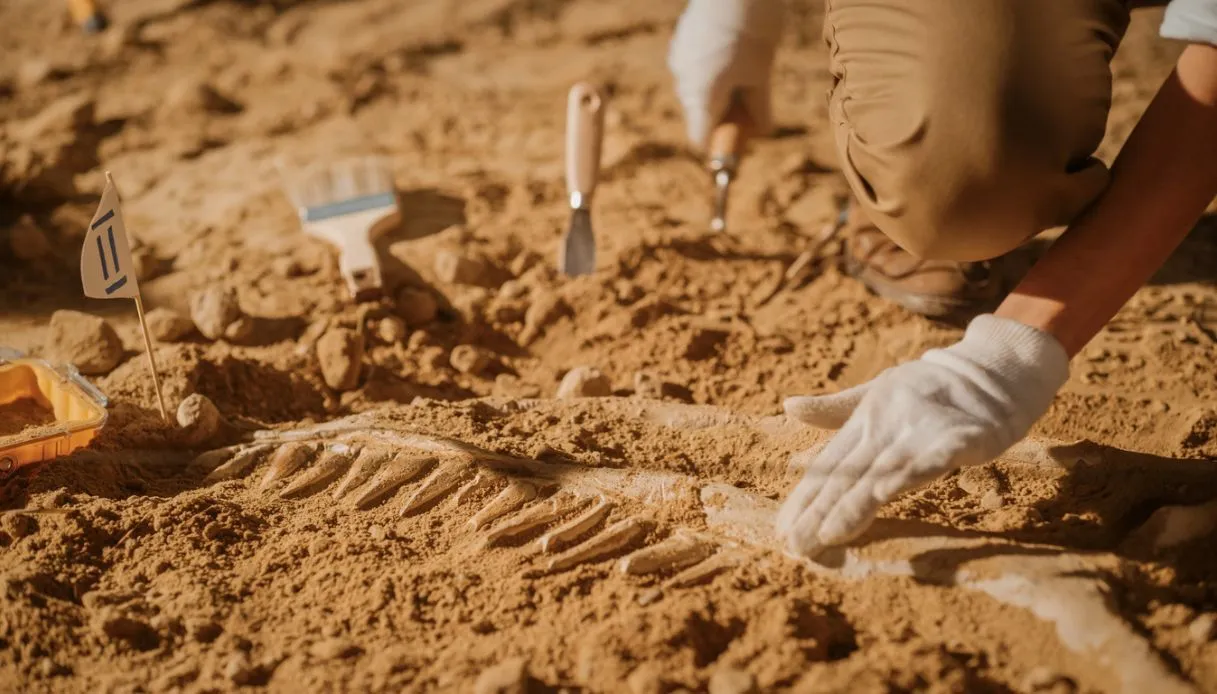
In Egypt, in the Beheira region, excavations at Tell el-Abqain are yielding a piece of history that had remained buried for three millennia. The site, once a military outpost on the western edge of the Nile Delta, formed part of the defensive system that the New Kingdom of Egypt had built against the incursions of Libyan tribes.
Among the new discoveries, what drew archaeologists’ attention most was a burial out of the ordinary: that of a horse, found intact and most likely sacrificed according to a precise ritual, together with evidence linking the site to the pharaoh Ramses II.
The discovery: a horse buried with care at Tell el-Abqain
Archaeological digs have brought to light a large brick-walled residential complex, crossed by two streets that intersect at right angles and connected to the fortress’s southern entrance, built in limestone. A deliberately planned urban layout that speaks of an organized community: in the rooms were found silos for grain, ovens for baking bread, and, in the southeastern corner, dwellings that grew around a cluster of wells already known to archaeologists for bearing the titles of Ramses II.
Some spaces, to the north of the main street, served as storerooms: within them were discovered large ceramic vessels containing remains of charcoalized grains, a direct proof of the food-preservation strategies employed in the fortress.
But the burial of a male horse, young and of medium size, is the most singular find. The animal, presumably reared for speed and intended for training or for the draught of war chariots, was laid to rest with its body intact and its head oriented in a precise direction, a detail suggesting a real ceremonial practice. Next to the burial, fragments of alabaster and calcite cylinders emerged, likely part of the decoration of a carriage fitting.
The link with Ramses II and fortress cults
What makes the discovery in Egypt even more intriguing are the written testimonies. For the first time in the Beheira region’s archaeological area, a limestone stele bearing a hieratic text refers to king Merneptah, extolling his strength by likening it to that of the god Seth, with a reference also to the creator god Ptah. A second stele carries the birth name, the throne name, and the name of Horus of Ramses II, while a third depicts a Libyan prisoner from the Meshwesh tribes, his body bent in a sign of submission.
Also the religious objects unearthed confirm how daily life in the fortress was intertwined with the sacred realm: scarabs bearing the names of Ramses II and Seti I, others associated with Amon, Sekhmet, Ptah, and Seth, as well as amulets in the shapes of fish, lotus flower, cobra, the nefer sign, and a baboon, symbols of protection, fertility, and renewal. Completing the picture, everyday items such as vessels for food storage, perfumes and oils, including a bottle linked to the Abido pilgrimages, loom weights, and grinding tools.
Taken together, the Tell el-Abqain fortress presents an image of a community in which military life coexisted with agriculture, craftwork, and religious devotion. Excavations continue, and researchers anticipate that further work will shed additional light on the role of the site in defending Egypt’s western frontier during the New Kingdom.