
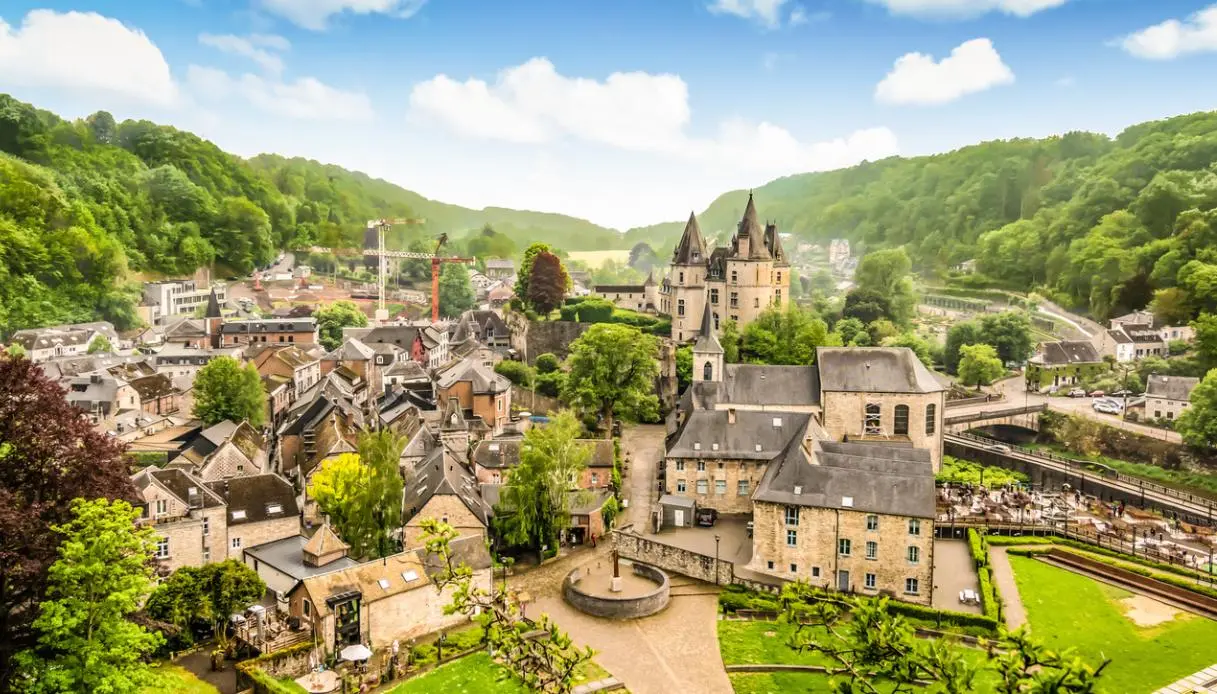
At first glance, Durbuy feels almost like a medieval set preserved in the heart of the Belgian Ardennes. Here, honey-colored stone houses crowd along cobbled lanes, while the Ourthe River traces a broad bend around the historic center and, higher up, the castle overlooks the landscape with its graceful, austere presence.
Its beautiful and precious historic center occupies only a small portion of the municipal territory, and it is precisely this compact size that has fueled the famous designation of the “world’s smallest city,” an epithet closely tied to its medieval history.
The title, in fact, has a particular explanation: in 1331 John I of Bohemia, Count of Luxembourg and King of Bohemia, granted the inhabitants of Durbuy a charter of franchise that recognized the town as a city. The decision carried strategic and military significance, aimed at strengthening the fortifications. Today the fortified aspect is barely noticeable among homes, squares, and shops, but traces of the ancient walls still allow a glimpse of the medieval town’s appearance.
What to See in Durbuy
The historic center of this Belgian town deserves attention down to the smallest details. It is worth allowing curiosity to lead the way, observing the city from eye level and alternating between its most famous monuments and the less conspicuous corners.
The Old Town
The old heart unfolds through a tangle of narrow, cobbled streets, enclosed by stones-and-mortar buildings typical of Ardennes architecture. Among the most characteristic lanes is rue Daufresne de la Chevalerie, considered the town’s oldest street and paved with cobbles sourced from the Ourthe.
< /ask-ai-widget>
The Durbuy Castle
On a rocky promontory above the Ourthe stands the castle, the dominant presence of the village. Its position immediately reveals the defensive role Durbuy played in the Middle Ages, when the town represented a strategic point for the Counts of Luxembourg.
The current building belongs to the d’Ursel family and is private property, so interior visits are subject to the owners’ own arrangements.
The Roche à la Falize and the Anticline
One of Durbuy’s most striking features comes from geology: the Roche à la Falize, often simply referred to as La Falize, forms part of the geological heritage of the Famenne-Ardenne Geopark.
The term anticline denotes a bend in rock layers caused by movements of the Earth’s crust. In Durbuy, this structure stands out in a particularly dramatic way, revealing the different stratifications of the rock.
The Topiary Park
On the Ourthe side, one of the town’s most unusual places takes shape. We’re talking about the Topiary Park, which spans about one hectare and houses nearly 250 plant sculptures created by trimming boxwood, yew, and holly.
Animals, human figures, and fantastic forms transform the garden into a kind of outdoor art gallery. The park also includes 39 beds and a section dedicated to medicinal plants.
The Halle aux Blés and the Durbuy History & Art Museum
To understand another facet of the local identity, it’s worth reaching the Halle aux Blés, a 16th-century building recognized among Wallonia’s exceptional heritage.
Today it hosts the Durbuy History & Art Museum, also known by the acronym DHAM, which brings local history into dialogue with modern and contemporary art.
What to Do in Durbuy
The town offers experiences that are very diverse: you can spend one morning among monuments and shops, while the afternoon can be spent along the Ourthe or exploring the Ardennes’ outdoor activities. Gastronomy also plays a significant role in the local experience, with restaurants, regional products, and specialties tied to Walloon tradition.
- Follow a guided historical itinerary: it helps you learn about episodes, buildings, and details that are hard to grasp on your own. The tourist office also offers routes focused on history and local gastronomy.
- Board the sightseeing train: it provides a different perspective on the village and takes you toward the higher ground, with viewpoints over the town and the valley.
- Drift down the Ourthe by kayak: offers a completely different vantage point, with the water as the main protagonist and the Ardennes’ hills as a backdrop.
- Try the activities at Adventure Valley Durbuy: the right choice for adrenaline seekers. The large adventure park offers numerous outdoor experiences in the region.
- Taste the local products: to discover the town’s gastronomic face. Among the must-try specialties are also the Ourthe shrimp, while shops and producers offer preserves, beers, and other handicrafts.
- Reach Wéris: expands the journey to one of Belgium’s most fascinating megalithic areas, with dolmens and menhirs tied to Neolithic farming communities. The Maison des Mégalithes is the starting point to learn about this prehistoric heritage.
Where It Is Located and How to Arrive
Durbuy lies in eastern Wallonia, in the Luxembourg Province, within the Belgian Ardennes. The historic center is clustered around the bend of the Ourthe and is easily reached, even if you leave your car in the external parking areas around the old town.
For travelers arriving by train, the most practical solution is a rail link to Barvaux-sur-Ourthe, a locality belonging to the Durbuy municipality, followed by a local connection to the center. By car, the town is easily accessible via the regional road network.
A visit can easily fill a full day, especially if you add the Topiary Park, a viewpoint, a lunch in the center, and a few hours along the Ourthe. Those who wish to explore the surroundings can use Durbuy as a base to discover Wéris, the Ardennes forests, and the valley’s other towns.
The secret of its charm perhaps lies precisely in the disparity between scale and character: Durbuy is small on paper, but its landscape holds medieval history, geology, water, gastronomy, and nature. Between a bend of the Ourthe and a stone façade, that old fortified city still manages to feel as if it has something to tell.
