
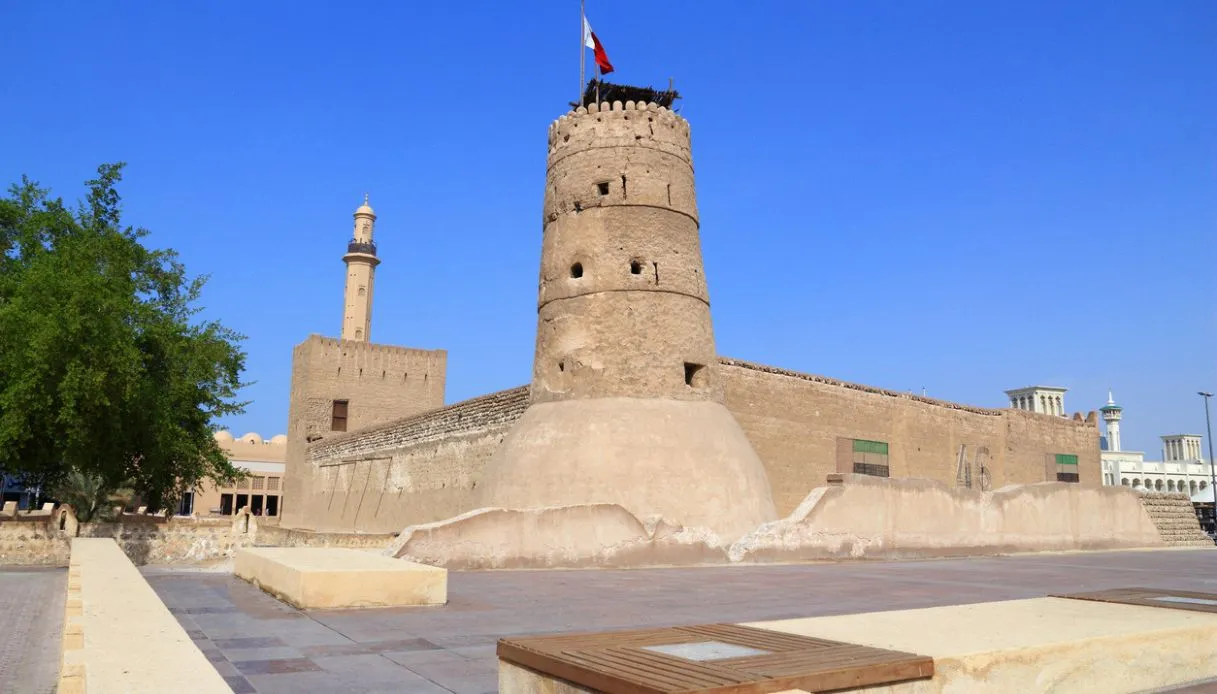
When we think of Dubai, the first image almost inevitably leans toward the future: dizzying skyscrapers, spectacular architecture, enormous shopping malls, artificial islands, and luxury hotels. Yet, before the skyline that today defines the metropolis, there was a much different Dubai, tied to the Creek, to traditional houses, and to a history whose roots run much further back in time.
It is precisely this lesser-known soul that returns to the spotlight with the upcoming reopening of the Al Fahidi Fort, in the heart of Old Dubai: the historic building, considered the oldest still standing in Dubai, is preparing to welcome visitors after a long restoration project lasting five years.
The reopening is expected in the “coming weeks or months,” according to Ayisha Khansaheb, director of the Al Fahidi Fort and of the specialized museums at the Dubai Culture & Arts Authority.
On the southern side of the Creek, in the historic Al Fahidi area, the fort stands as a tangible testimony to Dubai before its transformation into a global metropolis. Around it you will find traditional houses and cultural attractions that reveal a face far from the more futuristic image.
A fort over 230 years old that has changed its face along with the city
The history of Al Fahidi Fort begins around 1787, when it was built with a defensive purpose, but over more than two centuries its role has changed several times, following the transformations of the city and its institutions.
The fort has indeed been used as the sovereign’s residence, as well as a center of government and administration. In another phase of its long history it became also a prison.
Then, in 1971, came a new turning point: Al Fahidi Fort became Dubai’s first museum, in the same year as the formation of the United Arab Emirates.
Five years of restoration to bring the fort into the future
Al Fahidi Fort has been closed since 2021, when a broad restoration project began. After five years of work, it is now preparing to reopen with a renewed museum, in which the historic structure will engage with contemporary technologies and tools.
The new pathway aims to tell the fort’s history through artifacts, archival materials, and interactive technologies, and to link the building’s fortunes to Dubai’s own development.
One of the main novelties of the project is the underground extension where the visitor experience begins.
The contemporary galleries tackle various themes related to the fort’s and the city’s history, including defense, leadership, and craftsmanship. Only after this initial route does one enter the historical part of the building, with a passage between the most modern museum spaces and the fort’s original architecture.
Among the planned experiences is ‘The Vault’, a display dedicated to the evolution of Dubai’s defensive capabilities, conceived through a lighting-based experience and tangible elements.
The route then continues with ‘A Landmark Across the Ages’, a gallery that narrates the different roles assumed by Al Fahidi Fort over more than 230 years. The museum will also host a large collection of Islamic weapons and armor.
Finally, the project also includes interactive learning experiences for children, to make the visit more accessible and engaging for younger visitors.